
Table of Contents
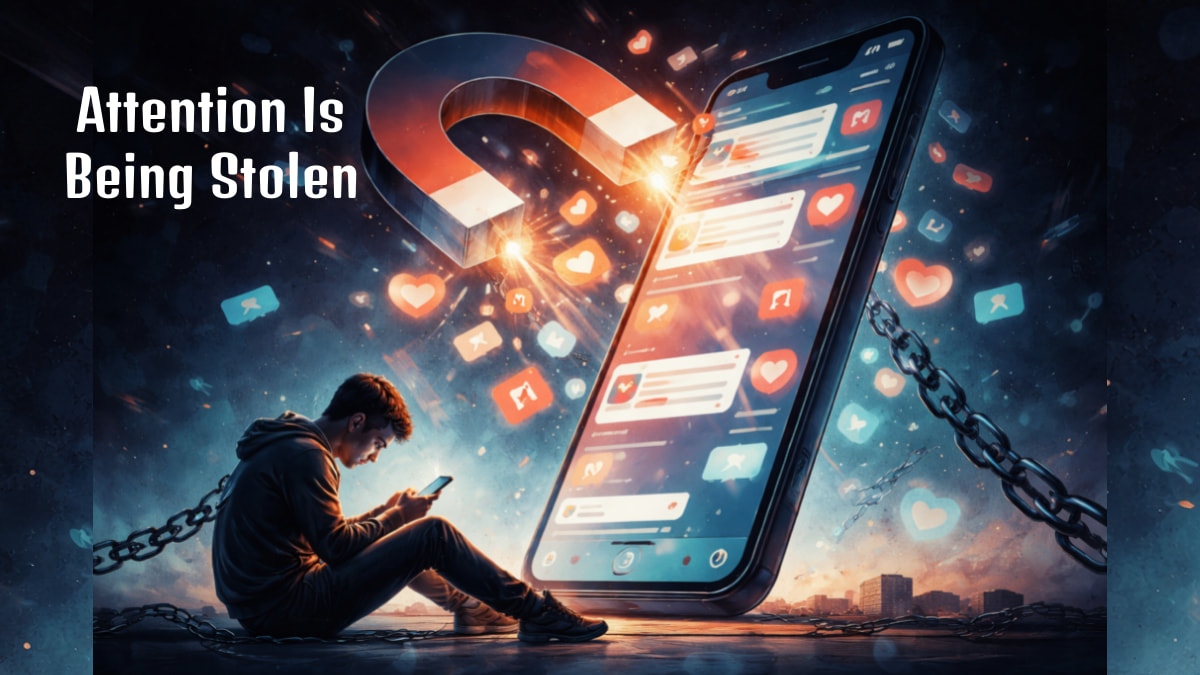
Every day, something incredibly valuable slips away from us—not with force, but with consent. It happens in moments that feel harmless: a quick scroll while waiting, a few videos before bed, a glance at notifications during work. Yet when added up, these fragments form a staggering reality. The average person now spends over 2 hours and 30 minutes daily on social media, which translates to nearly 38 days per year dedicated solely to scrolling. Over a lifetime, this can amount to 5–7 years of continuous attention spent on feeds.
Globally, there are more than 4.9 billion social media users, and the number continues to rise. What’s more striking is not just how many people use these platforms, but how frequently. Studies show that the average user checks their phone around 90–150 times per day, often without conscious intent. This behaviour is no longer occasional—it is habitual, automatic, and deeply embedded in daily life.
What makes this concerning is not just the time spent, but how it is spent. Most of this time is fragmented into micro-moments of distraction, preventing the brain from engaging in deeper, more meaningful cognitive processes. The result is a quiet but powerful shift in how we think, focus, and live.
“The successful warrior is the average man, with laser-like focus.” – Bruce Lee
The Science Behind Endless Scrolling
Scrolling is not random behaviour—it is engineered. At the core of this design is a psychological principle known as variable reward reinforcement, the same mechanism used in gambling systems. When you scroll, you don’t know what you’ll see next: a funny video, a shocking headline, or something emotionally engaging. This unpredictability keeps the brain hooked.
Neuroscience research shows that each time we encounter rewarding or novel content, the brain releases dopamine, reinforcing the behaviour. Over time, the brain begins to associate scrolling with reward, making it increasingly difficult to stop. In fact, studies have found that short-form video platforms can increase user engagement by up to 60% within weeks, as algorithms learn individual preferences and refine content delivery.
Another key factor is the concept of “infinite scroll.” Unlike traditional media, which has natural stopping points, scrolling platforms remove all friction. There is no clear end, no pause, no signal to disengage. This leads to what researchers call “time distortion,” where users lose track of how long they’ve been engaged. Surveys indicate that over 70% of users regularly spend more time online than they initially intended.
Additionally, algorithm-driven feeds analyse thousands of data points—what you like, pause on, share, or skip—to predict what will keep you engaged. This creates a highly personalized loop. The more you scroll, the more precise the system becomes. Over time, it doesn’t just respond to your attention—it shapes it.
The Decline of Deep Attention
One of the most significant consequences of constant scrolling is the erosion of sustained attention. The human brain is capable of deep focus, but it requires uninterrupted time and cognitive stability—both of which are increasingly rare in a scrolling-driven environment.
Research suggests that the average human attention span has dropped from about 12 seconds in the early 2000s to around 8 seconds today, largely due to digital consumption patterns. While this number is often debated, there is strong consensus that task-switching frequency has increased dramatically, with people now switching between tasks or stimuli every 40–60 seconds on average when using digital devices.
A study conducted on workplace productivity found that after a digital interruption, it can take over 23 minutes to fully regain focus. When multiplied across a day filled with notifications and scrolling breaks, the cumulative impact becomes enormous. Even brief distractions significantly reduce cognitive performance.
Furthermore, research indicates that heavy social media users show reduced gray matter density in areas of the brain associated with attention control and decision-making. This suggests that prolonged exposure to fast-paced, high-stimulation content may not just affect behaviour, but also brain structure over time.
Another important statistic comes from reading behaviour. Studies show that over 55% of users spend fewer than 15 seconds actively reading online content, preferring quick scanning instead of deep engagement. This shift affects not just reading habits, but thinking patterns. Complex ideas require sustained attention, and without it, comprehension becomes shallow.
The long-term implication is clear: as scrolling increases, the ability to engage deeply decreases.
Emotional and Psychological Costs
While scrolling often feels like relaxation, research paints a different picture. In reality, excessive scrolling is associated with increased emotional fatigue and reduced well-being.
A large-scale study found that individuals who spend more than 3 hours per day on social media are twice as likely to experience symptoms of anxiety and depression compared to those who use it less frequently. Another report indicates that nearly 60% of users feel worse about their lives after extended scrolling sessions, largely due to comparison, information overload, and negative content exposure.
Interestingly, scrolling does not effectively reduce boredom. In controlled experiments, participants who continuously switched between short videos reported higher levels of boredom than those who watched a single longer video. This suggests that rapid content consumption may actually reduce satisfaction rather than increase it.
Sleep disruption is another major concern. Studies show that over 70% of adults use their phones within 30 minutes of going to bed, and those who engage in late-night scrolling are significantly more likely to experience poor sleep quality. Blue light exposure, combined with mental stimulation, delays melatonin production and disrupts circadian rhythms.
Social relationships are also affected. Research on interpersonal behaviour reveals that “phubbing” (phone snubbing) is reported by over 40% of individuals in relationships, leading to reduced satisfaction and increased conflict. Even the presence of a phone on a table during a conversation has been shown to reduce perceived connection and empathy.
What begins as a private habit gradually spills into emotional health, relationships, and overall life satisfaction.
The Economics of Your Attention
To fully understand the persistence of scrolling, we must examine the system behind it. Social media platforms operate within what is known as the attention economy, where human focus is the primary commodity.
In 2025, global digital advertising spending exceeded $600 billion, with a significant portion driven by social media engagement. Platforms generate revenue by maximizing user time on screen, as more time equals more ad exposure. This creates a direct financial incentive to keep users scrolling.
Metrics such as “average session duration,” “daily active users,” and “engagement rate” are constantly optimized. Even a small increase in user retention—just a few extra seconds per session—can translate into millions of dollars in revenue at scale.
Internal studies from major tech companies have shown that design changes aimed at increasing engagement—such as autoplay, push notifications, and personalized feeds—can boost usage by 20–50%. These are not accidental features; they are deliberate strategies grounded in behavioural science.
This creates an imbalance. On one side, users rely on self-control. On the other, platforms employ teams of engineers, psychologists, and data scientists working to capture attention more effectively. The result is predictable: the system often wins.
Reclaiming Control in a Distracted World
Despite the scale of the challenge, attention is not lost—it is recoverable. Research suggests that small, intentional changes can significantly reduce compulsive scrolling and restore focus.
For example, studies show that simply turning off non-essential notifications can reduce phone usage by up to 30%. Similarly, placing time limits on apps or using grayscale mode can decrease engagement by making the experience less stimulating.
Creating structured boundaries also helps. Individuals who designate phone-free periods during work or before sleep report improved concentration and better sleep quality. Even short breaks from social media—such as a one-week detox—have been linked to measurable improvements in mood and focus.
Rebuilding attention requires deliberate practice. Activities such as reading long-form content, engaging in deep work, or even spending time in silence help retrain the brain. Neuroscientific research shows that attention functions like a muscle—the more it is exercised, the stronger it becomes.
Perhaps the most important shift is awareness. When people understand that their attention is being actively competed for, they are more likely to make conscious choices about how they spend it.
Conclusion: What Is the Real Cost?
The cost of scrolling is not just measured in hours—it is measured in attention, clarity, and presence. It is seen in the inability to focus on a single task, the habit of reaching for the phone in every idle moment, and the quiet discomfort of stillness.
When added up, the statistics are staggering: years of life spent scrolling, thousands of interruptions, and a measurable decline in cognitive and emotional well-being. Yet the most important cost is less visible—the gradual erosion of the ability to live deeply.
Attention shapes everything. It determines what we learn, how we connect, and what we create. When attention is fragmented, life becomes fragmented. When it is focused, life becomes intentional.
In a world designed to capture your mind, reclaiming your attention is no longer just a productivity strategy—it is an act of control.
Because in the end, what you pay attention to is not just what fills your time.
It is what defines your life.
Featured reads

Mindful Shots, Volume-1
Most people live their entire lives without truly understanding how their minds work or the immense power they hold within. Fewer than two percent of people can confidently answer questions like: What drives my thoughts? Why do I feel resistance to my own goals? You’ve likely experienced moments when you wanted to take a bold step—perhaps starting a new business or making a life-changing decision—only to hear an inner voice warning you of failure. That voice often justifies its fears by recalling countless stories of others’ setbacks—family members, friends, society, even distant headlines. It’s as if your mind maintains a detailed archive of every failure around you, replaying them to keep you from moving forward. But what if this inner voice could be understood, reprogrammed, and even turned into your greatest ally? Imagine what would be possible if both your conscious intentions and subconscious patterns worked together instead of pulling in opposite directions. This collection, Mindful Shots, brings together some of the most insightful writings on mindfulness from Fastlane Freedom. Each piece explores practical and scientific perspectives on how the mind shapes our choices, influences our health, and even participates in physical healing. Through research-backed insights and timeless wisdom, this book will help you see that the mind isn’t just a passive observer—it’s an active force capable of changing your reality. By learning how to quiet the noise, shift your mental inputs, and harness your inner voice, you’ll gain a clearer path to personal growth, emotional balance, and a deeper understanding of what mindful living truly means.

Parenting Essentials
Parenting is a journey—one of the most rewarding, challenging, and transformative experiences life has to offer. But it’s not a path we are meant to walk alone. Essential Parenting was born out of a deep desire to support and empower parents at every stage of their journey, from the early days of pregnancy to the complex teenage years. Drawing insights from the Fastlane Freedom platform, this book brings together wisdom, mindfulness, and practical strategies to help you raise confident, emotionally strong, and value-driven children. At Fastlane Freedom, we believe that conscious parenting begins with self-awareness. Children absorb more from our behaviour than our words. It’s in our everyday actions—our calm during chaos, our patience in moments of frustration, our consistency in values—that they find their foundation. Parenting is not about being perfect; it’s about being present, intentional, and compassionate.

The Wealth Code, Volume-1
The Wealth Code: Volume-1 is a personal development and financial education book written by Vinod Singh. It is designed to empower readers by teaching them principles of wealth creation, financial freedom, and personal growth. The book offers practical strategies to achieve financial success, with a vision to uplift and transform the lives of millions by promoting financial literacy and entrepreneurial thinking. Mr. Singh's approach is rooted in inspiring individuals to take control of their financial destinies while cultivating a mindset focused on long-term success and abundance.