
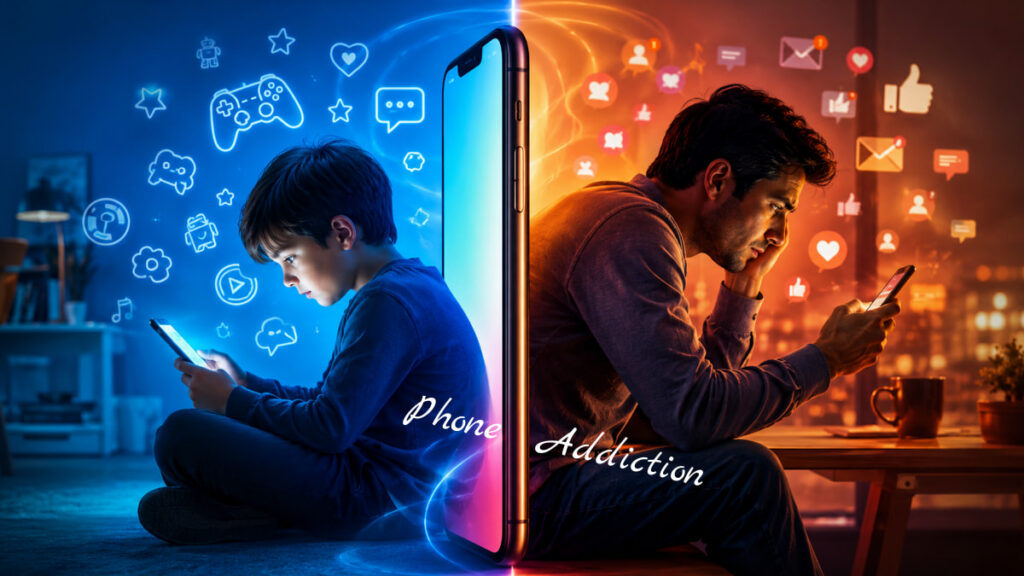
Every generation believes the next one is losing its way. Today, the modern villain is the smartphone. Walk into any restaurant, school, or family gathering and you will hear adults complain that children are “glued to screens.” Parents worry about gaming, endless scrolling, shrinking attention spans, and social media obsession. Teachers discuss digital distraction. News headlines warn about the psychological effects of smartphones on teenagers. The concern is real and justified.
But there is an uncomfortable truth most societies avoid discussing.
Adults may be just as addicted—perhaps even more addicted—than the children they criticize.
The difference is that adult addiction looks socially acceptable. When a child spends hours on TikTok, it is called a problem. When an adult spends hours jumping between WhatsApp, Instagram, LinkedIn, YouTube, emails, and news feeds, it is called work, networking, or “staying informed.” Yet the behaviour is often nearly identical: compulsive checking, emotional dependence, inability to sit still without stimulation, and anxiety when separated from the device.
Research increasingly shows that smartphone dependency affects adults deeply across emotional, psychological, and social dimensions. Excessive smartphone use has been linked to anxiety, depression, poor sleep quality, impulsive behaviour, emotional dysregulation, and reduced cognitive focus. Studies published through organizations such as the National Institutes of Health have repeatedly explored these patterns across different age groups. Teenagers remain highly vulnerable because their brains are still developing, but adults are quietly living inside a normalized digital addiction that has become woven into modern life itself.
The irony is striking. Many adults are trying to protect children from a world they themselves cannot escape.
“We warn children about screen addiction while adults quietly build their lives around notifications.”
The Normalized Addiction
One reason adult phone addiction goes unnoticed is because modern society rewards it. Smartphones are no longer viewed as optional devices; they are extensions of identity, work, entertainment, and validation. Adults wake up and immediately check notifications before even fully waking their minds. Many people scroll during meals, conversations, traffic lights, elevators, and even moments that once belonged to silence or reflection.
Unlike smoking or alcohol addiction, smartphone dependency hides behind productivity. A person may spend six hours daily on a device without realizing how little of that time was actually meaningful. Endless scrolling creates the illusion of engagement while quietly draining attention and mental energy.
Studies show that adults experience strong emotional attachment to smartphones. Many report anxiety when separated from their phones, and excessive usage patterns have become increasingly common across age groups. The average person now checks their phone dozens of times a day, often unconsciously, driven by dopamine-based reward loops designed into apps and platforms.
Social media companies understand human psychology exceptionally well. Notifications, infinite scrolling, autoplay videos, algorithmic recommendations, and unpredictable rewards keep users emotionally hooked. Adults are not immune to these systems simply because they are older. In fact, adults often face more emotional triggers—stress, loneliness, career pressure, financial anxiety, relationship struggles, and social comparison—which makes digital escape even more attractive.
Many adults no longer use phones intentionally. Phones use them automatically.
Kids Learn What Adults Model
Children are often blamed for screen addiction as though it emerged naturally from youth culture. In reality, children usually mirror adult behaviour. A child watching parents constantly checking phones during meals, conversations, or family time receives a powerful message about what normal life looks like.
Human beings learn far more through observation than instruction. Parents may tell children to reduce screen time while simultaneously scrolling endlessly themselves. This contradiction weakens credibility. It becomes difficult to convince children that phones are dangerous when adults visibly cannot detach from them either.
Research examining parental smartphone use has shown that excessive device absorption can affect responsiveness, emotional sensitivity, and family interactions. In many households, the greatest interruption is not television anymore—it is the constant presence of phones fragmenting attention.
Children notice this fragmentation. They see conversations interrupted by notifications. They see adults scrolling during movies, vacations, or even while spending time together. Over time, screens become emotionally associated with comfort, relief, and escape.
Ironically, some findings suggest young people are beginning to recognize the problem faster than adults. Increasing numbers of teenagers are voluntarily taking breaks from smartphones and social media to protect their mental health and concentration. Many younger users are becoming aware that excessive digital consumption leaves them anxious, distracted, or emotionally exhausted.
Adults, however, often remain trapped inside routines they no longer question.
The Illusion of Connection
One of the least discussed consequences of excessive smartphone usage is the illusion of social connection. Modern adults are constantly communicating, yet many feel increasingly lonely. Thousands of messages, reactions, comments, and online interactions create the appearance of deep social engagement, but much of it lacks emotional depth.
Earlier generations experienced boredom, silence, and solitude differently. People spent more uninterrupted time talking face-to-face, observing surroundings, reflecting quietly, or simply being mentally present. Today, many adults feel uncomfortable even standing in a queue without checking their phones. Every empty moment gets filled with digital noise.
Ironically, hyperconnectivity has not necessarily made people emotionally closer. Research from organizations like the American Psychological Association has repeatedly linked heavy social media use with feelings of loneliness, anxiety, and emotional dissatisfaction. People compare their behind-the-scenes lives with the curated highlights of others. Adults constantly see filtered success stories, luxury lifestyles, achievements, vacations, and “perfect” relationships online, which quietly affects self-worth and mental stability.
This comparison trap is especially dangerous because adults often internalize pressure silently. A teenager may openly express insecurity. Adults usually hide it behind humor, busyness, or overwork. Yet many are emotionally exhausted from constantly measuring themselves against unrealistic digital standards.
The smartphone has created a strange modern paradox: people are more connected digitally than ever before, yet many feel emotionally disconnected in real life.
The Mental Cost
The biggest danger of smartphone addiction is not only wasted time. It is the gradual restructuring of human attention and emotional life.
Constant scrolling trains the brain to seek stimulation every few seconds. Silence begins to feel uncomfortable. Waiting becomes unbearable. Deep thinking becomes harder. Even leisure loses its ability to relax because the mind stays trapped in a cycle of constant input.
Researchers have linked excessive smartphone use with sleep disorders, anxiety, impulsivity, lower emotional regulation, and reduced cognitive control. Other studies have connected problematic social media behaviour with emotional distress, particularly among younger users.
Adults experience these effects differently than children. Children may show visible behavioural symptoms like irritability or declining focus in school. Adults often suffer quieter consequences: chronic distraction, inability to concentrate deeply, emotional numbness, relationship disconnection, burnout, and mental fatigue.
One of the most dangerous aspects of adult screen addiction is emotional avoidance. Many people now reach for phones the moment discomfort appears. Boredom, loneliness, stress, awkward silence, uncertainty, or sadness are immediately interrupted with digital stimulation. Instead of processing emotions naturally, people learn to anesthetize themselves through endless content consumption.
This creates a subtle dependency. The phone stops being a tool and becomes emotional medication.
Over time, many adults lose the ability to simply sit with their own thoughts. Moments that once allowed creativity, reflection, or self-awareness become filled with scrolling. The mind remains busy but rarely peaceful.
Attention Spans Are Shrinking
Another major issue rarely acknowledged is how smartphones are reshaping the human brain’s ability to focus deeply. Adults often criticize children for short attention spans while struggling themselves to watch a full video, read a long article, or sit through a conversation without checking notifications.
The average digital environment conditions the brain for rapid stimulation. Short videos, instant updates, fast scrolling, autoplay features, and endless content streams train people to consume information in fragments rather than depth. Over time, sustained concentration begins to feel mentally demanding.
Researchers studying attention and digital behaviour have observed that constant task-switching weakens cognitive efficiency and increases mental fatigue. The brain does not fully reset every time attention jumps between apps, messages, videos, and notifications. Instead, mental residue remains, reducing focus quality and increasing exhaustion.
Adults now multitask constantly—replying to messages during meetings, scrolling during television shows, checking emails while eating, or consuming social media while supposedly relaxing. The result is a state of partial attention where the mind is never fully present anywhere.
This has enormous long-term implications. Deep work, creativity, problem-solving, emotional listening, and critical thinking all require sustained attention. Civilizations were built through long periods of concentration, not through fifteen-second bursts of stimulation.
Yet many adults today struggle to stay focused long enough to even read a book chapter without interruption.
The danger is not merely distraction. It is the gradual erosion of the mind’s ability to think deeply.
Sleep Is Under Attack
Smartphone addiction has also become one of the largest hidden destroyers of sleep quality in modern society. Many adults sleep with their phones beside their pillows, scroll late into the night, and check notifications immediately after waking up.
This constant digital engagement disrupts natural recovery cycles. Blue light exposure from screens interferes with melatonin production, making it harder for the brain to prepare for sleep. At the same time, emotionally stimulating content—news, arguments, short videos, financial stress, or social comparison—keeps the nervous system mentally active long after bedtime.
Research has consistently shown associations between excessive screen use and poor sleep quality, insomnia symptoms, reduced sleep duration, and daytime fatigue. Sleep deprivation then creates a vicious cycle: exhausted individuals seek more low-effort dopamine stimulation through scrolling, which further damages sleep patterns.
Adults are particularly vulnerable because they often carry existing stress from careers, finances, relationships, and responsibilities. Instead of mentally unwinding at night, many people unknowingly overstimulate their brains until the final moments before sleep.
The consequences extend beyond tiredness. Poor sleep affects memory, mood stability, emotional control, decision-making, productivity, and even long-term physical health. Yet despite knowing this, millions continue sacrificing rest for endless digital consumption.
Many people no longer end their day with reflection or calmness.
They end it with scrolling.
The Attention Economy
Modern smartphones are not neutral devices. Entire industries compete aggressively for human attention because attention has become one of the most valuable economic resources in the world.
Social media platforms profit when users stay online longer. More scrolling means more advertisements, more data collection, and more engagement. Algorithms are carefully designed to trigger emotional reactions because emotional content keeps people hooked. Outrage, comparison, fear, novelty, controversy, and validation generate repeated engagement cycles.
This system affects adults intensely because adults carry heavier emotional and psychological burdens. A teenager may compare appearance or popularity online. Adults compare careers, lifestyles, relationships, wealth, vacations, parenting, and social status. LinkedIn creates professional comparison. Instagram creates lifestyle comparison. News platforms create anxiety cycles. Messaging apps create pressure for constant availability.
The result is mental exhaustion disguised as connectivity.
Internet usage among teenagers is extraordinarily high, with many reporting being online almost constantly. Adults are often continuously connected as well through work communication, financial apps, entertainment platforms, and social media ecosystems. The addiction simply appears more sophisticated.
The attention economy thrives because human beings are emotionally vulnerable. Smartphones exploit ancient psychological instincts—curiosity, social belonging, validation, novelty, and fear of exclusion. Adults are not above these instincts. They are deeply influenced by them.
That is why even highly successful professionals frequently struggle to stay away from screens.
The Business of Addiction
It is important to understand that smartphone dependency is not accidental. Modern digital platforms are intentionally engineered to maximize user engagement. Former employees from major tech companies have openly discussed how apps are designed around behavioural psychology principles similar to those used in gambling industries.
Infinite scrolling removes stopping cues. Notifications create urgency. Variable rewards keep users checking repeatedly because the brain anticipates novelty. Algorithms learn emotional triggers and feed users content most likely to retain attention.
This is not merely technology anymore. It is behavioural engineering at a global scale.
Adults often believe they are immune because they are mature or educated. In reality, intelligence does not automatically protect against psychological manipulation. Even highly disciplined individuals can become trapped in compulsive digital habits because these systems exploit basic human instincts—curiosity, social belonging, status seeking, and emotional stimulation.
The average person now carries a highly personalized dopamine machine in their pocket twenty-four hours a day.
No previous generation in human history faced this level of constant neurological stimulation.
That is why reducing screen addiction requires more than “willpower.” It requires awareness, boundaries, and conscious lifestyle design.
Children Need Present Adults
Perhaps the most important issue of all is what excessive adult phone usage is doing to relationships and parenting. Children do not only need food, education, and safety. They need emotional presence.
A parent physically sitting beside a child while mentally absorbed in a screen is not truly present. Repeated small moments of distraction gradually weaken emotional connection. Eye contact decreases. Conversations shorten. Shared attention fragments.
Over time, children may begin competing with devices for attention.
Several studies examining family interaction patterns have found that parental device distraction can affect communication quality, emotional responsiveness, and bonding. Children are highly sensitive to attention. When they repeatedly experience partial attention, they notice it—even if adults do not realize it themselves.
Ironically, many parents worry about losing connection with children during teenage years while unknowingly weakening connection much earlier through constant digital distraction.
Presence cannot be outsourced.
Children remember emotional availability more than material success. They remember whether adults listened fully, laughed freely, and paid attention sincerely. In a world overflowing with digital stimulation, genuine presence has become one of the rarest forms of love.
Relearning Presence
The solution is not to demonize technology. Smartphones are powerful tools capable of improving education, communication, productivity, and creativity. The real challenge is learning how to use technology consciously instead of compulsively.
This begins with honesty.
Society must stop pretending that phone addiction is only a youth problem. Adults cannot effectively guide children while remaining digitally consumed themselves. Real change starts with modelling healthier behaviour.
Simple habits can create meaningful shifts. Keeping phones away during meals, reducing notifications, creating screen-free mornings, avoiding doomscrolling before sleep, and reclaiming offline hobbies can slowly rebuild attention spans and emotional balance. Many people who intentionally reduce screen time report improvements in sleep quality, calmness, and mental wellbeing.
Most importantly, people need to rediscover presence. Human life happens in physical reality—not inside endless feeds. Conversations, relationships, creativity, reflection, and meaningful experiences require uninterrupted attention. Constant scrolling steals that attention little by little until people begin living more online than in their actual lives.
Children certainly need guidance in the digital age. But perhaps the bigger question is whether adults are willing to examine their own habits first.
The Real Question
The debate about screen addiction often focuses on children because children make the problem visible. Their dependence appears obvious. But adult addiction is quieter, more sophisticated, and deeply normalized by modern culture.
The real question is not whether phones are dangerous.
The real question is whether society is still capable of controlling the tools it created.
Technology itself is not the enemy. Human unconsciousness is. Smartphones can educate, connect, inspire, and create opportunities unimaginable in previous generations. But when technology begins consuming attention faster than people can consciously manage it, life slowly becomes reactive instead of intentional.
Perhaps the future will not be divided between people who use technology and people who reject it.
Perhaps it will be divided between people who control their attention… and people whose attention is constantly controlled by algorithms.
Conclusion
Smartphone addiction is no longer just a teenage issue. It is a societal condition affecting nearly every age group. The difference is that children’s addiction appears visible and alarming, while adult addiction hides behind work, productivity, and social expectations.
Yet adults are often the architects of the digital culture they criticize. They normalize constant connectivity, emotional distraction, and compulsive scrolling through their own behaviour. Children merely inherit the environment around them.
The modern world does not simply compete for our time anymore. It competes for our attention, emotions, and consciousness. And in many cases, it is winning.
Perhaps the real crisis is not that children are growing up with phones.
It is that many adults have forgotten how to live without them.