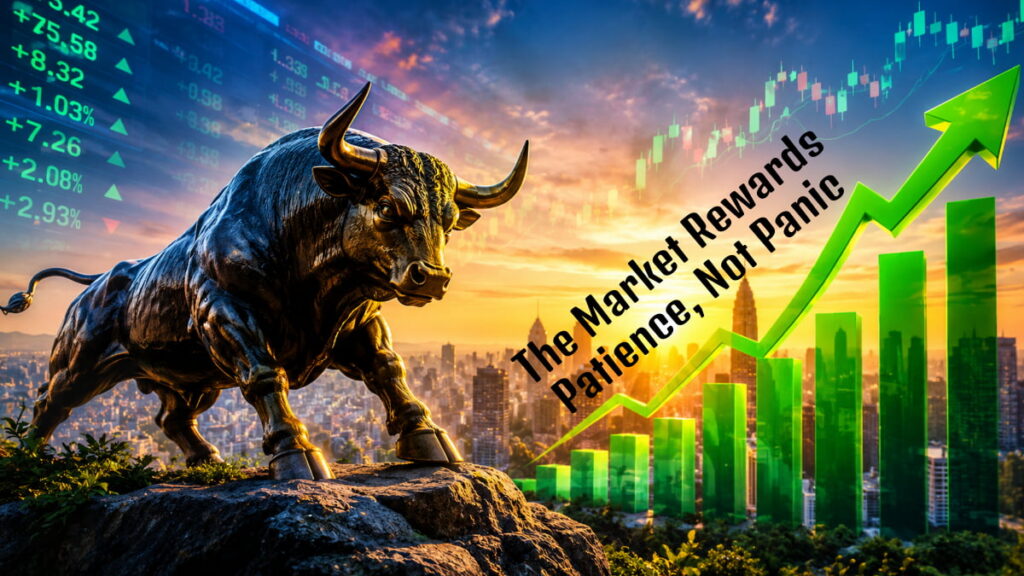
“The market transfers money from the impatient to the patient.”
This famous quote by Warren Buffett may sound simple, but it captures one of the deepest truths about wealth creation, investing, business, and even life itself.
Most people believe success comes from constant action. They think money is made by reacting quickly, trading frequently, chasing trends, or jumping from one opportunity to another. Modern culture reinforces this mindset every day. Social media glorifies overnight success. Financial influencers promote quick profits. News channels create urgency around every market movement. As a result, millions of people are trapped in emotional decision-making.
But history repeatedly shows a different reality. The biggest fortunes in markets were often created not by speed, but by patience. Investors who stayed calm during uncertainty, businesses that focused on long-term growth, and individuals who resisted emotional reactions often ended up far ahead of those constantly chasing quick rewards.
Patience is difficult because human psychology naturally seeks immediate gratification. Studies from behavioural economics show that people tend to value short-term rewards more than long-term gains, even when the long-term benefits are significantly larger. This tendency explains why many investors buy high during excitement and sell low during fear.
In many ways, markets are less a test of intelligence and more a test of emotional control. Those who can wait while others panic often benefit the most. Wealth compounds quietly over time, and patience becomes the bridge between opportunity and reward.
The Psychology of Impatience
Human beings are emotional creatures. Fear and greed influence financial decisions far more than logic. This is one of the main reasons why impatience dominates markets.
When prices rise rapidly, people feel they are missing out. This phenomenon, commonly known as FOMO — the fear of missing out — pushes individuals into rushed decisions. Investors suddenly abandon research and discipline because they do not want to “miss the rally.” During such moments, emotions overpower rational thinking.
The opposite happens during market declines. Fear spreads quickly. People begin to imagine catastrophic outcomes. Headlines become negative. Social media becomes filled with panic. Many investors sell assets not because fundamentals changed dramatically, but because they cannot emotionally tolerate uncertainty.
Research by financial behaviour firm DALBAR has repeatedly shown that average investors often underperform market indexes because of emotional timing mistakes. Instead of staying invested consistently, many buy during periods of excitement and sell during periods of fear. Ironically, their impatience destroys the very returns they seek.
Psychologists also describe something called “loss aversion,” a concept developed by Daniel Kahneman and Amos Tversky. Studies show that the pain of losing money feels psychologically stronger than the pleasure of gaining the same amount. This emotional imbalance causes people to react impulsively during downturns.
Markets exploit emotional weakness. They shake out impatient participants while rewarding those who remain disciplined. Short-term volatility often acts like a transfer mechanism — moving wealth from emotional decision-makers to patient investors who understand the long-term picture.
The Power of Compounding
One of the greatest reasons patience creates wealth is compounding. Compounding is slow in the beginning but incredibly powerful over long periods.
Albert Einstein is often associated with the phrase that compound interest is the “eighth wonder of the world.” Whether he actually said it or not, the principle remains true. Small gains repeated consistently over time create extraordinary outcomes.
Consider the growth of long-term stock markets. According to historical data from the S&P Global, the U.S. stock market has delivered average annual returns of roughly 10% over long periods despite wars, recessions, political crises, and economic uncertainty. Investors who remained patient through multiple decades often saw life-changing wealth accumulation.
The problem is that compounding does not feel exciting. Early progress appears small. People become impatient because they expect dramatic results immediately. They underestimate what consistency can achieve over ten, twenty, or thirty years.
This pattern exists beyond investing as well. Businesses grow through sustained effort. Skills develop through repeated practice. Relationships strengthen through time and trust. Health improves through consistent habits rather than temporary bursts of motivation.
Modern culture struggles with patience because everything is designed for instant gratification. Food arrives in minutes. Entertainment streams instantly. Social validation appears through likes and notifications. Over time, people become psychologically conditioned to expect immediate results everywhere, including wealth creation.
But markets do not reward urgency. They reward endurance. Those who understand compounding realize that success often looks boring in the short term but extraordinary in the long term.
Why Most People Fail to Wait
Waiting sounds easy in theory but becomes incredibly difficult in practice. Markets constantly test emotional stability.
Financial media thrives on urgency because urgency attracts attention. Every day there is “breaking news,” market predictions, economic fears, or excitement around the next big opportunity. Investors are continuously encouraged to react.
This environment creates what experts call “action bias.” People feel productive when they are constantly doing something, even when doing nothing would actually produce better results. Many traders overtrade simply because inactivity feels uncomfortable.
A study by researchers at the University of California, Berkeley found that individuals often prefer action over inaction during uncertainty, even when action increases the probability of failure. In markets, this behavior leads to unnecessary trading, emotional decisions, and reduced long-term returns.
Social comparison makes the problem even worse. People see others posting profits online and feel pressure to move faster. They compare their slow, steady progress with someone else’s temporary success story. This creates frustration and impatience.
The reality, however, is that many fast gains disappear just as quickly. History is filled with speculative bubbles where people chased easy money only to experience devastating losses later. From the dot-com bubble to cryptocurrency manias, impatience repeatedly created financial destruction.
Patience requires emotional maturity because it often means resisting the crowd. During extreme market conditions, patient investors may appear inactive, cautious, or even foolish. But over time, disciplined behavior tends to outperform emotional reactions.
True patience is not passive laziness. It is controlled discipline. It is the ability to stay focused on long-term goals while ignoring temporary noise.
Patience Creates Opportunity
Interestingly, patience is not just about holding investments. It is also about waiting for the right opportunities.
Legendary investors often spend long periods doing very little. They wait for moments when probabilities strongly favor them. Instead of forcing action daily, they conserve emotional and financial energy for high-quality opportunities.
Charlie Munger once explained that big opportunities in life and investing are relatively rare. The challenge is having the patience and courage to act decisively when those moments appear.
Many people lose money because they constantly chase mediocre opportunities. They confuse activity with progress. But successful investors understand that avoiding bad decisions is often more important than making frequent decisions.
This principle applies to business as well. Companies that focus on sustainable growth instead of short-term hype tend to survive longer. Research from McKinsey & Company has shown that organizations prioritizing long-term strategy often outperform those obsessed with short-term quarterly performance.
Patience also creates psychological clarity. Emotional people make reactive decisions. Patient individuals think strategically. They are able to observe situations calmly, identify real value, and avoid unnecessary risks.
In markets, panic often creates opportunities for disciplined investors. During financial crises, prices frequently fall below intrinsic value because fear becomes extreme. Patient investors who remain rational during such periods can benefit enormously once conditions stabilize.
History repeatedly demonstrates this cycle. Markets rise, collapse, recover, and grow again. Those who survive emotionally difficult periods often emerge stronger than those who react impulsively.
The Real Meaning of Wealth
At its core, patience is deeply connected to how people define success and wealth.
Many individuals chase quick money because they believe wealth is about immediate status, luxury, or validation. But true wealth is often built slowly and quietly. It comes from consistency, discipline, emotional stability, and long-term thinking.
Some of the world’s most successful investors spent decades allowing their investments to compound. Warren Buffett accumulated the majority of his net worth after the age of 50, not because of sudden brilliance late in life, but because decades of compounding finally became enormous.
This reveals an important truth: patience magnifies results over time. Small advantages repeated consistently become massive advantages later.
The same principle applies beyond money. Patient learners master skills deeply. Patient parents build stronger relationships with children. Patient leaders create healthier organizations. Patient individuals often experience less stress because they are not constantly reacting emotionally to every temporary setback.
Impatience creates exhaustion. Patience creates stability.
In a fast-moving world obsessed with instant success, patience has become a rare competitive advantage. Those who can stay calm while others panic, stay focused while others chase distractions, and stay disciplined while others seek shortcuts often achieve extraordinary outcomes over time.
Conclusion
“The market transfers money from the impatient to the patient” is far more than an investing quote. It is a reflection of how success works in many areas of life.
Markets reward emotional discipline because most people struggle to control fear, greed, and impatience. The desire for immediate rewards pushes individuals into poor decisions, while patience allows time, compounding, and opportunity to work together.
The irony is that patience often feels unproductive in the moment. Waiting does not create excitement. Long-term thinking rarely goes viral. Quiet consistency does not attract attention like dramatic success stories do. Yet history shows that enduring wealth is usually built slowly rather than instantly.
In an age driven by speed, notifications, and constant stimulation, patience has become one of the most valuable skills a person can develop. It protects individuals from emotional mistakes, encourages strategic thinking, and allows compounding to unfold naturally over time.
The market does not simply test financial knowledge. It tests human behaviour. And in the end, those who master patience often discover that waiting was never wasted time at all.