
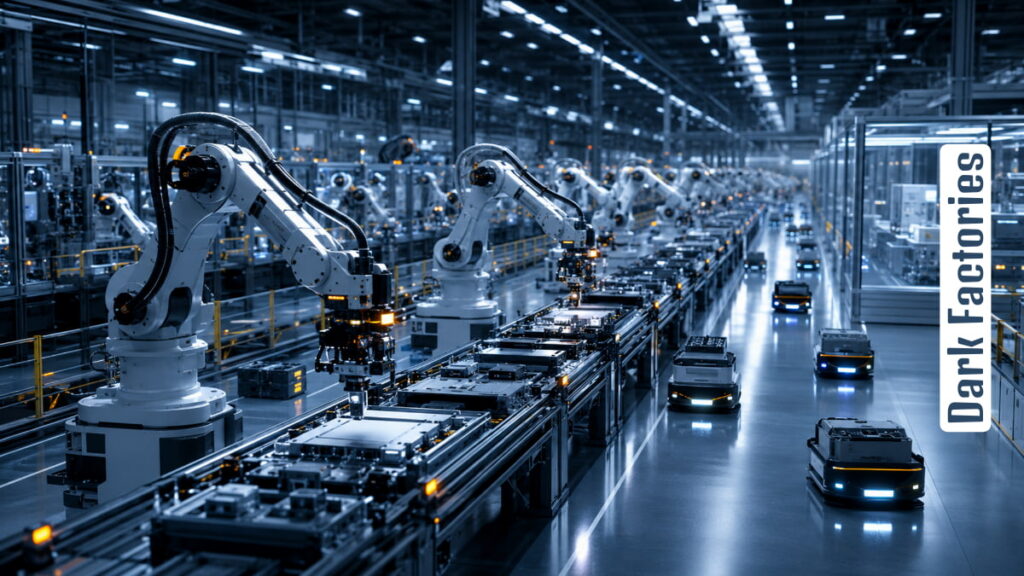
The concept of the dark factory—also known as a lights-out factory—has evolved from a futuristic idea into a practical and increasingly common manufacturing model. A dark factory is a facility designed to operate with minimal or no human presence on the production floor, relying almost entirely on robotics, automation, advanced software, and artificial intelligence to maintain continuous production cycles. The name comes from the premise that if no human workers are needed, the facility does not require lighting, heating, ventilation, or many of the amenities that humans traditionally require. In reality, such facilities might still have lights for maintenance or safety systems, but the principle remains: these factories are capable of operating autonomously around the clock.
While the idea of automated production lines is not new—factories have relied on robotics for decades—the level of autonomy, integration, and optimization seen in modern dark factories represents a major leap forward. Instead of humans supervising machines, the machines increasingly supervise themselves. They are capable of adjusting to variations in input materials, detecting defects, organizing logistics, and even predicting when maintenance is needed. The result is a system that promises extraordinary levels of efficiency, consistency, and productivity. Dark factories are not merely mechanized facilities; they are cyber-physical ecosystems where robotics, IoT sensors, digital twins, and AI-driven decision-making merge to create uninterrupted, self-regulating manufacturing environments.
A deeper aspect of the dark factory concept is its reliance on advanced software algorithms that allow machines to make decisions independently. AI can analyse vast streams of sensor data, detect anomalies, and reconfigure production sequences in real time to maintain optimal performance. This represents a philosophical shift in manufacturing—from human-directed assembly to machine-driven orchestration. The workforce, rather than being physically present on the shop floor, is increasingly concentrated in control rooms, maintenance hubs, and software management centers, marking a complete transformation in how human labour interacts with production systems.
“A dark factory is not just a factory without lights—it is a vision of manufacturing where machines think, act, and optimize themselves around the clock.”
Where Dark Factories Are Already Operational
Although dark factories were once limited to high-tech experimental sites, today they are operational in several parts of the world, particularly in manufacturing powerhouses such as China, Germany, Japan, and the Netherlands. China stands at the forefront, driven by its national focus on industrial upgrading, labour optimization, and AI-powered production. Companies like Xiaomi operate fully automated plants where robots handle almost every aspect of assembly for certain products. Their facility in Beijing’s Changping District is often referenced as one of the most advanced dark manufacturing environments, using hundreds of robots, intelligent logistics vehicles, and self-optimizing systems guided by AI models that adapt production runs in real time.
Gree Electric, another major Chinese manufacturer, has implemented large-scale 5.5G-enabled production facilities that push automation even further. These factories are designed with high-speed industrial communication networks that connect thousands of sensors and robots, enabling a deeply integrated “smart” ecosystem capable of functioning without direct human control. Meanwhile, specialized manufacturers like Changying Precision have adopted dark-factory principles for high-volume, standardized component production, demonstrating the scalability of the concept beyond just consumer electronics.
Outside of China, Germany has also been a strong adopter, with Siemens’ Amberg facility often cited as a leading example of advanced automated manufacturing. Although not fully dark, the facility integrates such a deep level of robotics and AI-powered quality inspection that human roles have shifted mostly to supervision and optimization. Similarly, Japanese robotics giant FANUC has operated lights-out manufacturing lines for years, at times reportedly running up to a month without human intervention. Their experience is particularly significant because they build the very robots used in other automated plants, demonstrating a high degree of confidence in self-replicating automation.
In Europe, the Netherlands is home to one of the most well-known partly lights-out factories operated by Philips in Drachten. The plant uses sophisticated robotics to manufacture electric razors and other small appliances with extraordinary consistency and low defect rates. Even though humans remain present in selective quality-control roles, the facility approaches the dark-factory ideal in many areas. South Korea, too, has embarked on similar implementations through companies like Samsung, leveraging high-precision robotics for semiconductor and electronics production.
The growth of dark factories across continents reflects both the technological maturity and the economic incentives driving their adoption. Countries with high labour costs, as well as those with strategic interests in improving manufacturing competitiveness, have been particularly eager to move in this direction. Moreover, several pilot projects in North America, particularly in the United States, demonstrate the feasibility of retrofitting existing production lines with robotic and AI systems to achieve semi-autonomous operations, further highlighting the global momentum behind this manufacturing paradigm.
Technologies Enabling the Factory of No Workers
The operational viability of dark factories relies on a convergence of technological innovations that have matured simultaneously. Robotics sits at the center, but it is no longer limited to simple, repetitive motions. Modern industrial robots integrate machine vision systems, force sensors, and increasingly sophisticated AI-trained behaviour models, enabling them to make micro-adjustments or handle non-standard items that older automation systems could not accommodate.
Another essential layer is the Industrial Internet of Things (IIoT). Networks of interconnected sensors monitor temperature, humidity, machine stress, vibration, alignment, power usage, and dozens of other parameters. These sensors feed data into AI-driven analytical systems that use predictive modelling to recommend or automatically schedule maintenance. This significantly reduces unplanned downtime, one of the most significant obstacles to implementing human-free facilities.
Digital twins—virtual replicas of the entire factory—play a crucial role by simulating production runs, forecasting system bottlenecks, and testing adjustments without affecting physical processes. AI agents continually analyse data from robots, machines, and logistics systems, learning patterns and autonomously optimizing workflows. Logistics automation has also advanced dramatically, with autonomous guided vehicles (AGVs), autonomous mobile robots (AMRs), and robotic storage-and-retrieval systems ensuring uninterrupted material movement within the facility.
Cloud and edge computing support real-time decision-making, enabling factories to run with minimal latency while maintaining connectivity to broader enterprise systems. Cybersecurity, too, is a foundational pillar, as fully automated factories must defend against software vulnerabilities that could disrupt production. Together, this integrated technological stack allows dark factories to function not as isolated machines but as intelligent, cooperative systems. Additionally, the integration of augmented reality (AR) and virtual reality (VR) tools allows remote engineers to interact with equipment virtually, further reducing the need for on-site human presence.
Global Examples
Beyond dark factories, several other automation-driven manufacturing concepts are gaining ground globally. One prominent model is the “smart factory,” commonly associated with Industry 4.0. Smart factories integrate automation with advanced analytics, human-machine collaboration systems, and adaptable production lines capable of switching to different products with minimal reprogramming. Unlike fully dark factories, smart factories maintain significant human involvement, especially in areas requiring creativity, customization, and oversight.
Flexible manufacturing systems (FMS) represent another important concept. Here, machines are designed to adapt to varying product types without extensive manual intervention. FMS often incorporates CNC machines, modular robots, and reconfigurable production lines. These systems are not fully dark but serve as precursors to dark-factory-level adaptability.
High-automation logistics hubs—like Amazon’s fulfilment centers or Alibaba’s smart warehouses—also illustrate how robotics, computer vision, and machine learning are reshaping industrial environments. These facilities use fleets of robots to retrieve inventory, package items, and route orders. Although people remain involved in complex tasks, the level of automation has increased exponentially.
In South Korea and Taiwan, semiconductor fabrication plants (fabs) are among the most automated facilities in the world. While not dark factories, they rely on robotic wafer transfer systems, automated inspection equipment, and controlled environments where human presence is minimized due to contamination risks. Similarly, pharmaceutical companies are using robotic process automation and sterile-environment manufacturing systems with reduced human participation, providing another example of how industries are evolving toward autonomous production.
Even agriculture is adopting “dark” principles. Vertical farms equipped with climate-control systems, automated nutrient delivery, and robotic harvesting are capable of running day and night with minimal human presence. These indoor farms represent an extension of the “lights-out” idea applied beyond manufacturing, demonstrating how the concept is influencing broader industrial and agricultural transformation. This diversification illustrates that the dark-factory model is not industry-specific but is increasingly relevant wherever efficiency, precision, and continuous operation are paramount.
Benefits Driving Adoption Across Industries
The appeal of dark factories lies in a combination of economic efficiency, operational consistency, and strategic resilience. Running machines continuously without breaks, weekends, or labour-shift transitions offers a tremendous productivity boost. Manufacturers can reduce per-unit production costs, maintain just-in-time output more reliably, and shorten lead times. Consistency improves because machines do not suffer from fatigue, distraction, or manual variance. For industries such as electronics, semiconductors, and precision-engineered components, even minor variations can lead to major defects, making robotic precision invaluable.
Another benefit involves safety and environmental conditions. Removing humans from the production floor eliminates exposure to hazardous chemicals, loud machinery, or heavy materials. Factories can also operate at temperatures, humidity levels, or lighting conditions optimized for machines rather than people, lowering energy consumption and reducing the environmental footprint.
Supply-chain resilience is another significant advantage. During global disruptions—such as natural disasters or pandemics—automated factories are less affected by labour shortages or movement restrictions. Companies with advanced automation infrastructure were able to maintain output far more reliably during recent global disruptions, accelerating industry interest in dark-factory capabilities. Additionally, these facilities enable rapid scalability: once a production line is established, expanding output often requires simply adding more robotic units or adjusting AI parameters, rather than hiring and training thousands of workers.
Challenges and Ethical Considerations
Despite the promise of dark factories, the model comes with significant challenges. One core challenge is the upfront investment cost. Robots, sensors, AI systems, and network infrastructure require substantial capital, making dark factories less accessible to small and mid-sized manufacturers. Operational integration is complex as well; creating a fully self-sufficient production system requires careful coordination of numerous subsystems that must communicate seamlessly.
Another challenge lies in the lack of flexibility. While dark factories excel at standardized, high-volume production, they struggle with custom or rapidly changing product designs unless they incorporate expensive reconfigurable robotics. Maintenance also poses issues: although predictive systems can preempt failures, occasional breakdowns still require highly skilled technicians, and the infrastructure must be designed to accommodate both autonomous operation and human intervention safely.
Ethically, dark factories raise concerns about job displacement. The transition toward fully automated systems can impact workers whose roles become redundant. While automation creates new jobs in robotics maintenance, programming, and data analytics, these positions demand specialized skills. Societies must grapple with how to support displaced workers through retraining programs, education reforms, and new labour policies that ensure a just transition. There is also a psychological and societal dimension, as large-scale automation may transform communities historically dependent on industrial labour, potentially affecting local economies, social cohesion, and regional identity.
The Future of Autonomous Production
Dark factories represent the leading edge of a much broader shift toward autonomous production environments. As AI becomes more capable, robots more flexible, and sensors more precise, industries across the world are moving toward higher autonomy, reduced variability, and greater operational intelligence. The global trend suggests that future factories may combine the strengths of dark facilities with the adaptability of smart factories—creating hybrid environments that can operate autonomously while maintaining the flexibility to switch product lines or accommodate custom orders.
Future advancements may include self-healing machinery capable of repairing minor issues without human intervention, AI systems capable of designing their own production workflows, and fully autonomous supply chains that connect smart warehouses, logistics hubs, and manufacturing sites into unified intelligent ecosystems. Dark factories are not merely a technological novelty; they are a sign of where global manufacturing is headed. As more countries and industries adopt these models, the idea of factories running silently and efficiently in the dark may no longer be futuristic—it may become the new standard for industrial production worldwide. Furthermore, the integration of AI-driven predictive analytics will allow factories to anticipate market demands, optimize inventory levels, and respond to disruptions even before they occur, introducing a level of proactive efficiency previously unimaginable.
Implications of Dark Manufacturing
As dark factories continue to spread across global manufacturing landscapes, their influence extends far beyond industrial efficiency and into the larger economic and geopolitical framework that defines international trade. Autonomous manufacturing offers nations a strategic advantage by decoupling productivity from labour constraints, allowing countries with high wages, aging populations, or limited labour pools to remain competitive. This shift is already reshaping global supply chains: instead of relying heavily on low-cost labour regions, advanced economies may increasingly bring manufacturing back within their borders through reshoring or nearshoring initiatives powered by automation. When labour is no longer the primary cost driver, proximity to markets, political stability, and reliable infrastructure become the dominant factors influencing manufacturing decisions.
The geopolitical impact becomes even more significant when considering technological sovereignty. Countries investing heavily in AI, robotics, and automated infrastructure are creating long-term national assets that will influence their economic resilience and global bargaining power. Dark factories reduce dependency on foreign labour markets but increase dependence on advanced software, sensors, semiconductor components, and cybersecurity protections, making technological leadership a core competitive requirement. Nations capable of producing their own industrial robots, automation systems, and AI models—such as Japan, China, Germany, South Korea, and the United States—are likely to gain disproportionate control over future manufacturing standards and global production capacities.
There is also an emerging divide between nations that can adopt dark-factory systems and those that lack the digital or financial infrastructure to support them. Developing economies historically relied on labour-intensive manufacturing to fuel economic growth. As automation becomes more dominant, these countries may face challenges integrating into global value chains unless they shift toward higher-skilled technical industries, innovation-driven services, or automation-enabled agriculture. International organizations and policymakers may need to reconsider economic development frameworks, labour laws, and trade agreements to prevent widening inequality between automation leaders and laggards. In addition, the strategic deployment of dark factories could alter global trade balances, making certain nations less dependent on imports while concentrating critical production capabilities in regions with technological supremacy.
Ultimately, dark factories signal not only a technological transformation but a profound restructuring of global manufacturing power dynamics. As more countries adopt autonomous production systems, the world may witness a redistribution of industrial centers, a redefinition of economic dependencies, and a new era in which technological capability becomes one of the most critical determinants of national competitiveness. The rise of these autonomous environments also challenges international labour markets, regional development strategies, and corporate investment decisions, emphasizing that the implications of dark factories extend far beyond factory walls.