
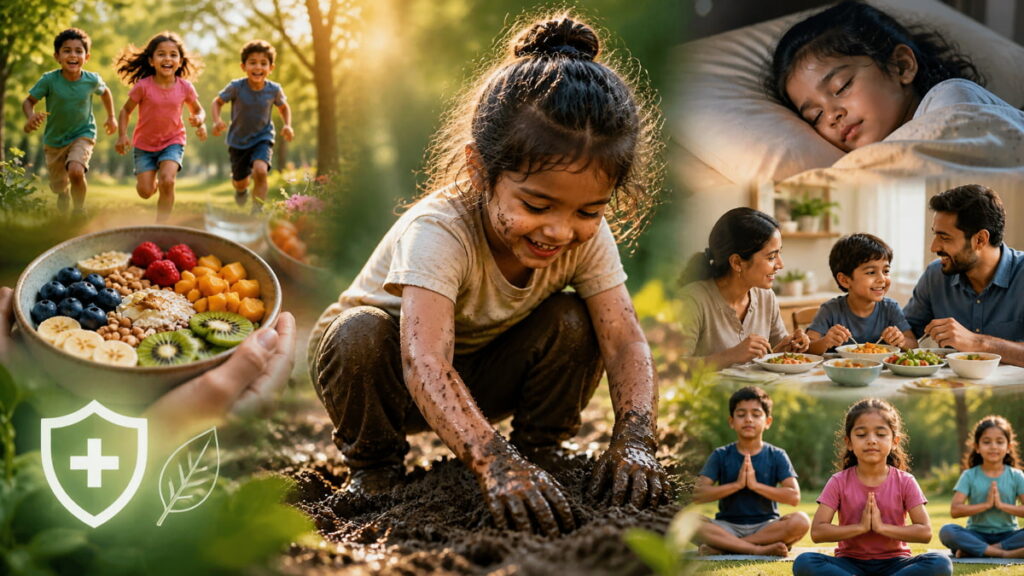
Every parent wants their child to grow up healthy and strong. Yet in a world of increasing allergies, frequent colds, and rising rates of childhood infections, many parents find themselves asking: what more can we do? The answer, according to a growing body of scientific research, may be simpler than we think. A child’s immune system is not fixed at birth. It is shaped, day by day, by the food they eat, the sleep they get, the environments they are exposed to, and even how much time they spend outside getting their hands dirty. Building strong immunity in children is less about adding expensive supplements and more about returning to the fundamentals of a healthy, natural childhood.
Research from institutions such as the University of Helsinki, Harvard T.H. Chan School of Public Health, and the American Academy of Pediatrics consistently points to the same conclusion: lifestyle habits formed in the early years have the most powerful and lasting effect on immune development. The immune system of a child under the age of twelve is still learning, still building its database of threats and responses. This is a window of opportunity. The choices made during these years, from what goes on the dinner plate to how many hours are spent asleep, directly influence how well that immune system will function for decades to come. This blog explores six evidence-based, practical ways to strengthen your child’s immunity through the rhythms of everyday life.
“The immune system is not built in a doctor’s office — it is built in the mud, at the dinner table, and in the quiet of a good night’s sleep.”
1. The Power of a Whole-Food Diet
The connection between nutrition and immunity is one of the most well-established relationships in all of medical science. The immune system depends on a continuous supply of vitamins, minerals, and antioxidants to function properly, and the most reliable source of these nutrients is real, minimally processed food. Vitamin C, found abundantly in oranges, strawberries, kiwis, and bell peppers, plays a direct role in the production of white blood cells — the body’s primary soldiers against infection. Vitamin D, which can be obtained through sunlight and fatty fish like salmon and mackerel, is critical for the activation of immune defenses and has been linked in multiple studies to reduced rates of respiratory infections in children. Zinc, present in lentils, beans, seeds, and whole grains, supports the development of immune cells and helps the body mount a faster response to pathogens.
Beyond individual nutrients, the gut microbiome — the community of trillions of bacteria living in the digestive tract — plays a central role in immune regulation. Research published in the journal Nature Reviews Immunology has confirmed that approximately seventy percent of the immune system resides in the gut. Fermented foods such as yogurt with live cultures, kefir, and miso introduce beneficial bacteria that strengthen this internal ecosystem. Fiber-rich foods like fruits, vegetables, legumes, and whole grains serve as food for these good bacteria, helping them thrive. Encouraging children to eat a wide variety of colourful foods is not just good advice for growth — it is one of the most direct investments a parent can make in their child’s long-term immune health. Limiting ultra-processed foods, sugary snacks, and excessive refined carbohydrates is equally important, as these have been shown to promote inflammation and disrupt the balance of gut bacteria that the immune system depends on.
2. Prioritize Sleep
Sleep is perhaps the most underrated pillar of childhood immunity. During sleep, the body does not simply rest — it actively repairs, regenerates, and strengthens. Studies from the National Sleep Foundation and the American Academy of Sleep Medicine have found that children who consistently get inadequate sleep are significantly more likely to fall ill after exposure to viruses, recover more slowly, and experience more severe symptoms. This is because sleep is the period during which the body produces and releases cytokines — small proteins that are critical to fighting infection and inflammation. Without adequate sleep, cytokine production drops, and the immune system is left less equipped to respond to threats.
The sleep requirements for children vary by age but are consistently higher than most parents realize. Toddlers between one and two years of age need eleven to fourteen hours per day, including naps. Preschoolers aged three to five need ten to thirteen hours, while school-aged children between six and twelve need nine to twelve hours. Teenagers require eight to ten hours. Creating a consistent sleep environment plays a major role in helping children meet these targets. This means establishing a regular bedtime routine, limiting screen exposure in the hour before bed, keeping the bedroom cool and dark, and avoiding stimulating activities close to sleep time. Parents who treat sleep as a non-negotiable daily priority — not something to be compromised for an extra hour of television — give their children a powerful immune advantage that no supplement can replicate.
3. Let Them Play Outside
One of the most exciting areas of immunological research in recent years is the study of how exposure to natural environments shapes the immune system in children. A landmark study conducted by Finland’s Natural Resources Institute found that when children in urban daycare centers played in environments enriched with soil, moss, forest floor, and natural plants, their microbiomes became significantly more diverse within just twenty-eight days. This diversity was linked to increased levels of regulatory T-cells — immune cells that help prevent overreaction, which is the mechanism behind allergies and autoimmune conditions. The children in these enriched environments also showed reductions in bacteria associated with disease on their skin and in their gut.
These findings build upon what scientists call the biodiversity hypothesis, which proposes that reduced contact with the natural microbial world — a result of increasingly urbanized, sanitized childhoods — may be contributing to the dramatic rise in allergies, asthma, eczema, and other immune-related conditions seen in children today. The practical implication for parents is both simple and liberating: let children play outside, and let them get dirty. Digging in soil, rolling in grass, handling leaves and sticks, and exploring natural environments are not just fun — they are forms of immune education. The body learns to distinguish between harmless environmental microbes and genuine threats, building tolerance and resilience in the process. Regular time spent in parks, gardens, forests, or even a patch of backyard soil can make a measurable difference in a child’s immune profile over time.
4. Keep Them Moving
Regular physical activity has well-documented benefits for adult immune function, and research increasingly confirms the same holds true for children. Exercise improves circulation, which means immune cells are transported more efficiently throughout the body. It reduces levels of stress hormones like cortisol, which in elevated quantities are known to suppress immune function. It also promotes the production of anti-inflammatory proteins and helps regulate the body weight that, when excessive, is associated with chronic low-grade inflammation — a condition that undermines immune resilience over time. A study published in the British Journal of Sports Medicine found that physically active individuals experienced significantly fewer days of respiratory illness compared to sedentary ones, and this protective effect was observed across all age groups studied.
For children, the World Health Organization recommends at least sixty minutes of moderate to vigorous physical activity every day. This does not need to be structured sport or formal exercise — active play counts entirely. Running, jumping, climbing, cycling, swimming, dancing, and even energetic games in the garden all contribute meaningfully to the daily total. What matters more than the type of activity is the consistency. Families that build movement into the fabric of daily life — walking to school instead of driving, choosing the park over the screen on afternoons, playing together in the yard after dinner — create lasting habits that protect health across a lifetime. The immune benefits of regular movement begin accumulating immediately and compound over time.
5. Manage Stress and Nurture Emotional Wellbeing
The relationship between stress and immunity is not limited to adults. Children experience stress too — through school pressures, social dynamics, family changes, overscheduled routines, and the passive absorption of adult anxiety. Chronic psychological stress triggers the sustained release of cortisol and adrenaline, hormones that in small amounts are helpful but in excess suppress the activity of natural killer cells, reduce antibody production, and slow the body’s inflammatory response. Research from the American Psychological Association has shown that children who experience high levels of chronic stress are more susceptible to infections, heal more slowly, and show weaker responses to vaccinations.
Protecting a child’s emotional health is therefore not separate from protecting their physical health — it is deeply intertwined with it. Warm, responsive parenting has been shown to directly reduce stress hormone levels in children. Adequate unstructured playtime — time with no agenda, no screens, and no adult direction — is one of the most powerful stress regulators available to children. Mindfulness practices such as simple breathing exercises, quiet reading, or time in nature have been shown to lower cortisol and improve immune markers even in young children. Maintaining predictable daily routines also reduces anxiety and helps children feel safe. When children feel emotionally secure and are not chronically overwhelmed, their immune systems are free to do what they were designed to do.
6. Limit Unnecessary Antibiotics
One of the most consequential ways parents can protect their child’s long-term immune health is also one of the least discussed: being thoughtful about antibiotic use. Antibiotics are life-saving medications and have an essential role in treating serious bacterial infections. However, they are frequently prescribed for viral infections such as the common cold, most sore throats, and many ear infections — conditions for which they provide no benefit. The problem is that antibiotics are indiscriminate. They eliminate not only harmful bacteria but also the beneficial microbes that populate the gut and play a foundational role in immune regulation. Research has shown that a single course of antibiotics can significantly reduce the diversity of the gut microbiome, with effects that can last for months or longer, and that repeated antibiotic use in early childhood is associated with higher rates of allergies, asthma, and inflammatory conditions.
This does not mean avoiding antibiotics when they are truly needed — that would be dangerous. It means advocating for clarity before accepting a prescription, asking the doctor whether the illness is bacterial or viral, and whether watchful waiting is a reasonable option before medication. When antibiotics are genuinely necessary, supporting microbiome recovery through probiotic-rich foods and a high-fiber diet during and after the course can help restore the balance of beneficial bacteria more quickly. More broadly, avoiding routine antibacterial soaps and sanitizers in everyday home life, allowing children to be exposed to the normal microbial world through outdoor play and pets, and encouraging a diverse whole-food diet all contribute to the kind of rich, resilient microbiome that underpins a strong immune system.
Conclusion
Building a strong immune system in children is not a single action — it is a collection of daily habits, all working together. Real food over processed food. Adequate sleep over late nights. Muddy outdoor play over sanitized indoor screens. Regular movement over sedentary routines. Emotional warmth over chronic stress. Thoughtful antibiotic use over reflexive prescriptions. None of these is complicated or expensive. All of them are supported by a substantial and growing body of research. The science is clear that the early years of a child’s life represent a unique and irreplaceable window in which the immune system is most receptive to the influences around it.
What is most encouraging about this research is that the power largely lies in the hands of families, not pharmaceutical companies or medical interventions. The everyday choices made at mealtimes, bedtimes, weekends in the park, and moments of comfort after a hard day are the very things that shape how resilient a child’s immune system will become. In raising healthy children, the oldest wisdom and the newest science often arrive at the same conclusion: give children what they have always needed — good food, good sleep, time in nature, love, and room to move and play. The immune system, given those conditions, knows exactly what to do.