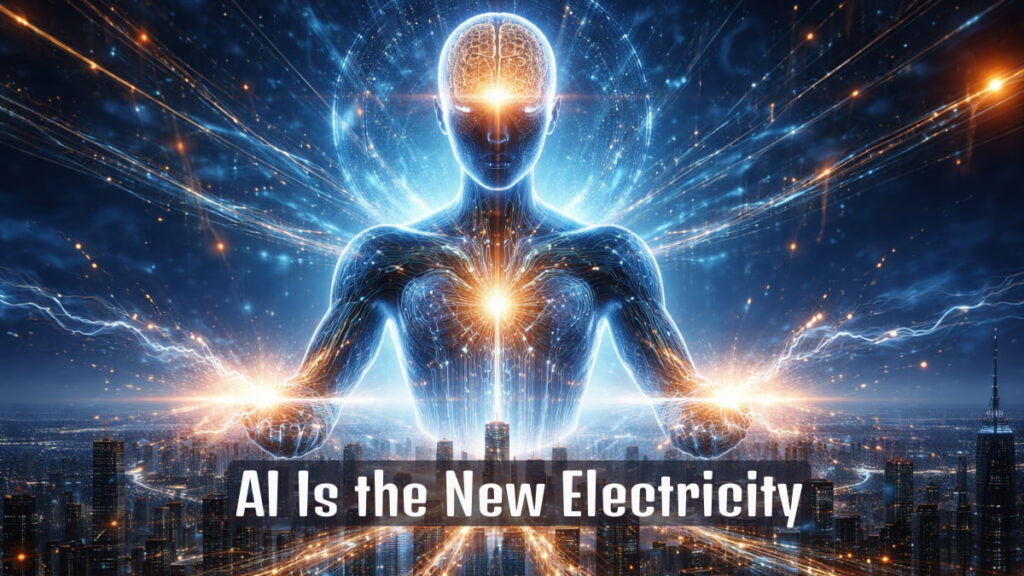
In 1882, Thomas Edison famously lit up the streets of New York City with electricity. That innovation did more than brighten lamps—it transformed society, redefined economies, and reshaped the trajectory of human progress. Today, we stand on the brink of a similarly transformative era, one defined not by light bulbs, but by algorithms, neural networks, and machines that can learn and think: Artificial Intelligence (AI). Just as electricity became the invisible force powering the modern world, AI is becoming the new electricity—an omnipresent, versatile force with the potential to revolutionize every sector of human endeavour. Those who understand and harness its capabilities will dominate the next decade, while those who ignore or underestimate it risk obsolescence.
AI is no longer confined to science fiction or niche technological applications. It is embedded in the apps we use daily, the services we rely on, and increasingly, the decisions that govern industries, governments, and global economies. From self-driving cars to predictive healthcare, AI is rewriting the rules of productivity, efficiency, and innovation. It is not merely a tool; it is an amplifier of human potential. The question is no longer whether AI will shape the future, but rather who will wield it most effectively.
“Artificial Intelligence is the tool, human wisdom is the compass.” – Vinod Singh
The Universal Power of AI
To understand the magnitude of AI’s impact, we need to compare it to one of history’s most disruptive forces: electricity. Before widespread electrification, factories depended on water wheels and steam engines, homes relied on candles, and cities operated under the constraints of daylight. The advent of electricity did not simply replace older technologies—it created entirely new industries, opportunities, and ways of living. Similarly, AI is not just a better version of previous software; it has the potential to redefine what is possible across every domain.
Consider healthcare. Traditional medicine relied heavily on manual analysis, intuition, and limited data. Today, AI algorithms can analyse millions of patient records, predict disease outbreaks, and even assist in diagnosing conditions with remarkable accuracy. In business, AI-powered analytics can forecast market trends, optimize supply chains, and automate customer service, reducing costs while increasing efficiency. In transportation, autonomous vehicles promise to reduce accidents and revolutionize logistics. In each case, AI functions like electricity: a foundational technology whose applications extend far beyond its immediate use, empowering other innovations to flourish.
Moreover, the universality of AI makes it both powerful and disruptive. Electricity was a platform technology—it enabled other inventions but was rarely seen directly. AI mirrors this phenomenon: while we interact with applications like virtual assistants or recommendation engines, the underlying intelligence powers countless unseen processes that shape decisions and outcomes. Companies and nations that integrate AI deeply into their operations, infrastructure, and culture are effectively laying down the power grid of the 21st century. Those who hesitate may find themselves permanently disconnected.
Beyond industry, AI is beginning to reshape daily life in subtle but profound ways. Smart home systems learn our routines to optimize energy usage. Personal digital assistants anticipate our needs before we articulate them. AI is embedded in communication tools, transportation systems, and even our entertainment experiences, creating environments that respond dynamically to human behaviour. This pervasiveness signals a societal shift: AI is becoming a silent infrastructure, just as electricity once was, touching every aspect of life without being directly noticed.
The Competitive Advantage of Early Adoption
History teaches us that the early adopters of transformative technology gain disproportionate advantages. Companies that embraced electricity, assembly lines, and computers decades ago became the giants of their industries. The same principle applies to AI. Organizations that integrate AI into their core strategies can achieve unparalleled speed, scale, and precision, leaving competitors scrambling to catch up.
Take the example of large tech firms. Companies like Google, Amazon, and Microsoft have invested billions into AI research and integration. They use machine learning not just for product recommendations or search algorithms, but to optimize operations, manage data centers, and even develop AI-driven software platforms that other companies can leverage. Their investment in AI creates a virtuous cycle: more data improves AI performance, which in turn generates more data, strengthening their market position. In contrast, companies that treat AI as a mere supplementary tool risk falling behind, much like businesses that failed to electrify before their competitors in the early 20th century.
The competitive advantage of AI extends beyond corporate profitability. Nations that lead in AI research and infrastructure gain geopolitical leverage. AI can enhance national security, drive economic growth, and increase global influence. Countries investing heavily in AI education, research, and industrial applications are positioning themselves as the superpowers of the next decade. Those slow to adopt risk being left on the margins of innovation and decision-making.
Early adoption also allows organizations to experiment and iterate faster. By integrating AI now, companies can gather valuable real-world insights, train their systems on proprietary datasets, and refine models in ways that latecomers cannot. In the business world, this translates into sharper decision-making, optimized resource allocation, and an almost self-reinforcing advantage over competitors. In many ways, adopting AI early is not simply an opportunity—it is an existential imperative.
AI as a Force Multiplier for Human Creativity
One of the most misunderstood aspects of AI is the belief that it will replace humans. While AI can automate routine tasks, its true transformative power lies in amplifying human creativity and intelligence. Like electricity, which allowed humans to build skyscrapers, explore space, and automate manufacturing, AI enables us to transcend limitations and focus on higher-order thinking.
In creative industries, AI is already augmenting artistic expression, music composition, and content generation. Writers use AI to brainstorm ideas, designers employ it to generate novel visuals, and filmmakers explore AI-driven editing and special effects. In science, AI accelerates research by modelling complex systems, predicting outcomes, and analysing datasets far larger than any human could manage. The fusion of AI with human ingenuity promises breakthroughs that were previously inconceivable, from personalized medicine to climate change solutions.
Moreover, AI democratizes access to knowledge and capabilities. Small businesses, startups, and individual innovators can leverage AI tools to compete with established giants, levelling the playing field in unprecedented ways. The barrier to entry in many industries is lowered, empowering a new generation of creators, thinkers, and problem-solvers. Those who harness AI effectively become not just more productive, but more innovative, unlocking value that was once reserved for those with vast resources or specialized expertise.
The ability of AI to enhance creativity also extends to problem-solving in complex, real-world situations. In engineering, AI can simulate multiple design scenarios rapidly, revealing solutions that may never have been considered. In social policy, AI can model the potential impacts of different interventions, helping governments design more effective programs. By acting as a force multiplier, AI allows humans to focus on strategic thinking, intuition, and innovation—areas where machines cannot fully replace human insight.
AI in Education and Workforce Transformation
A critical dimension often overlooked is AI’s role in reshaping education and workforce development. Traditional education systems, built for industrial-age economies, often struggle to keep pace with technological change. AI offers tools for personalized learning, adaptive curricula, and real-time feedback, enabling students to learn at their own pace and according to their unique strengths. Intelligent tutoring systems can identify knowledge gaps, suggest resources, and even simulate real-world problem-solving scenarios. This individualized approach has the potential to significantly improve learning outcomes across age groups and geographies.
Workforce transformation is equally profound. AI is redefining job roles, skill requirements, and the nature of work itself. Routine and repetitive tasks are increasingly automated, while demand grows for analytical, creative, and strategic skills. Employees who embrace AI as a collaborator rather than a competitor gain a competitive edge, becoming more efficient and innovative. Organizations that invest in AI-driven training programs ensure their workforce is future-ready, bridging the gap between technology and human capability.
The educational implications extend beyond formal schooling. Lifelong learning becomes practical and scalable with AI-powered platforms. Professionals in medicine, engineering, law, and finance can continuously upskill, leveraging AI to stay ahead in fast-changing fields. This shift fundamentally changes how societies prepare for economic and technological challenges, making AI an essential enabler of human potential.
Ethical, Social, and Strategic Considerations
With great power comes great responsibility. As AI becomes central to business, government, and society, ethical and strategic considerations cannot be ignored. Unlike electricity, which was largely value-neutral, AI can shape human decisions, influence behaviours, and even amplify biases present in data. Misuse or neglect can lead to societal harm, economic disruption, and loss of public trust.
Companies must navigate ethical challenges such as privacy, transparency, accountability, and fairness. Governments must consider regulations that protect citizens without stifling innovation. Ethical AI is not just a moral imperative—it is a strategic one. Organizations that build trust, maintain transparency, and deploy AI responsibly are more likely to achieve sustainable competitive advantages. Conversely, unethical use or negligence can result in regulatory backlash, reputational damage, and market penalties.
The societal impact of AI also extends to economic inequality and labour displacement. While AI can create new opportunities, it can simultaneously disrupt existing employment structures. Policymakers, business leaders, and educators must collaborate to ensure AI-driven progress is inclusive and equitable. Reskilling programs, universal access to AI tools, and forward-looking labour policies are critical to ensuring that AI serves society broadly rather than concentrating power in a few hands.
Strategically, leaders must recognize that AI is not a one-time investment but a continuous process of learning, iteration, and integration. Unlike traditional tools, AI systems improve over time with data and experience. Those who fail to adapt risk technological stagnation. Furthermore, strategic deployment requires understanding where AI can create the most impact—automating repetitive tasks, enabling predictive insights, or enhancing decision-making. Treating AI as a novelty or side project is insufficient in a world where competitors view it as infrastructure.
AI as a Solution to Global Challenges
AI is not just a tool for corporate advantage—it has the potential to address some of humanity’s most pressing global challenges. Climate change, resource management, and environmental sustainability are areas where AI-driven insights are increasingly indispensable. Machine learning models can optimize energy consumption, predict extreme weather events, and identify solutions to reduce carbon emissions. In agriculture, AI helps increase crop yields, monitor soil health, and predict pest outbreaks, enabling more sustainable food production. In healthcare, AI assists in epidemic modelling, drug discovery, and efficient allocation of medical resources.
By applying AI to global challenges, we are not only improving efficiency but also creating systemic resilience. Governments, NGOs, and international organizations increasingly rely on AI for policy design, crisis response, and resource management. Those who integrate AI into sustainability and development initiatives can not only achieve competitive advantage but also contribute to the long-term survival and prosperity of society as a whole.
The Future Is AI-Driven
As we look toward the next decade, the trajectory is clear: AI will be pervasive, powerful, and indispensable. Just as electricity reshaped every facet of society, AI will redefine work, commerce, governance, and daily life. Those who master it will not merely survive—they will lead, innovate, and dominate. Those who fail to engage will face increasing irrelevance.
The transformation will be uneven. Industries that adopt AI aggressively will see exponential growth and efficiency gains, while sectors that lag may struggle to maintain competitiveness. Societies that prioritize AI education, research, and ethical deployment will thrive, while those that neglect it may face widening economic and social divides. AI is both an opportunity and a challenge—a force that can uplift or disrupt, depending on how it is harnessed.
In this new era, leadership is defined not by possession of capital or resources alone, but by the ability to leverage intelligence—both artificial and human. The companies, individuals, and nations that integrate AI thoughtfully, creatively, and ethically into their strategies will wield unparalleled influence. They will set the standards, define the markets, and shape the societal norms of the next decade. AI is not a tool of the future; it is the electricity of today, powering the engines of tomorrow.
Conclusion
AI’s rise marks the dawn of a transformative epoch. Like electricity in the early 20th century, it is a foundational technology whose effects ripple across industries, societies, and economies. The narrative is not merely about automation or efficiency—it is about redefining what is possible. The analogy to electricity is more than metaphorical: both are universal forces, capable of magnifying human potential and creating entirely new landscapes of opportunity.
Those who understand AI, invest in it, and integrate it strategically will dominate the next decade. They will shape industries, drive innovation, and redefine societal norms. Those who hesitate risk falling behind, constrained by outdated methods and reactive strategies. The era of AI is not coming—it is here. And just as electricity illuminated the modern world, AI will illuminate the path to the future. The choice is clear: harness it, or be left in the shadows.