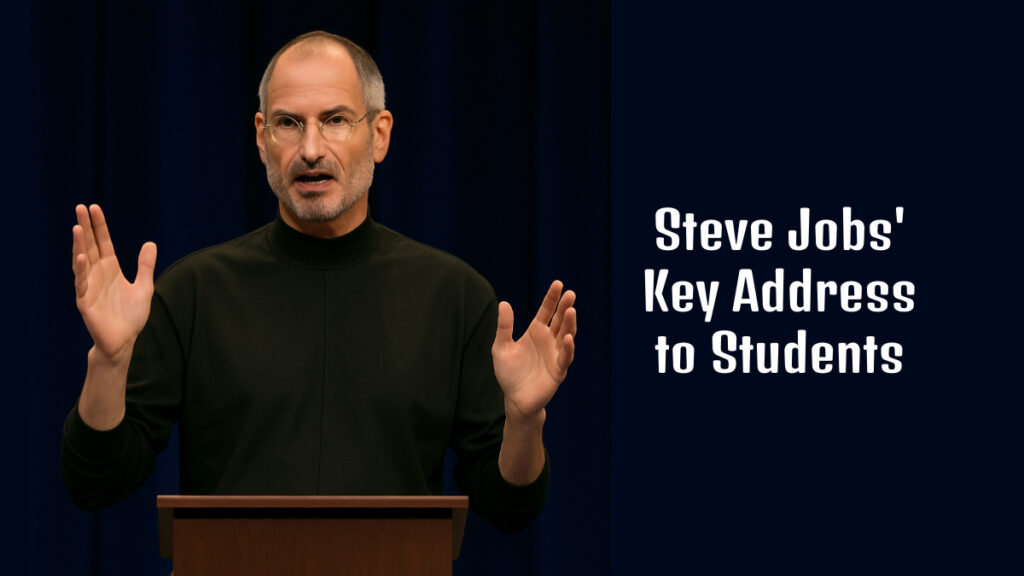
In 2005, Steve Jobs, the visionary co-founder of Apple and Pixar, delivered one of the most iconic commencement speeches in history at Stanford University. Though he wasn’t a graduate himself, his 15-minute address conveyed more wisdom than many could hope to gain from a four-year degree. Jobs shared his personal story with striking candour, weaving together three simple yet profound tales: connecting the dots, love and loss, and death.
This speech has since become a blueprint not just for aspiring entrepreneurs, but for anyone striving to lead a meaningful and impactful life. In this blog, we’ll delve deeply into the essence of Jobs’ key messages, explore the life lessons hidden in each story, and draw timeless insights for students, professionals, and dreamers alike.
The First Story: Connecting the Dots
“You can’t connect the dots looking forward; you can only connect them looking backward.”
Jobs began by recounting his decision to drop out of Reed College after just six months. However, instead of leaving the campus entirely, he continued to “drop in” on classes that intrigued him. One such class was on calligraphy—a subject that seemed to have no practical use at the time but fascinated him deeply. A decade later, when designing the first Macintosh, that calligraphy course influenced the computer’s revolutionary typography system.
Key Lesson #1: Trust Your Intuition
Jobs’ story teaches that not all learning has to be linear or tied to immediate gain. His decision to follow curiosity, rather than a conventional path, led to creative innovations that changed the world. In a society that often prizes productivity over passion, this is a powerful reminder to trust your gut and explore interests—even if they seem irrelevant in the moment.
Key Lesson #2: Embrace Uncertainty
Many students feel anxious about having their life “figured out” by graduation. Jobs’ experience reassures us that life doesn’t follow a neat script. Often, it’s only in hindsight that the chaos makes sense. He believed that believing the dots will somehow connect in the future gives you the confidence to follow your heart, even when it leads off the well-worn path.
The Second Story: Love and Loss
“The only way to do great work is to love what you do.”
In the second story, Jobs shared how he was fired from Apple—the company he started in his garage. For many, this could have been the end. For Jobs, it was a new beginning. He founded NeXT and Pixar, and in the process, rediscovered his passion for creating.
When Apple bought NeXT years later, he returned to lead the company to its greatest innovations—including the iPod, iPhone, and iPad.
Key Lesson #3: Failure Can Be the Best Teacher
Jobs’ ousting from Apple could have been the most devastating moment of his life. But instead of giving up, he used it as an opportunity to grow. This story exemplifies how failure isn’t the opposite of success—it’s part of the journey. For students, rejection letters, poor grades, or failed projects aren’t the end of the road—they’re stepping stones to something greater.
Key Lesson #4: Passion Fuels Excellence
Jobs emphasized that real success stems from doing what you love. When you love your work, you’re more resilient, more innovative, and more willing to go the extra mile. His message to students was clear: Don’t settle. If you haven’t found what you love yet, keep looking. Don’t rest until you do.
The Third Story: Death
“Remembering that you are going to die is the best way I know to avoid the trap of thinking you have something to lose.”
Jobs’ third story was perhaps the most profound. A year before the speech, he had been diagnosed with pancreatic cancer. Though the initial diagnosis was grim, he recovered from surgery and reflected deeply on mortality.
He spoke about how confronting death helped him prioritize what truly mattered and strip away external expectations. Knowing that time is limited, he said, was the most powerful tool he had to make big life decisions.
Key Lesson #5: Live with Urgency and Purpose
Jobs urged students not to waste time living someone else’s life. Social pressures, fear of failure, or the expectations of others can cloud our judgment. But death has a way of clarifying what really matters. For students, this means pursuing passions boldly, speaking your truth, and refusing to settle for mediocrity.
Key Lesson #6: Stay Hungry, Stay Foolish
Jobs concluded his address with the now-famous words from the back cover of the final issue of The Whole Earth Catalog: “Stay Hungry. Stay Foolish.” These four words have since become a rallying cry for dreamers and doers across the world. To stay hungry is to remain curious, ambitious, and passionate. To stay foolish is to keep taking risks, asking questions, and embracing the unknown.
Breaking Down the Timeless Relevance for Students
1. Rethinking Traditional Success
In most academic institutions, success is narrowly defined. High GPAs, prestigious internships, and acceptance into elite graduate programs are often considered the gold standard. But Steve Jobs’ life forces a radical re-evaluation of that mindset.
Despite dropping out of college, Jobs became a titan of industry. His journey reminds students that real-world success is not always tied to academic achievement. It is driven by imagination, perseverance, adaptability, and the willingness to defy convention.
Jobs’ example pushes students to ask deeper questions:
- Are your choices truly your own, or are they shaped by societal expectations?
- Are you pursuing grades, or growth?
- Are you optimizing your education to develop as a thinker, creator, and problem-solver—or just trying to earn a diploma?
Jobs wasn’t dismissing education; he was challenging the one-size-fits-all notion of success. His approach speaks to students who feel alienated by rigid systems. It opens the door for alternative routes, like self-directed learning, apprenticeships, or building a startup out of a dorm room. In this sense, Jobs validates not just the dreamers, but the misfits—the very people who often go on to disrupt industries.
2. The Intersection of Technology and Liberal Arts
Jobs often spoke about the magic that happens when technology meets the humanities. Unlike many tech leaders who focused strictly on engineering or computing, Jobs brought an artist’s eye to product design.
The result? Apple products that weren’t just tools—they were experiences. The elegance of the iPhone’s interface, the symmetry of the Mac, the minimalist simplicity of Apple stores—these were not accidental. They were born from an appreciation of beauty, proportion, and intuitive design.
For students, this is a powerful call to:
- Combine disciplines rather than choose between them.
- Develop both technical and soft skills.
- Study philosophy, psychology, art, and literature—not as extras, but as critical to innovation.
In today’s age of AI, automation, and data science, the need for ethical reasoning, storytelling, empathy, and human-centered thinking has never been greater. Jobs was ahead of his time in urging a multidisciplinary approach that’s now reshaping how top universities structure their programs.
As Steve Jobs once said, “It’s in Apple’s DNA that technology alone is not enough—it’s technology married with liberal arts, married with the humanities, that yields us the results that make our hearts sing.”
3. Failing Forward
Jobs’ fall from Apple was public and brutal. He described it as a moment of devastation—but also liberation. With no weight of expectations, he could start again. And he did—founding NeXT and Pixar, the latter eventually revolutionizing animation.
For students, especially in a culture obsessed with “winning” and external validation, this reframing of failure is deeply empowering.
Failure, when reflected upon, can be the greatest teacher:
- It builds resilience.
- It teaches humility and emotional intelligence.
- It forces creative problem-solving.
- It redirects you toward something better aligned with your strengths.
Jobs didn’t romanticize struggle. He respected it. He endured it, learned from it, and grew through it. Students must learn not to fear mistakes but to leverage them as pivot points toward growth and reinvention.
Real-World Applications of Jobs’ Advice
1. For Students Choosing Majors
The pressure to “choose wisely” can paralyze students. Often, they pick majors based on the perceived job market—leading to mismatches between skills, passion, and career satisfaction.
Jobs’ story offers a compelling counter-narrative. His casual calligraphy class—unrelated to any career path—became the cornerstone of Apple’s user interface revolution. That seemingly irrelevant interest became a catalyst for change.
This highlights the importance of exploring broadly in college. Today’s seemingly unprofitable interest could become tomorrow’s innovation. Passion is not a luxury; it’s a differentiator.
Actionable Insight: Choose a major that balances marketability with meaning. Seek side courses, workshops, or personal projects that light you up. Keep experimenting.
2. For Young Entrepreneurs
Jobs’ entrepreneurial journey wasn’t clean. It was chaotic, uncertain, and full of detours. But what stood out was his relentless execution of vision.
For aspiring entrepreneurs, Jobs offers several hard-earned lessons:
- Start small but think big. Apple began in a garage.
- Don’t be afraid of bold ideas. The iPhone wasn’t just a product—it redefined communication.
- Iterate relentlessly. Jobs was famously detail-obsessed and constantly improved his products.
- Resilience matters more than resources. He was once broke, but never broken.
Today’s students, with access to crowdfunding, open-source tools, and social media, have more opportunity than ever to create. Jobs’ life is a call to action: don’t wait for permission. Start. Fail. Learn. Repeat.
3. For Students Entering the Workforce
The jump from classroom to cubicle can be jarring. Many students enter the workforce expecting clear purpose, passion, and impact. The reality is often bureaucracy, burnout, or misalignment.
Jobs’ speech offers grounding advice: “Don’t settle.”
It’s okay if your first job isn’t perfect. What matters is using each role as a step toward alignment with your values and gifts. Explore. Move. Pivot. Ask yourself:
- Does this job make me feel alive?
- Is it aligned with the type of impact I want to make?
- Am I learning, or just earning?
If the answer is no, Jobs would advise you to move on—with courage, not fear.
A Look at the Speech’s Lasting Legacy
Jobs’ address set a new standard. Many speakers today attempt to replicate its format: three stories, one truth. But what makes his speech enduring isn’t the structure—it’s the vulnerability. Jobs wasn’t trying to impress; he was trying to serve.
Educators, too, have drawn lessons from Jobs’ life. Institutions increasingly emphasize creativity, interdisciplinary studies, and innovation hubs—values that mirror Jobs’ journey. The idea that education should nurture curiosity, not conformity, has gained widespread traction.
The speech has been translated into dozens of languages, quoted in countless books, and even featured in films. Its viral longevity is a testament to the universal appeal of its core message: live authentically, love deeply, and create fearlessly.
What Would Jobs Say to Students Today?
If Steve Jobs were alive today, speaking to a class of 2025 graduates, what might he add?
He might speak about the perils and possibilities of AI. He’d likely emphasize the importance of protecting privacy, staying human in a digital age, and using technology as a tool, not a crutch. But one suspects his core message would remain unchanged:
- Trust your instincts.
- Follow your passion.
- Don’t waste your life living someone else’s dream.
Jobs’ 2005 address wasn’t just a speech. It was a gift—a blueprint for navigating life with purpose, even when the path is uncertain. In an age of constant noise, his simple truths ring louder than ever.
Conclusion: A Speech That Lives On
Steve Jobs’ commencement address to Stanford students transcends time, context, and circumstance. Its brilliance lies not in complexity, but in clarity. In just three stories, Jobs delivered a lifetime’s worth of guidance.
As students step into a world that is often chaotic and unpredictable, Jobs’ words remain a compass:
“Your time is limited, so don’t waste it living someone else’s life.”
This isn’t just advice. It’s a call to action. A reminder that greatness doesn’t come from playing it safe—but from daring to dream, fail, and rise again.
Stay hungry. Stay foolish. And keep connecting the dots—even when you can’t yet see the whole picture.