
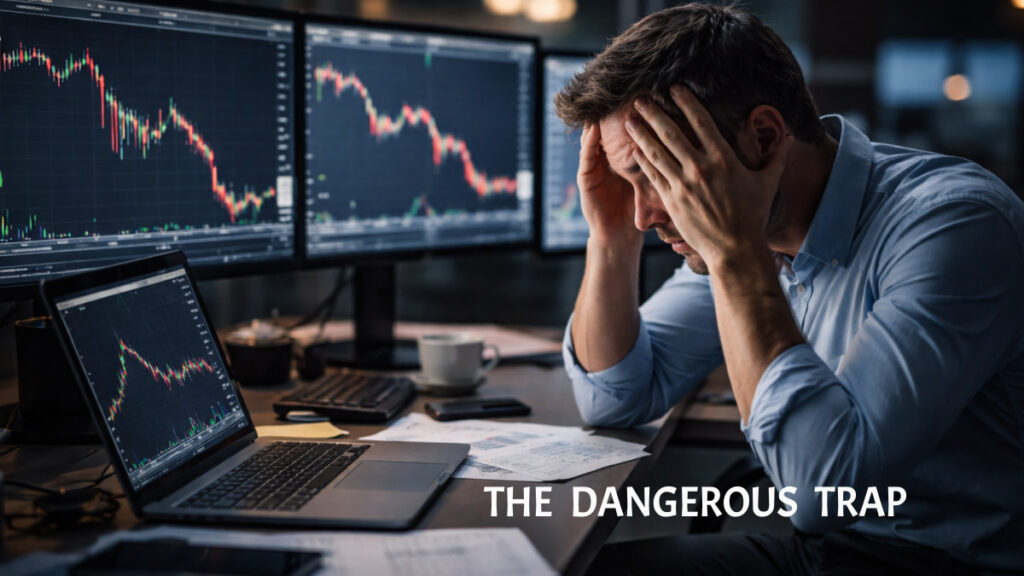
Trading, whether in stocks, forex, crypto, or commodities, is often painted as a path to financial freedom. Yet for every success story, there are countless tales of traders who started with promise but ended up losing more than they expected. One of the most dangerous traps in trading, which affects almost every trader at some point, is the urge to recover losses immediately.
This is not just a trading mistake—it is a psychological trap. When a trader loses money, the natural reaction is to feel urgency, panic, or even a sense of failure. The mind whispers, “One good trade will fix everything.” Unfortunately, this is rarely the case. Acting on this impulse transforms measured, strategic trading into emotional gambling, which almost always leads to larger losses.
Warren Buffett famously said, “The stock market is designed to transfer money from the active to the patient.” In other words, impatience is the enemy of profits. The market does not owe you a single trade to recover your loss; it rewards patience, discipline, and consistency. Understanding why this trap exists, how to identify it, and how to prevent it is essential for anyone serious about trading.
The Psychology of Loss Recovery
Losses are not merely numerical—they affect us emotionally in ways we often underestimate. When a trade goes against us, we experience stress, frustration, and disappointment. These feelings can be so intense that traders are tempted to chase the loss, often disregarding their trading plan.
This is explained by loss-aversion bias, a concept in behavioural finance. Humans naturally perceive losses as twice as painful as gains are pleasurable. In trading, this means losing $100 can feel as devastating as winning $200 feels rewarding. This imbalance often drives impulsive decisions.
Revenge trading, the act of trying to immediately make up for a loss, is the most common manifestation of this bias. After a loss, a trader may increase position sizes, enter trades prematurely, ignore stop-losses, or deviate from their plan—all in an attempt to “get back on track.” The irony is that these actions rarely recover the loss and often compound it.
Benjamin Graham, the father of value investing, warned: “The investor’s chief problem—and even his worst enemy—is likely to be himself.” In trading, it is rarely the market that defeats us—it is our own emotional reaction to setbacks.
Consider this scenario: A trader loses $500 on a trade. Immediately, he feels an urgent need to recover that money and enters a second trade without following his standard setup. Predictably, the second trade goes against him, and now he has lost $1,000 instead of $500. The first loss was manageable; the second, fuelled by emotion, could have been avoided entirely.
How Greed Disguises Itself as Urgency
The urge to recover losses often disguises itself as urgency. Traders think, “I just need one good trade to recover,” or “I can’t afford to stop now.” But this mindset is dangerous because it transforms logical trading into emotion-driven gambling.
When traders operate under this false urgency, several destructive behaviours emerge:
- Premature entries: Entering trades without waiting for confirmation
- Ignoring risk management: Abandoning stop-losses or widening them
- Overleveraging positions: Taking a bigger risk than the account can handle
- Chasing patterns: Forcing trades that do not meet the original criteria
The market does not recognize your personal losses or financial stress. It moves according to supply and demand, global events, and trader sentiment—not your emotions. Therefore, chasing a loss rarely brings a trader back to their starting point. Instead, it often multiplies the damage.
Ed Seykota, a legendary commodities trader, captured this truth succinctly: “The trend is your friend until the end when it bends.” Just as trends are neutral and indifferent to personal goals, the market’s response to your loss is equally impartial. Recognizing this indifference is the first step in avoiding emotional traps.
The Importance of Capital Protection
After suffering a loss, the immediate priority for any trader should be protecting the remaining capital. This concept, while simple in theory, is one of the most ignored principles in trading.
Think of trading as running a business. When a business experiences a downturn, it does not recklessly spend resources to recover lost revenue. Instead, it stabilizes, analyzes what went wrong, and resumes growth with a clear strategy. Trading should be approached in the same manner. Protecting capital is not a sign of fear—it is a sign of strategic thinking.
Paul Tudor Jones, a billionaire trader, highlighted this principle: “The most important rule of trading is to play great defense, not offense.” In practice, this means that after a loss, traders should step back, assess, and avoid making trades under emotional pressure. The goal is not to erase the loss immediately, but to maintain the ability to trade effectively over time.
Many traders fail because they focus solely on profits, ignoring the reality that the first priority must always be to stay in the game. Without capital preservation, all strategies and insights become irrelevant.
Creating Rules to Combat Emotional Trading
Emotional trading is rarely intentional. It is often subconscious, triggered by the stress of a loss. To combat this, traders must adopt non-negotiable post-loss rules that govern their behaviour. These rules remove reliance on willpower, which is notoriously weak under stress, and replace it with structured discipline.
Some examples of effective rules include:
- Taking a 15–30 minute break after a losing trade
- Ceasing trading for the day after two consecutive losses
- Maintaining a trade journal to document emotional state and decision-making
These rules prevent the trader from acting impulsively. Over time, following such structured habits ensures that emotions no longer dictate decisions, and the urge to chase losses is neutralized before it takes root.
Richard Dennis, famed for the Turtle Trading experiment, stressed the importance of rules and discipline: “You can’t become consistently profitable without rules. Discipline is the bridge between goals and accomplishment.” In trading, rules are not constraints—they are tools that allow traders to make decisions calmly, even when the market is volatile.
Redefining Success in Trading
Many traders define success narrowly as making money each day. This mindset creates an emotional pressure that makes it almost impossible to recover from a loss rationally. True success in trading should be measured by process, discipline, and adherence to strategy, rather than short-term profits.
A “successful” trading day can be defined by:
- Following the trading plan faithfully
- Respecting stop-loss levels
- Avoiding revenge trades
- Maintaining emotional composure
By focusing on process over outcome, traders remove the compulsion to recover losses immediately and can approach the market with a clear, objective mindset.
Mark Douglas, author of Trading in the Zone, emphasized this: “Consistency in trading comes not from predicting the market but from managing your behaviour in it.” When traders align their definition of success with behaviour rather than results, emotional traps lose their power.
The Role of Mindset and Mental Reset Techniques
One critical element often overlooked by traders is the importance of mindset and mental reset. Trading is not just a skill of analysis—it is a skill of emotional management. Even the most sophisticated strategies fail if the trader’s mind is clouded by stress, anxiety, or frustration from prior losses.
Mental reset techniques can include:
- Meditation or mindfulness exercises to calm racing thoughts
- Short walks or physical activity to release tension
- Visualization techniques, imagining following the trading plan perfectly despite losses
When traders implement these mental resets, they create space between emotional reactions and rational decisions. This allows them to return to the screen clear-headed, reducing the likelihood of impulsive trades and overleveraging.
As Brett Steenbarger, a trading psychologist, explains: “The trader’s edge comes from controlling what is controllable—one’s own mind—before attempting to control the market.” The ability to reset your mental state after a loss can be the difference between long-term survival and repeated catastrophic losses.
Practical Steps to Avoid the Trap
Understanding the theory behind loss-chasing is only half the battle. The real difference between consistently profitable traders and those who fail lies in actionable, practical steps that control emotions and enforce discipline. Here’s a detailed guide to implementing these strategies:
#1. Pause After a Loss :
The first and most crucial step is to pause immediately after a losing trade. The moment you experience a loss, adrenaline and cortisol spike, impairing decision-making. Continuing to trade under these conditions is like driving while angry—your reactions are faster, but your judgment is clouded.
A simple but effective approach is to step away from the screen for 15–30 minutes, take deep breaths, stretch, or even go for a short walk. This allows your nervous system to settle and your mind to reset. Some traders even use meditation or focused breathing exercises during this pause. The goal is to create mental distance from the loss, so your next trade is based on strategy, not emotion.
Example: Imagine you lost $500 on a trade. Instead of immediately entering another trade to recover it, you step away, drink water, and review market conditions calmly. When you return, you are in control and can evaluate opportunities objectively rather than reactively.
#2. Review Your Trading Plan:
A loss often tempts traders to deviate from their plan. To avoid this, make it a habit to review your trading criteria before every trade, especially after a loss. Ask yourself: Does this trade meet all the original conditions? Am I entering it because it’s a good setup or because I want to recover my money?
If the trade does not satisfy your plan, it is better to skip it entirely. Sticking to your rules ensures that even when the market goes against you, you are trading systematically, not emotionally. Over time, this discipline compounds into consistent profitability.
Example: Suppose your trading plan requires a specific technical setup, such as a moving average crossover with volume confirmation. After a loss, you feel tempted to enter on just the crossover. By reviewing your plan, you notice the volume doesn’t align and decide not to trade. This simple act protects your account from a second, emotionally driven loss.
#3. Reduce Position Size:
Loss-chasing often leads traders to increase position sizes in the hope of “recovering quickly,” which is one of the fastest ways to amplify losses. Instead, reducing your position size after a loss can help you trade with a calmer mindset and maintain objectivity.
Smaller positions reduce emotional pressure because each trade now carries less risk relative to your account. This prevents impulsive decisions driven by frustration or urgency. Traders often find that they make better, more rational decisions when their exposure is limited.
Example: If you normally trade 2 lots of a currency pair, consider trading 1 lot or even 0.5 lots after a loss. You are still active in the market but without the emotional intensity that comes from risking too much at once.
#4. Journal Every Trade:
One of the most effective ways to prevent emotional traps is keeping a detailed trading journal. This should include not only trade entries and exits but also your reasoning, emotional state, and lessons learned.
A journal forces reflection and accountability. When you record why a loss happened and how you reacted, you create a feedback loop that helps prevent repeating the same mistakes. Over time, this builds awareness of emotional triggers and strengthens self-discipline.
Example: Write down: “Entered trade at 1.1050 against plan due to frustration after previous loss. Exited at 1.1020. Emotional state: anxious. Lesson: Never enter a trade to recover loss.” Seeing this in writing reinforces the importance of following your plan and managing emotions.
#5. Accept Losses as Business Expenses:
One of the most overlooked yet critical mindsets in trading is to treat losses as the cost of doing business, not personal failures. Every professional trader accepts that losing trades are inevitable and necessary for growth.
By framing losses as expenses—like rent, utilities, or equipment in a business—you detach personal emotion from financial reality. This mindset allows you to focus on the next opportunity rather than obsess over recovery.
Example: If you risked 2% of your account on a trade and lost, view it as paying a “trading fee” for the chance to make a profitable trade. This reframing reduces panic, stress, and impulsive attempts at loss recovery.
#6. Incorporate Mindset Resets:
Finally, maintaining a strong mental state is essential to avoid the loss-recovery trap. Mental reset techniques include mindfulness, meditation, deep breathing, visualization, or even brief physical activity.
Before entering another trade, take 5–10 minutes to calm your mind. Visualize executing your trading plan perfectly and remaining disciplined even after a loss. This creates a mental buffer between the emotional impact of the prior loss and the rational decision-making needed for your next trade.
Example: After a loss, you close your laptop, do a 5-minute meditation, and visualize following your trading plan step by step. When you return, you are calmer, more focused, and far less likely to chase the loss impulsively.
By implementing these steps, traders build a strong buffer between emotion and action, drastically reducing the likelihood of compounding losses. Over time, these habits foster confidence, patience, and consistency. They transform trading from a reactive, emotional activity into a disciplined, strategic process. Traders who internalize these practices gain an edge not because they predict the market better, but because they control themselves better.
Conclusion
The desire to recover losses immediately is a trap that every trader, regardless of experience, encounters. It is fuelled by emotion, loss-aversion, and the illusion that a single trade can undo damage. Yet the market is indifferent—it does not recognize personal financial needs or emotional states.
The key to avoiding this trap lies in psychological awareness, strict risk management, disciplined routines, and mental reset practices. Protecting capital, enforcing post-loss rules, redefining success, detaching emotions from trades, and maintaining a clear mindset are the strategies that separate consistently profitable traders from those who repeatedly fall into the same trap.
As trading experts remind us: “The goal of a successful trader is to make the best trades consistently, not to recover yesterday’s losses today.” Losses are inevitable. Emotional reactions are optional. Mastering the mind, rather than trying to control the market, is what ultimately leads to sustained success.
Remember, losing a trade is unavoidable, but losing your discipline is optional. Avoiding the dangerous trap of chasing losses is not just a strategy—it is the foundation of every trader’s long-term survival and success.