In an era overloaded with information, many people confuse knowing the name of something with knowing something. True understanding means being able to explain a concept clearly, simply, and confidently—without relying on memorized definitions or jargon. This is where the Feynman Technique stands out as one of the most effective tools for learning anything deeply.
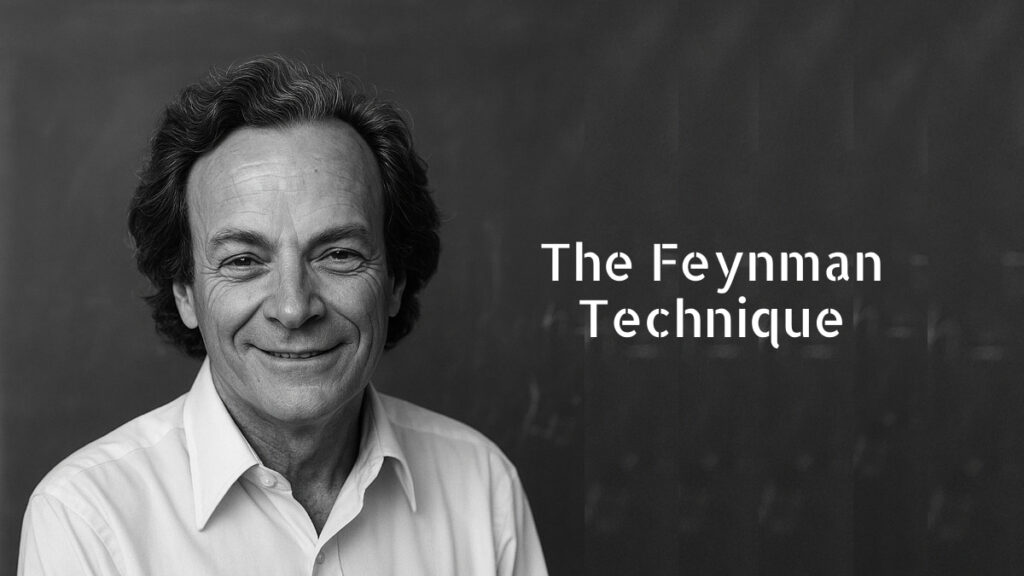
Named after the legendary physicist Richard Feynman, this learning technique focuses on one simple principle: If you can’t explain it simply, you don’t understand it well enough. Feynman didn’t just win a Nobel Prize; he was known for his uncanny ability to make even the most complex scientific theories feel understandable and even fun. His technique is a practical, four-step method that helps you absorb, retain, and apply knowledge with crystal clarity.
Whether you’re a student, entrepreneur, professional, or lifelong learner, mastering the Feynman Technique can transform the way you study, work, and solve problems.
“If you can’t explain it simply, you don’t understand it well enough.” – Albert Einstein
The Man Behind the Method
Before we dive into the steps, it’s worth understanding the man behind this technique. Richard Feynman was a theoretical physicist known not only for his contributions to quantum electrodynamics but also for his passion for teaching. What set Feynman apart wasn’t just his brilliance, but his relentless insistence on clarity. He didn’t tolerate vague or abstract thinking—not even in himself. In fact, he kept notebooks labelled “Notebook of Things I Don’t Know About,” where he would teach himself subjects by writing down everything he knew and then identifying the gaps.
Feynman believed that the ultimate test of knowledge is the ability to teach it to someone else, especially a child. His method doesn’t rely on rote memorization or cramming. Instead, it pushes you to break down knowledge, rebuild it from the ground up, and express it in plain English.
Now let’s explore the four powerful steps of the Feynman Technique—each one a leap closer to true mastery.
Step 1: Choose a Concept and Teach It
The first step is deceptively simple: pick a topic you want to understand better, and try to teach it as if you’re explaining it to a child or someone with no background in the subject.
Don’t just think about it—write it down on paper or say it out loud. You could pretend you’re giving a lecture to a curious 12-year-old, or explaining it to a friend over coffee. The key is to use plain, simple language. Avoid complex terms, acronyms, or textbook definitions. Instead, aim to make the topic feel intuitive and approachable.
For example, if you’re learning about compound interest, don’t just say “It’s interest calculated on the initial principal and also on the accumulated interest of previous periods.” That’s just repeating a definition. Instead, say something like, “It’s like earning interest on your money, and then earning interest on the interest you already earned. Over time, it grows faster because it keeps building on itself.”
The goal is clarity. If you can teach the idea in everyday language, you’re on the right track. If you stumble, feel confused, or fall back on technical words without really knowing what they mean, that’s a sign you need to keep going.
Step 2: Identify the Gaps in Your Explanation
This step is the heart of the Feynman Technique. As you attempt to explain the concept, you’ll notice moments where you hesitate, get stuck, or realize you’re faking your way through a term or idea. That’s a powerful signal. These gaps are your opportunity for real learning.
The brilliance of this step lies in its honesty. Most traditional learning methods don’t force us to confront what we don’t understand—we read, we highlight, we memorize, and we move on. But when you’re trying to explain something clearly and stumble, you’re forced to admit: “I don’t get this part.”
This might happen when you try to connect two ideas and realize the link is fuzzy. Or you might use a word like “entropy” or “inflation” and suddenly wonder what it actually means. Maybe you’re trying to explain why multiplying two negative numbers results in a positive, and the reasoning escapes you.
Instead of ignoring those moments, you highlight them. Circle them. Write a question mark next to them. These gaps are not weaknesses—they’re your roadmap for what to learn next. This is where deep understanding is built.
Step 3: Go Back and Fill in the Gaps
Now that you’ve identified the areas you don’t fully understand, it’s time to go back to your source material—books, lectures, videos, or expert discussions—and review those specific areas. But unlike traditional studying, your focus is now laser-sharp. You’re not passively reading the whole chapter again. You’re targeting the exact areas that need reinforcement.
Let’s say you’re struggling to explain how the stock market works. You understand supply and demand at a basic level, but you can’t quite explain what causes stock prices to rise or fall. Instead of starting from scratch, you now zero in on those dynamics—perhaps the role of investor sentiment, company performance, or macroeconomic trends.
This focused review strengthens your mental framework. It transforms isolated facts into connected understanding. You’re not just memorizing answers—you’re reconstructing meaning. And once you’ve filled those knowledge gaps, you return to your explanation and try again from the beginning.
This cycle—explain, identify gaps, research, refine—creates a feedback loop of clarity and retention. You’re actively working with the information, not just letting it pass through your mind.
Step 4: Simplify and Create Analogies
Once you’ve reviewed and refined your explanation, it’s time to distill it even further. Rewrite or re-express your explanation in the simplest form possible. Ask yourself: “Can I make this even clearer?” Think about how you’d explain it to a 5th grader. Could you use a metaphor, a story, or a relatable comparison?
Analogies are incredibly powerful here. They connect unfamiliar concepts to everyday experiences. For example, if you’re explaining how data encryption works, you might say: “It’s like locking a message in a box with a key. Only someone with the right key can open it and read what’s inside.”
This is the final test. If your explanation flows easily, makes sense, and feels satisfying, you’ve likely achieved a solid understanding. But if you still find areas that feel clunky or unclear, go back to Step 2 and repeat the process.
This isn’t a one-time trick—it’s a lifelong habit. With each repetition, your understanding becomes more refined, and your memory becomes more durable.
Why the Feynman Technique Is So Effective
What makes this technique so universally effective is that it aligns with how the brain actually learns. Most people study by passive review—reading notes, watching videos, or highlighting textbooks. These are low-effort tasks that create the illusion of learning but often fail to produce results in real-world scenarios like exams, problem-solving, or explaining concepts to others.
The Feynman Technique, on the other hand, emphasizes active recall—retrieving information from memory, explaining it aloud or in writing. This process not only strengthens neural connections but also reveals the limits of your understanding.
It also encourages metacognition, which means thinking about your own thinking. You’re constantly evaluating what you know and what you don’t. This builds awareness and adaptability—key traits for any high-level learner.
Another strength lies in the use of simplification and analogies, which taps into elaborative rehearsal—a learning method where you relate new knowledge to existing knowledge. When you simplify a complex concept into your own words or compare it to something familiar, you create mental anchors that help the concept stick.
Finally, the Feynman Technique turns learning into a creative and engaging process. It transforms the student into the teacher, the consumer into the creator. This shift in role changes your relationship with the material—you no longer feel like a passive observer but an active participant in your learning journey.
From Classroom to Boardroom: Real-World Power
The Feynman Technique isn’t just for students. It’s been adopted in boardrooms, classrooms, science labs, and creative studios. Entrepreneurs use it to master business models. Coders use it to grasp algorithms. Public speakers use it to simplify complex topics for their audiences. Even artists use it to understand and explain abstract ideas in design and storytelling.
One of the most famous endorsements comes from Elon Musk, who often breaks problems down to their first principles—a process similar to Feynman’s method of rebuilding understanding from scratch. Musk has said, “You boil things down to the most fundamental truths… and then reason up from there.”
In corporate training, the technique is used to ensure employees truly understand processes, policies, or technologies. It eliminates vague instructions and ensures that people can explain not just what to do, but why they’re doing it.
Teachers have adopted it by having students “teach back” material to the class or create simple explainers for difficult topics. In doing so, students build confidence, improve communication, and absorb knowledge far more effectively than through memorization alone.
Even in personal development, the technique can be transformative. Want to improve your understanding of relationships, emotions, or decision-making? Apply the Feynman steps and teach those concepts to yourself. You’ll be amazed at how much deeper your awareness becomes.
Make It a Lifelong Habit
In a world that rewards speed and surface-level knowledge, the Feynman Technique offers a refreshing alternative: slow down, go deeper, and make it yours.
Start by setting aside 30 minutes a week to apply this technique. Choose a concept—maybe something you’ve struggled with, or something new that excites you. Write it out. Teach it. Identify what you don’t know. Then fill the gaps. Simplify. Analogize. Teach again. Repeat.
Over time, you’ll notice a shift. You’ll stop nodding along in meetings when you don’t really get it. You’ll stop memorizing things for short-term use. Instead, you’ll become a thinker, a builder of knowledge. You’ll see connections others miss and express ideas others find confusing.
Most importantly, you’ll gain confidence—not because you know everything, but because you know how to learn anything.
Final Thoughts
The Feynman Technique isn’t a trick or a hack—it’s a philosophy of learning that values clarity, simplicity, and curiosity. In a world full of noise and superficial knowledge, it invites you to go deeper, think clearer, and teach better.
Richard Feynman once said, “I would rather have questions that can’t be answered than answers that can’t be questioned.” That’s the essence of real learning: questioning, exploring, simplifying, and growing. The Feynman Technique gives us a map for that journey.
Whether you’re trying to pass an exam, write a book, give a presentation, or simply make sense of the world—this technique can change how you learn, how you teach, and how you think. One concept at a time.