• Author
  • Copyright Report
  • Privacy Policy
  • Terms & Condition
  • Contact
  • About
Wednesday, June 24, 2026
Fastlane Freedom
No Result
View All Result
  • Mindfulness
  • Money
  • Grow Business
  • Essential Reading
  • Popular Quotes
  • Student
  • Parenting
  • Videos
  • About
  • Contact
  • Mindfulness
  • Money
  • Grow Business
  • Essential Reading
  • Popular Quotes
  • Student
  • Parenting
  • Videos
  • About
  • Contact
No Result
View All Result
Fastlane Freedom
No Result
View All Result
  • Author
  • Copyright Report
  • Privacy Policy
  • Terms & Condition
  • Contact
  • About

Home » The Impact of Rethinking in Business – Have a Scientific Mindset

The Impact of Rethinking in Business – Have a Scientific Mindset

Vinod Singh by Vinod Singh
June 17, 2022
Reading Time: 6 mins read
A A
0
The Impact of Rethinking in Business

Table of Contents

  • Scientific Thinking
  • An Experiment on Entrepreneurs
  • The Outcome of the Experiment
  • Apple’s Story of Rethinking
  • Dramatic Leap in Rethinking (iPhone)

Rethinking is a powerful mindset, which provides an edge in the business world. Two decades ago Phil Tetlock, a political science writer, discovered something peculiar. As we think and talk, we often slip into the mindsets of three different professions: preachers, prosecutors, and politicians. In each of these modes, we take on a particular identity and use a distinct set of tools. We go into preacher mode when our sacred beliefs are at risk: we deliver sermons to protect and promote our ideals. We enter prosecutor mode when we recognize flaws in other people’s reasoning: we rationalize arguments to prove them wrong and win our case. And we shift into politician mode when we’re seeking to win over an audience: we campaign and lobby for the approval of our constituents.

The risk is that we become so wrapped up in preaching that we’re right, prosecuting others who are wrong, and politicking for support that we don’t bother to rethink our own views. (Inspired from “Think Again” by Adam Grant, a must-read recommendation by Bill and Malinda Gates).

Scientific Thinking

Like the above three professions, there is one more profession as scientists. Rethinking is fundamental to this profession. They’re paid to be constantly aware of the limits of their understanding. They’re expected to doubt what they know, be curious about what they don’t know, and update their views based on new data.

In the past century alone, the application of scientific principles has led to dramatic progress. Biological scientists discovered penicillin. It’s a group of antibacterial drugs that attack a wide range of bacteria. The discovery and manufacture of penicillins have changed the face of medicine, as these drugs have saved millions of lives. Rocket scientists sent us to the moon. Computer scientists built the internet.

But being a scientist is not just a profession. It’s a frame of mind—a mode of thinking that differs from preaching, prosecuting, and politicking. We move into scientist mode when we’re searching for the truth: we run experiments to test hypotheses and discover knowledge. Scientific tools aren’t reserved for people with white coats and beakers, and using them doesn’t require toiling away for years with a microscope and a petri dish. Hypotheses have as much of a place in our lives as they do in the lab. Experiments can inform our daily decisions. So now: is it possible to train people in other fields to think more like scientists, and if so, do they end up making smarter choices?

An Experiment on Entrepreneurs

Recently, a quartet of European researchers decided to find out. They ran a bold experiment with more than a hundred founders of Italian startups in the technology, retail, furniture, food, health care, leisure, and machinery. Most of the founders’ businesses had yet to bring in any revenue, making it an ideal setting to investigate how teaching scientific thinking would influence the bottom line.

The entrepreneurs arrived in Milan for a training program in entrepreneurship. Over the course of four months, they learned to create a business strategy, interview customers, build a minimum viable product, and then refine a prototype. What they didn’t know was that they’d been randomly assigned to either a “scientific thinking” group or a control group. The training for both groups was identical, except that one was encouraged to view startups through a scientist’s goggles. From that perspective, their strategy is a theory, customer interviews help to develop hypotheses, and their minimum viable product and prototype are experiments to test those hypotheses. Their task is to rigorously measure the results and make decisions based on whether their hypotheses are supported or contradicted.

The Outcome of the Experiment

Over the following year, the startups in the control group averaged under $300 in revenue. The startups in the scientific thinking group averaged over $12,000 in revenue. They brought in revenue more than twice as fast—and attracted customers sooner, too. Why? The entrepreneurs in the control group stay connected to their original strategies and products. It was too easy to preach the virtues of their past decisions, prosecute the vices of alternative options, and politick by catering to advisers who favored the existing direction. The entrepreneurs who had been taught to think like scientists, in contrast, pivoted more than twice as often. When their hypotheses weren’t supported, they knew it was time to rethink their business models.

What’s surprising about these results is that we typically celebrate great entrepreneurs and leaders for being strong-minded and clear-sighted. They’re supposed to be the shining examples of conviction: decisive and certain. Yet evidence reveals that when business executives compete in tournaments to price products, the best strategists are actually slow and unsure. Like careful scientists, they take their time so they have the flexibility to change their minds.

Apple’s Story of Rethinking

“I’m pretty confident that in life, rethinking is an increasingly important habit. Of course, I might be wrong. If I am, I’ll be quick to think again.”- Adam Grant

Our convictions can lock us in prisons of our own making. The solution is not to decelerate our thinking—it’s to accelerate our rethinking. That’s what revived Apple from the brink of bankruptcy to become the world’s most valuable company.

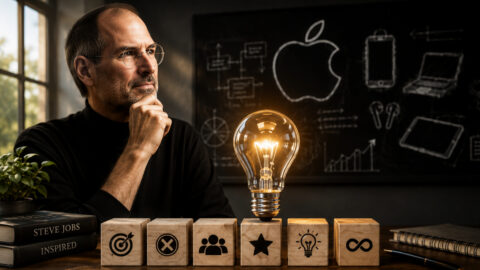
The legend of Apple’s revival revolves around the lone genius of Steve Jobs. It was his conviction and clarity of vision, the story goes, that gave birth to the iPhone. The reality is that he was dead-set against the mobile phone category. His employees had the vision for it, and it was their ability to change his mind that really revived Apple. Although Jobs knew how to “think different,” it was his team that did much of the rethinking.

In 2004, a small group of engineers, designers, and marketers pitched Jobs on turning their hit product, the iPod, into a phone. “Why the f@*& would we want to do that?” Jobs yelled. “That is the dumbest idea I’ve ever heard.” The team had recognized that mobile phones were starting to feature the ability to play music, but Jobs was worried about cannibalizing Apple’s thriving iPod business. He hated cell phone companies and didn’t want to design products within the constraints that carriers imposed. When his calls dropped or the software crashed, he would sometimes smash his phone to pieces in frustration. In private meetings and on public stages, he swore over and over that he would never make a phone.

Dramatic Leap in Rethinking (iPhone)

Yet some of Apple’s engineers were already doing research in that area. They worked together to persuade Jobs that he didn’t know what he didn’t know and urged him to doubt his convictions. It might be possible, they argued, to build a smartphone that everyone would love using—and to get the carriers to do it Apple’s way.

The engineers who worked closely with Jobs understood that this was one of the best ways to convince him. They assured him that they weren’t trying to turn Apple into a phone company. It would remain a computer company—they were just taking their existing products and adding a phone on the side. Apple was already putting twenty thousand songs in your pocket, so why wouldn’t they put everything else in your pocket, too? They needed to rethink their technology, but they would preserve their DNA. After six months of discussion, Jobs finally became curious enough to give the effort his blessing,

Two different teams were off to the races in an experiment to test whether they should add calling capabilities to the iPod or turn the Mac into a miniature tablet that doubled as a phone. Just four years after it launched, the iPhone accounted for half of Apple’s revenue. The iPhone represented a dramatic leap in rethinking the smartphone. Since its inception, smartphone innovation has been much more incremental, with different sizes and shapes, better cameras, and longer battery life, but few fundamental changes to the purpose or user experience. The curse of knowledge is that it closes our minds to what we don’t know. Good judgment depends on having the skill—and the will—to open our minds.

Featured reads

RELATED POSTS

Stop Over-Conscious Parenting: Raising Confident Kids

Great Entrepreneurs Aren’t Perfect—But They Build the Future

Why the World Needs More Risk-Takers, Not More Critics

Escaping the Traffic Jam of Stress, Salary & Spreadsheets

Why Saving Money Is Like Dieting—Easier Said Than Done

Meetings: Where Minutes Are Taken and Hours Are Lost

Mindful Shots, Volume-1 cover
Mindful Shots, Volume-1
Vinod Singh
Self-Help, Mindfulness

Mindful Shots, Volume-1

Vinod Singh

4.5 · reviews

Most people live their entire lives without truly understanding how their minds work or the immense power they hold within. Fewer than two percent of people can confidently answer questions like: What drives my thoughts? Why do I feel resistance to my own goals? You’ve likely experienced moments when you wanted to take a bold step—perhaps starting a new business or making a life-changing decision—only to hear an inner voice warning you of failure. That voice often justifies its fears by recalling countless stories of others’ setbacks—family members, friends, society, even distant headlines. It’s as if your mind maintains a detailed archive of every failure around you, replaying them to keep you from moving forward. But what if this inner voice could be understood, reprogrammed, and even turned into your greatest ally? Imagine what would be possible if both your conscious intentions and subconscious patterns worked together instead of pulling in opposite directions. This collection, Mindful Shots, brings together some of the most insightful writings on mindfulness from Fastlane Freedom. Each piece explores practical and scientific perspectives on how the mind shapes our choices, influences our health, and even participates in physical healing. Through research-backed insights and timeless wisdom, this book will help you see that the mind isn’t just a passive observer—it’s an active force capable of changing your reality. By learning how to quiet the noise, shift your mental inputs, and harness your inner voice, you’ll gain a clearer path to personal growth, emotional balance, and a deeper understanding of what mindful living truly means.

Amazon Flipkart
Parenting Essentials cover
Parenting Essentials
Vinod Singh
Self-Help, Parenting

Parenting Essentials

Vinod Singh

4.5 · reviews

Parenting is a journey—one of the most rewarding, challenging, and transformative experiences life has to offer. But it’s not a path we are meant to walk alone. Essential Parenting was born out of a deep desire to support and empower parents at every stage of their journey, from the early days of pregnancy to the complex teenage years. Drawing insights from the Fastlane Freedom platform, this book brings together wisdom, mindfulness, and practical strategies to help you raise confident, emotionally strong, and value-driven children. At Fastlane Freedom, we believe that conscious parenting begins with self-awareness. Children absorb more from our behaviour than our words. It’s in our everyday actions—our calm during chaos, our patience in moments of frustration, our consistency in values—that they find their foundation. Parenting is not about being perfect; it’s about being present, intentional, and compassionate.

Amazon Flipkart
The Wealth Code, Volume-1 cover
The Wealth Code, Volume-1
Vinod Singh
Self-Help, Finance

The Wealth Code, Volume-1

Vinod Singh

4.5 · reviews

The Wealth Code: Volume-1 is a personal development and financial education book written by Vinod Singh. It is designed to empower readers by teaching them principles of wealth creation, financial freedom, and personal growth. The book offers practical strategies to achieve financial success, with a vision to uplift and transform the lives of millions by promoting financial literacy and entrepreneurial thinking. Mr. Singh's approach is rooted in inspiring individuals to take control of their financial destinies while cultivating a mindset focused on long-term success and abundance.

Amazon Flipkart
ShareSendTweetPinShareShareShareShareShareShareBookmarkShare
Vinod Singh

Vinod Singh

In 2019, Vinod Singh, a Belief Changer, founded Fastlane Freedom after 3.5 years of research on Mindfulness and its connection to money. Fastlane Freedom is driven by a vision: ‘Enhancing Lives of Millions’ by reshaping people’s beliefs to transform their financial situations. With 16 years of professional experience, Vinod dedicates himself to providing top-notch, practical content on Mindfulness, Money, Business, Parenting, Popular Quotes and Student Life.

Related Posts

Stop Over-Conscious Parenting

Stop Over-Conscious Parenting: Raising Confident Kids

June 21, 2026
Great Entrepreneurs Aren't Perfect

Great Entrepreneurs Aren’t Perfect—But They Build the Future

June 17, 2026
The World Needs More Risk-Takers

Why the World Needs More Risk-Takers, Not More Critics

June 15, 2026
Escaping the Traffic Jam of Stress, Salary & Spreadsheets

Escaping the Traffic Jam of Stress, Salary & Spreadsheets

June 7, 2026
Saving Money Is Like Dieting

Why Saving Money Is Like Dieting—Easier Said Than Done

June 6, 2026
meetings

Meetings: Where Minutes Are Taken and Hours Are Lost

June 2, 2026
Analysis paralysis

Analysis Paralysis: The Silent Success Killer Nobody Talks About

May 31, 2026
The Power of Selective Blindness

The Power of Selective Blindness: Why Success Often Requires Ignoring the Noise

May 29, 2026
The Market Rewards Patience, Not Panic

The Market Rewards Patience, Not Panic – Fastlane Freedom

May 28, 2026
Load More

Support Ad-Free Content

Dear Valued Reader,

At Fastlane Freedom, we believe in delivering the highest quality content without the distraction of ads. Our platform is dedicated to enriching your life with insightful blogs on Mindfulness, Financial Wisdom, Business Strategies, Student Success, and Effective Parenting.

To keep our content free from ads and accessible to all, we need your support. Your donation helps us maintain our commitment to providing valuable, ad-free resources that empower you to thrive in every aspect of life.

Join us in our mission to “Enhancing Lives of Millions” by fostering knowledge and growth. Every contribution is invaluable and directly enhances the quality and accessibility of our content. Donate now and help us continue to make a difference!

Support Now

Main Category

  • Mindfulness
  • Money
  • Grow Business
  • Essential Reading
  • Popular Quotes
  • Student
  • Parenting
  • Videos
  • About
  • Contact

Money

  • Power of Compounding
  • Learn from Rich People
  • Power of Saving
  • Money Tips
  • Financial Freedom
  • Debt Management

Grow Business

  • Business Tips
  • Workplace Practices
  • Marketing Tips
  • Entrepreneurship
  • Success Rules
  • Leadership
  • Productivity Improvement

Mindfulness

  • Subconscious Mind
  • Growth Mindset
  • Overcome Fear
  • Success Habits
  • Achieve Goals
  • Happiness Secrets

Parenting

  • Before Birth Facts
  • Health and Wellness
  • Parenting Tips and Strategies

Student

  • Early Success Secrets
  • Study Tips
  • Career Goals

© 2026 fastlanefreedom.com - Design and Manage by Binary Techne.

No Result
View All Result
  • Money Blogs
  • Essential Reading
  • Mindfulness
  • Grow Business
  • Parenting
  • Student
  • Popular Quotes
  • About
  • Contact

© 2026 fastlanefreedom.com - Design and Manage by Binary Techne.