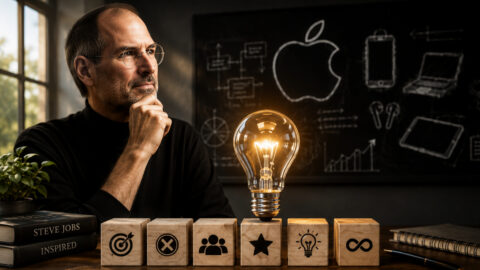
When we talk about business legends, Steve Jobs and Elon Musk stand at the very top. They didn’t just build companies; they shaped the future. Their products, ideas, and leadership styles changed how the world thinks about technology and progress. But if you strip away the glamour, the genius, and the headlines, one habit sits quietly at the core of both men’s success: focus.
Both Jobs and Musk mastered the art of directing their time, energy, and attention toward what truly mattered — and eliminating everything else. Jobs followed what he called an 80:20 signal-to-noise ratio, meaning that 80% of his time was devoted to the small fraction of things that actually made a difference. Musk, on the other hand, takes it to the extreme. His approach isn’t 80:20; it’s closer to 100:0 — total concentration on the mission, with zero tolerance for distraction.
The way they practiced this focus wasn’t just a productivity trick. It was a worldview, a discipline, and in many ways, a personal philosophy. To understand how they achieved what they did, we have to understand how they thought about time, attention, and clarity.
Steve Jobs and the 80:20 Principle
Steve Jobs didn’t just work hard — he worked with precision. He was known for his marathon 16-to-18-hour workdays, but contrary to what people might imagine, he didn’t fill those hours with endless meetings or scattered tasks. He poured his energy into just a few things that truly mattered — three to five mission-critical priorities that shaped Apple’s direction.
He understood something most leaders miss: being busy isn’t the same as being effective. In fact, most activity in business is noise — tasks that make you feel productive but move you nowhere. Jobs refused to let Apple fall into that trap. He practiced what could be called “ruthless prioritization.”
If a project didn’t fit Apple’s larger vision, it was out. If a meeting didn’t serve a clear purpose, it was cancelled. If a design idea wasn’t excellent, it was rejected. Even entire product lines were axed because they diluted focus. When Jobs returned to Apple in 1997, he famously cut 70% of its product lineup to focus on just a few — the Mac, iPod, and later, the iPhone. That bold simplification set the stage for Apple’s greatest innovations.
He once said, “Deciding what not to do is as important as deciding what to do.” That mindset wasn’t about minimalism for its own sake. It was about building momentum by concentrating force. By saying “no” to almost everything, Jobs could say an emphatic “yes” to what truly mattered.
The 80:20 principle — that 80% of results come from 20% of actions — was his operating system for life. It allowed him to turn focus into leverage. And when you multiply that focus by Apple’s talent, design thinking, and customer obsession, you get one of the most valuable companies in human history.
Ruthless Focus: The Price of Greatness
Jobs’ leadership style often divided people. He wasn’t known for being patient or soft-spoken. He could be brutally honest, sometimes even cutting. But behind that sharpness was clarity — an unwavering belief that excellence requires hard choices and emotional discipline.
He didn’t want yes-men; he wanted truth-tellers and doers. He didn’t lead with comfort; he led with conviction. If a prototype wasn’t perfect, he’d send it back again and again until it met his standards. Many found this exhausting. But for those who shared his passion, it was electric. They weren’t just building gadgets; they were changing the world.
This kind of intensity comes at a price. It requires saying no to comfort, to approval, and often to balance. Jobs wasn’t trying to be everyone’s favourite boss — he was trying to create a company that would outlast him. He understood that real leadership isn’t about making people happy in the short term; it’s about building something meaningful in the long term.
And that’s the uncomfortable truth about greatness: focus is not gentle. It cuts through excuses, habits, and distractions. It demands sacrifice. But as Jobs proved, it’s also what transforms ordinary work into art.
Signal vs. Noise: The Invisible Battle
Every one of us wakes up to two competing forces: signal and noise.
The signal represents clarity — the few things that move us closer to our mission. It’s the big idea, the strategic project, the moment of deep creative work that defines your career or business. The noise, on the other hand, is everything that demands attention but adds little value — endless emails, Slack messages, shallow tasks, and meetings that go nowhere.
Jobs mastered the ability to filter one from the other. He wasn’t driven by what was urgent; he was guided by what was important. His famous “Apple simplicity” wasn’t just about design — it was a philosophy. He simplified Apple’s structure, its products, even its marketing. The reason you can recognize an Apple product instantly isn’t just because of its logo, but because of its clarity — no extra buttons, no clutter, no confusion. Every decision served a purpose.
In our world today, that battle between signal and noise has become even louder. We live in the age of distraction — constant notifications, social feeds, multitasking, and mental clutter. We confuse movement with progress and communication with clarity. As Jobs would likely say, we are “busy being busy.”
Learning to distinguish signal from noise might be the single most valuable skill of the 21st century. Every time you stop checking your phone to finish deep work, every time you say no to another pointless meeting, you’re reclaiming your signal.
Elon Musk: From 80:20 to 100:0
If Jobs worked with an 80:20 ratio, Elon Musk operates closer to 100:0. His intensity redefines focus itself. While Jobs concentrated on three or four key things at Apple, Musk manages entire industries — rockets, cars, AI, tunnels, satellites, and more — yet applies the same rule: total commitment to mission-critical work.
Kevin O’Leary once remarked that Jobs ran Apple on an 80:20 signal-to-noise ratio, but Musk runs his companies on “100% signal.” He eliminates anything that doesn’t directly advance his goals. He doesn’t attend ceremonial events, avoids unnecessary media appearances, and famously told his employees, “If a meeting isn’t useful, walk out.”
For Musk, every second counts. Time, to him, is the scarcest resource on Earth — more valuable than money, talent, or even technology. He’s known to sleep on factory floors, work through weekends, and divide his week between companies. This relentless dedication may look extreme, but it produces results that normal routines can’t achieve.
There’s also a cost to this 100:0 intensity. Musk has spoken about burnout, stress, and the weight of responsibility. His critics call him chaotic, impulsive, or even reckless. But in his own words, “If something is important enough, you do it even if the odds are not in your favor.”
That’s not just focus — it’s obsession powered by vision. And that obsession has pushed humanity closer to multi-planetary life, clean energy, and AI innovation. If Jobs’ focus built Apple, Musk’s focus is building the future itself.
Applying the 80:20 Mindset to Your Own Life
You don’t have to run Apple or SpaceX to apply these principles. Focus isn’t just for billionaires — it’s the foundation for anyone who wants to create meaningful impact in work and life.
Start by identifying your core mission. What truly matters to you? What’s your version of Apple’s iPhone or SpaceX’s rocket? It could be your business, a creative goal, or even a personal transformation. If you can’t define your signal, you’ll spend your life reacting to noise.
Once your mission is clear, simplify your days. You don’t need a long to-do list. Pick three to five key actions that will drive real progress. Tackle those first. This isn’t about doing less; it’s about doing what matters most. Focus gives your time direction.
Next, learn to say no with purpose. Every “yes” has a cost. When you agree to things that don’t align with your signal, you dilute your energy and weaken your focus. Saying no doesn’t make you rude — it makes you responsible for your own priorities.
Also, remember that focus isn’t popular. People may misinterpret it as arrogance or obsession. They’ll ask why you don’t attend every event, why you don’t reply instantly, or why you seem “too serious.” But every great leader — from Jobs to Musk — has faced that misunderstanding. The truth is, focus looks strange in a world addicted to distraction.
Finally, create a personal signal filter. Before saying yes to any task or opportunity, ask yourself: Is this signal or noise? If it’s noise, drop it. If it’s signal, commit to it fully. This small mental filter can reshape your productivity, mindset, and peace of mind.
The Real Lesson: Focus Is Freedom
Steve Jobs’ life wasn’t balanced — but it was meaningful. He turned simplicity into strength and focus into a superpower. He made it clear that doing fewer things, but doing them with excellence, is the path to mastery.
Elon Musk continues that legacy differently. His life is chaos on the surface, but there’s a deep order underneath: a mission so clear that every action connects to it. He’s not chasing balance; he’s chasing impact.
Both men show us something timeless — focus is not limitation; it’s liberation. When you eliminate distractions, you gain freedom from noise, indecision, and wasted energy. Your work becomes deeper, your results stronger, and your purpose sharper.
So tomorrow morning, before you open your inbox or scroll through your phone, pause for a moment and ask yourself one simple question: “What’s my signal today?”
Because everything great — every company, every idea, every movement — starts when someone chooses to focus on the signal and ignore the noise.