We live in an era where opinions travel faster than actions. A startup launches in Bengaluru, and within hours people across the world are predicting its failure. A scientist announces a breakthrough, and social media immediately fills with doubts, jokes, and accusations. A teacher experiments with a new way of teaching, a young artist shares original work, or an entrepreneur introduces a bold idea, and criticism often arrives before understanding.
Criticism itself is not a problem. In fact, constructive criticism is essential for human progress. Democracies depend on citizens questioning authority. Scientific discoveries become stronger through peer review. Organizations improve when employees can speak honestly about what is not working. Healthy criticism identifies weaknesses and encourages better thinking. It acts as a safeguard against arrogance and blind spots.
The challenge arises when criticism becomes more fashionable than contribution. Modern technology has made it incredibly easy to point out flaws from a safe distance. It takes only a few seconds to dismiss someone’s effort with a sarcastic comment or a clever remark. Building something meaningful, however, requires months or years of effort, uncertainty, sacrifice, and persistence. The imbalance is striking. We have created a culture where opinions are abundant but courage is increasingly rare.
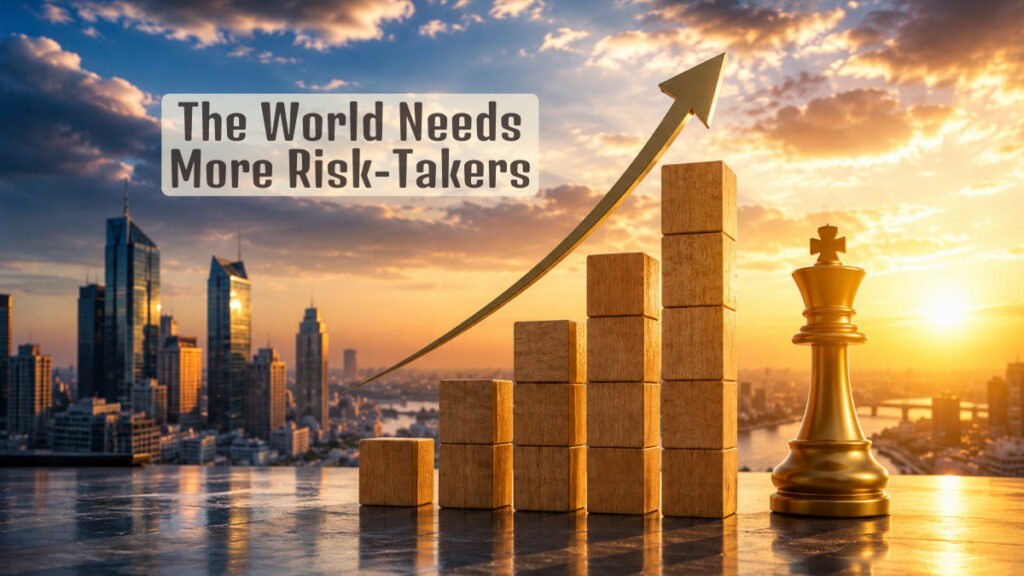
History teaches us that the world has never advanced because people perfected the art of commentary. It moved forward because individuals chose action despite uncertainty. Every invention, institution, and innovation that improves our lives today exists because someone accepted the possibility of failure in exchange for the possibility of progress. The future will not belong to those who merely explain why things cannot be done. It will belong to those willing to attempt what others hesitate to try.
“Only those who will risk going too far can possibly find out how far one can go.” – T.S. Eliot
The People Who Move Humanity Forward
Civilization has always been shaped by individuals who took risks before certainty existed. Long before their names appeared in textbooks, these people faced skepticism, ridicule, and repeated setbacks. They moved forward not because success was guaranteed but because standing still felt unacceptable.
Consider the Wright brothers. At a time when many experts believed human flight was impossible, two bicycle mechanics from Ohio dared to think differently. Their experiments failed repeatedly. They encountered criticism and disbelief from people who had never attempted such a feat themselves. Yet their persistence transformed transportation and permanently altered the way the world connects.
The same pattern appears across cultures and continents. Thomas Edison reportedly tested thousands of unsuccessful prototypes before creating a commercially viable electric light bulb. Marie Curie worked under extraordinary constraints to pioneer research on radioactivity, becoming the first person to win Nobel Prizes in two separate scientific fields. Nelson Mandela risked his freedom and ultimately spent twenty-seven years in prison while fighting apartheid, changing the political future of South Africa. These individuals did not operate with certainty. They operated with conviction.
India offers powerful examples of risk-taking as well. Dhirubhai Ambani began with modest means and built one of India’s largest business empires by challenging accepted limitations. Nandan Nilekani helped shape India’s technology revolution through Infosys and later contributed to Aadhaar, the world’s largest biometric identity program, expanding access to services for millions of citizens. Verghese Kurien, often called the Father of the White Revolution, transformed India from a milk-deficient nation into one of the world’s largest milk producers through the cooperative movement.
China’s economic transformation also illustrates the importance of entrepreneurial courage. Over the past few decades, millions of people escaped poverty partly because entrepreneurs built businesses in manufacturing, technology, and commerce despite uncertainty and changing regulations. Across Africa, innovators have developed solutions tailored to local challenges. Kenya’s M-Pesa revolutionized mobile payments and financial inclusion, allowing millions without access to traditional banks to participate in the economy. Nigeria’s startup ecosystem continues to generate innovations in healthcare, logistics, education, and agriculture.
The lesson remains remarkably consistent. The people who move humanity forward are rarely those waiting for ideal circumstances. They are the individuals who decide that the possibility of creating something valuable outweighs the fear of criticism.
What the Evidence Says
The importance of risk-takers is not simply philosophical or inspirational. It is supported by evidence from around the world. Economies grow stronger, societies become more resilient, and opportunities expand when people are encouraged to experiment, innovate, and build.
According to the Organisation for Economic Co-operation and Development (OECD), young firms account for roughly 20 percent of employment across OECD economies while creating nearly half of all new jobs. These businesses inject fresh ideas into markets, challenge established organizations, and stimulate economic activity. Without new ventures willing to take risks, job creation slows and economies become less dynamic.
Eurostat, the statistical office of the European Union, reports that young enterprises experience average annual employment growth rates exceeding 12 percent during their first five years. While not every business survives, those that succeed generate opportunities far beyond their founders. Employees gain livelihoods, suppliers gain customers, consumers gain choices, and governments receive tax revenues that support public services.
The Global Entrepreneurship Monitor (GEM), one of the world’s largest studies of entrepreneurship covering dozens of economies, consistently highlights the role of entrepreneurs in strengthening resilience and creating opportunities. Recent GEM findings show that entrepreneurial intentions remain strong despite inflation, geopolitical tensions, and economic uncertainty. Interestingly, several African economies rank among the highest in entrepreneurial activity, demonstrating that innovation is not restricted to wealthy nations.
Scientific progress follows a similar pattern. Pharmaceutical companies often invest billions of dollars in research projects that may never reach the market. Estimates suggest that only a small fraction of drug candidates entering clinical trials eventually receive approval. Yet without accepting these risks, medical breakthroughs would be impossible. The vaccines, treatments, and technologies that save millions of lives each year exist because researchers continued despite repeated failures.
These statistics reveal an important truth. Failure is not evidence that risk-taking is wasteful. Failure is often the unavoidable cost of discovery. Societies that understand this principle create environments where experimentation is encouraged rather than punished. Those that fear failure excessively often sacrifice long-term progress for short-term comfort.
The Hidden Cost of Playing Safe
Many people believe avoiding risks protects them from disappointment. While caution has its place, excessive caution carries its own consequences. The dangers of inaction are often less visible than the dangers of action, but they can be equally profound.
A student may avoid pursuing an unconventional career path because of fear of judgment. An employee may remain silent despite having an idea that could improve an organization. A talented individual may postpone launching a business year after year, waiting for the perfect moment that never arrives. Parents may continue unhealthy generational patterns simply because changing them feels uncomfortable. The immediate reward is safety. The long-term cost is unrealized potential.
Psychologist Carol Dweck’s research on growth mindset offers valuable insight into this phenomenon. Individuals with a growth mindset tend to interpret setbacks as opportunities to learn and improve. Those with a fixed mindset often interpret failure as evidence of personal inadequacy. This distinction influences whether people embrace challenges or avoid them entirely.
James Dyson built more than 5,000 prototypes before creating the vacuum cleaner that ultimately transformed his company into a global enterprise. J.K. Rowling faced numerous rejections before the Harry Potter series found a publisher. Colonel Harland Sanders reportedly encountered repeated rejection before establishing Kentucky Fried Chicken. Their stories are powerful not because they avoided failure but because they refused to let failure define their future.
There is another hidden consequence of avoiding risks: regret. Studies on end-of-life reflections frequently reveal that people regret opportunities they never pursued more than failures they experienced while trying. The pain of embarrassment fades. Financial losses can often be recovered. Skills can be rebuilt. But the persistent question of “What if I had tried?” can remain for decades.
Playing safe may appear responsible in the short term. Yet over the course of a lifetime, refusing to act often becomes the greatest risk of all.
Critics and Builders
Every society contains both critics and builders. The distinction is not that critics are intelligent while builders are naive. Rather, the difference lies in responsibility.
Constructive critics seek improvement. They challenge assumptions, identify weaknesses, and offer solutions. Their feedback strengthens ideas and protects against avoidable mistakes. Societies need such voices because they elevate standards and encourage accountability.
Destructive critics, however, derive satisfaction from judgment without participation. They point out flaws without attempting alternatives. They dismiss ideas without understanding the effort required to create them. Their primary contribution is commentary rather than progress.
Theodore Roosevelt captured this distinction beautifully in his famous “Man in the Arena” speech. He argued that credit belongs not to the critic who points out how others stumble but to the person actually striving, whose face is marred by dust, sweat, and effort. The person in the arena may fail repeatedly, but at least they dared greatly.
Modern digital culture often rewards the opposite behaviour. Social media algorithms amplify outrage because outrage drives engagement. Sarcasm spreads faster than thoughtful analysis. Negative commentary can generate attention without requiring accountability. As a result, many people become reluctant to share ideas, fearing public humiliation more than missed opportunities.
Research published in Harvard Business Review consistently emphasizes the importance of psychological safety in organizations. Teams perform better when individuals feel safe expressing ideas, experimenting, and occasionally making mistakes without fear of ridicule. Innovation thrives where people are encouraged to contribute rather than merely criticize.
This does not mean abandoning standards or celebrating recklessness. It means recognizing that excellence emerges through iteration. The first attempt is rarely perfect. The first draft requires revision. The first prototype exposes flaws. If societies punish every imperfection, they discourage the very experimentation that leads to progress.
The Risks the Future Demands
Humanity stands at a remarkable moment in history. The challenges we face are complex, interconnected, and unprecedented. Climate change requires breakthroughs in energy, agriculture, and sustainability. Healthcare systems must adapt to aging populations and emerging diseases. Artificial intelligence is reshaping industries and redefining work itself. Education systems are preparing students for careers that may not yet exist.
These problems cannot be solved through observation alone. They demand action from people willing to experiment responsibly. Scientists must pursue uncertain hypotheses. Entrepreneurs must invest time and resources into unproven ideas. Policymakers must pilot new approaches rather than relying exclusively on outdated models. Teachers must rethink traditional methods of learning. Parents must prepare children not merely to follow instructions but to adapt, create, and lead.
The World Economic Forum consistently identifies creativity, resilience, adaptability, critical thinking, and problem-solving among the most important skills for the future workforce. None of these qualities develop in environments where people avoid uncertainty. They emerge when individuals confront challenges, recover from setbacks, and continue learning.
It is important to distinguish courage from recklessness. Responsible risk-taking involves preparation, ethical considerations, learning, and thoughtful decision-making. The entrepreneur conducts research before launching. The investor diversifies rather than gambling irresponsibly. The scientist follows rigorous standards. Courage without wisdom becomes recklessness. Wisdom without courage becomes stagnation.
The world does not need more reckless gamblers chasing attention. It needs more thoughtful individuals willing to act despite incomplete information. Waiting for absolute certainty often means waiting forever. The future favours those prepared to make informed decisions and adjust as they learn.
Choosing the Arena
Ultimately, the choice between contribution and commentary belongs to each of us. We do not need extraordinary wealth, influence, or talent to become risk-takers. We simply need the willingness to act.
You become a risk-taker when you finally begin the project you have postponed for years. You become a risk-taker when you have a difficult but necessary conversation. You become a risk-taker when you return to education after believing it is too late. You become a risk-taker when you challenge harmful family patterns and choose a healthier path for the next generation. You become a risk-taker whenever you create rather than merely consume.
The world we enjoy today was built by people who accepted criticism as part of the process. Someone risked ridicule to invent the technologies we now consider indispensable. Someone risked financial security to build companies that employ millions. Someone risked reputation to challenge accepted beliefs and expand human understanding.
Progress has never depended on perfection. It has depended on participation.
Perhaps the greatest challenge of our age is not a shortage of intelligence, information, or opinions. We possess those in abundance. What we increasingly lack is the courage to transform ideas into action. The world does not need fewer thoughtful critics. It simply needs far more builders, creators, problem-solvers, and ordinary individuals willing to step into the arena.
History has never been changed by those who stood safely on the sidelines explaining why something could not be done. It has always been shaped by those who tried anyway. Their attempts were imperfect. Their journeys were uncertain. Their failures were real.
But because they dared to act, the world moved forward.