Most people think changing their life is mainly a matter of willpower. If you want to become fit, you need more discipline. If you want to save money, you need stronger self-control. If you want to stop using your phone, you simply need to decide not to use it so much.
But there is a problem with this approach. Your willpower does not operate in isolation. Every day, your surroundings are constantly giving you signals, creating temptations, making some choices easier and others harder. Your home, workplace, friends, phone, food availability and daily routines are quietly influencing your behaviour.
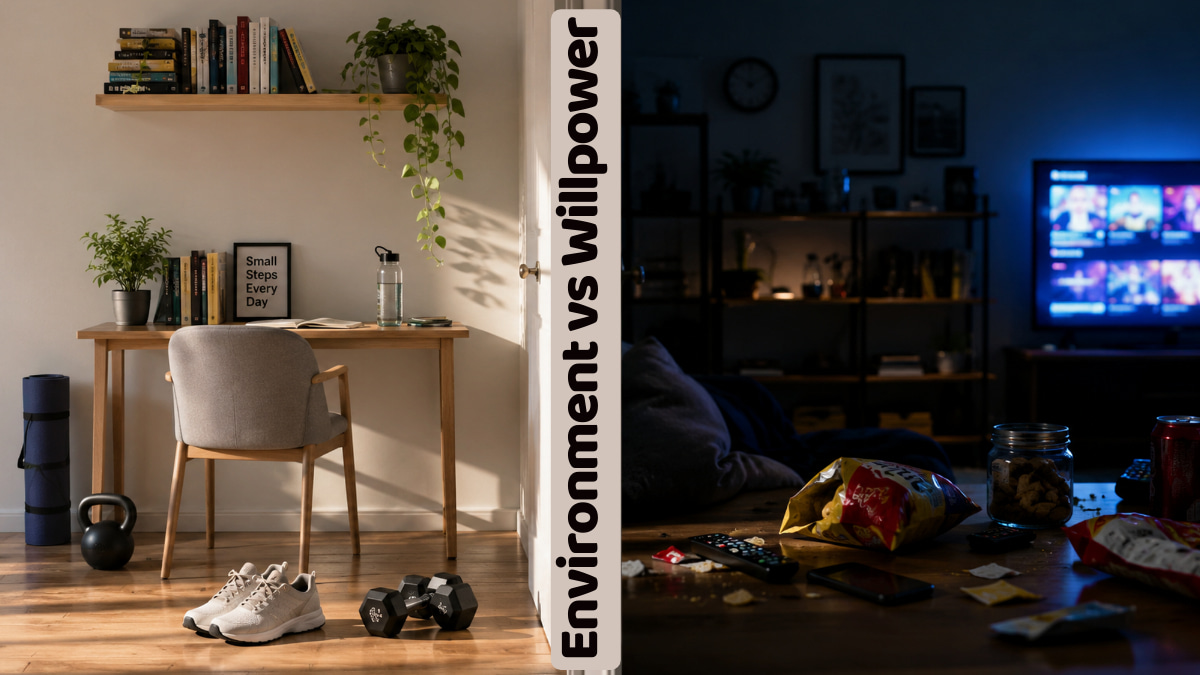
Imagine two people who both decide to exercise every morning. One keeps workout clothes beside the bed, prepares everything the night before and has a gym close to home. The other sleeps with the phone beside the pillow, stays up late, has to search for workout clothes in the morning and travels 30 minutes to reach the gym.
Both may have the same goal. Both may even have the same motivation. But the second person has created a daily environment that makes success harder.
This is why sometimes the smartest way to improve your behaviour is not to demand more from yourself. It is to change what surrounds you.
“Don’t depend on willpower to fight your environment; redesign your environment to support your goals.”
Willpower Is Not Enough
Willpower is valuable, but relying on it for every decision is a poor long-term strategy. Every time you resist a distraction, avoid an unnecessary purchase or say no to tempting food, you are making a conscious decision.
But many everyday behaviours do not happen after long internal debates. They happen almost automatically.
Research by psychologists Sheina Orbell and Bas Verplanken found that habits are closely connected to cues in the environment. Their research described habitual behaviour as a cue-response process, where familiar situations can automatically activate familiar behaviours.
Think about what happens when you enter your kitchen. You may automatically open the refrigerator. When you sit on your sofa, you may pick up your phone. When you get into your car, you may automatically turn on music.
You do not make a fresh decision every time.
The environment has become connected with the behaviour.
That explains why simply saying, “I will have more discipline tomorrow,” often fails. If tomorrow looks exactly like today, the same cues are still there.
Suppose you want to stop eating unhealthy snacks. If your kitchen contains biscuits, chips and chocolate sitting in visible places, you will repeatedly encounter cues associated with eating them. You can resist them, but you have created unnecessary battles.
Now imagine changing the environment. Keep healthier food visible and convenient while making unhealthy food less accessible. The goal is exactly the same, but the number of temptations you encounter has changed.
You are not depending entirely on willpower anymore.
You are designing the situation in your favour.
Small Changes Can Change Choices
One of the strongest areas of research supporting this idea comes from what behavioural scientists call choice architecture.
Choice architecture means changing the way options are presented without necessarily removing people’s freedom to choose.
A particularly useful real-world example comes from Massachusetts General Hospital. Researchers led by Anne Thorndike studied food purchases in a large hospital cafeteria. They first introduced traffic-light labels, using colours to indicate healthier and less healthy choices. Later, they changed the placement and convenience of healthier products.
The cafeteria had an enormous amount of real-world purchasing data—more than 977,000 items were included in the baseline analysis. After the intervention, sales of red-labelled beverages fell by 16.5% during the first phase and another 11.4% during the second phase. Sales of green beverages increased 9.6% and then another 4.0%. Bottled-water purchases increased 25.8% after the choice-architecture changes.
This is important because nobody was forced to make a healthier choice.
The unhealthy products were still available.
The environment simply made healthier choices more visible and convenient.
A later longitudinal study at the same hospital provides another interesting case. Researchers followed 5,695 employees before and after a cafeteria program combining traffic-light labels with changes in product placement. Average calories purchased per transaction fell by 19 calories after one year and 35 calories after two years. Purchases of red-labelled items fell substantially, while purchases of green-labelled items increased.
This does not prove that changing a cafeteria automatically makes everyone healthier. It does show something much more practical: the structure surrounding a decision can influence the decision itself.
Convenience Shapes Behaviour
We often underestimate the power of convenience.
If something takes two seconds, we are much more likely to do it than if it requires ten additional steps.
Think about your phone. Social media is designed to be available instantly. Open the app, and new content is already waiting. There is almost no friction between wanting stimulation and receiving it.
Now compare that with reading a book. You have to find the book, open it and decide where to start.
This difference may seem tiny, but repeated thousands of times, small differences matter.
The same principle applies to money. If shopping websites remember your payment details, send notifications and make purchasing possible with a few clicks, spending becomes extremely convenient. If saving requires you to manually transfer money every month, saving becomes another task you must remember.
The answer is not necessarily stronger discipline.
It may be better design.
Automating savings, for example, removes a decision from your daily life. You don’t have to repeatedly convince yourself to save. The system does part of the work.
This principle also explains why keeping your running shoes beside the door can be more useful than writing another motivational quote on your wall. The shoes are a behavioural cue connected directly to the action.
Make the desired behaviour easier.
Make the unwanted behaviour slightly harder.
Your Social Environment Counts
Your environment is not only your physical surroundings. The people around you are also part of your environment.
Your friends, colleagues, family members and online communities influence what feels normal.
If everyone around you constantly talks about spending, expensive lifestyles and instant gratification, those behaviours may gradually seem normal. If the people around you regularly discuss books, business, health, learning or long-term goals, those behaviours can also become normal.
This does not mean you need to abandon everyone who behaves differently from you. It means you should become conscious of the environments you repeatedly expose yourself to.
The same principle applies to digital environments.
Your social-media feed is an environment.
The YouTube recommendations you repeatedly watch are an environment.
The WhatsApp groups you spend hours in are an environment.
The websites you open automatically are an environment.
If your digital environment constantly pushes you toward distraction, comparison and impulsive consumption, you are asking willpower to fight an enormous battle every day.
Changing the feed can sometimes be more effective than repeatedly telling yourself, “I need more focus.”
But Environment Is Not Magic
There is an important qualification.
It would be wrong to claim that environment controls human behaviour completely. People are not machines. Motivation, personality, financial circumstances, knowledge, stress and individual preferences all matter.
Research on choice architecture also shows that environmental interventions do not always work equally well.
For example, a review discussing supermarket interventions noted that simply placing healthier products more prominently does not always overcome people’s established preferences for particular brands or habitual choices. Researchers have suggested that placement may work better when combined with other approaches such as pricing, defaults or clearer information.
This is actually good news.
It means the lesson is not “change one thing and your life will transform.”
The better lesson is: stop expecting one tool—especially willpower—to solve everything.
Use motivation when you have it.
Use discipline when necessary.
But also redesign the environment so that you need less of both.
A systematic review of adult food-purchasing studies found evidence that several types of nudges—including changes in salience, prompts and defaults—can influence healthier purchasing, although the strength of evidence varies by intervention.
The science therefore supports a balanced conclusion: environment matters, but it works as one part of a larger behavioural system.
Design Your Default Life
The most powerful environment is often the one you barely notice.
If you want to read more, leave a book where you normally sit.
If you want to exercise, prepare your clothes and equipment before you sleep.
If you want to eat better, make healthy food the easiest food to reach.
If you want to spend less, remove unnecessary shopping notifications and create automatic savings.
If you want deeper concentration, keep distracting apps away from your work environment.
If you want to sleep earlier, stop making your bedroom an entertainment center.
You are creating defaults.
And defaults matter because you do not make every decision from scratch.
Think about a cafeteria. If fruit is placed conveniently at the beginning of the serving line and unhealthy options are less prominent, the environment is influencing the decision. A randomized clinical trial involving 2,638 students in 14 schools found that changes involving school food presentation and choice architecture affected the selection of fruits and vegetables, although improving the actual taste of food was particularly important for increasing consumption.
That final point is especially valuable. Environment should not be viewed as a magic trick. The strongest solutions often combine several factors: availability, convenience, attractiveness, quality and repeated exposure.
The same principle applies to your life.
Don’t just ask, “How can I become more disciplined?”
Ask, “What is my environment repeatedly encouraging me to do?”
Look around your bedroom.
Look at your kitchen.
Look at your phone.
Look at your workplace.
Look at your bank account setup.
Look at the people you spend the most time with.
Then ask one powerful question:
“If I continue living in this exact environment for the next five years, what kind of person will it turn me into?”
That question can be uncomfortable.
But it can also be transformative.
Because your future is not created only by the big decisions you make occasionally. It is being shaped by the small choices your environment makes easier every single day.
You don’t need to win a battle against yourself every morning.
Build a life where the right choice is easier to make.
Because when your environment constantly supports the person you want to become, willpower stops being your only defense.
And that is the real secret:
The strongest people are not always the ones with the strongest willpower. Sometimes, they are simply living in environments that make discipline easier.