
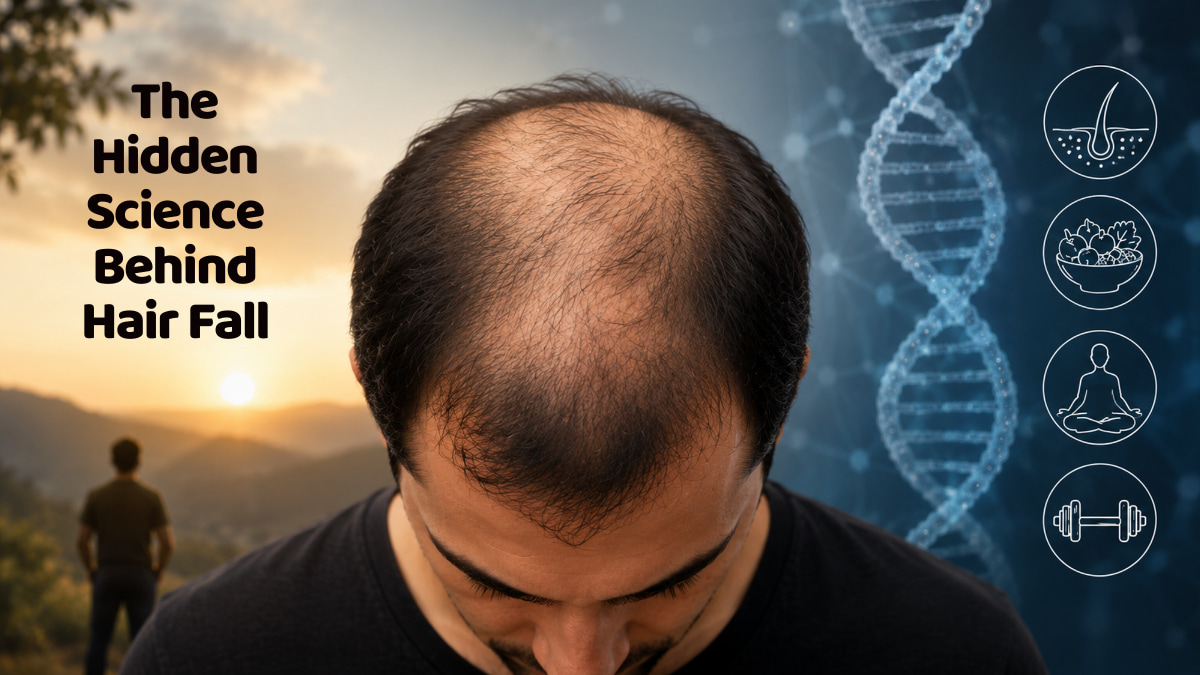
The moment a young person notices extra hair on the pillow, thinning near the forehead, or a receding hairline, one thought often appears immediately: “Is my future already decided?” Many people then hear a statement that creates fear: “Your father is bald, so you will also become bald.” While family history does influence the possibility of hair loss, the way this information is communicated can have a powerful psychological impact.
For many young people, this statement does not remain just a medical observation. It becomes a belief. They start seeing baldness as an unavoidable destiny rather than a health condition influenced by multiple factors. This creates unnecessary fear, stress, and a feeling of helplessness.
Hair loss at a young age has become a major concern worldwide. According to dermatological research, androgenetic alopecia, commonly known as male pattern baldness, affects a significant percentage of men during their lifetime. Studies suggest that approximately 30–50% of men experience some degree of male pattern hair loss by the age of 50, with some showing signs much earlier. However, genetics is only one part of this complex biological process.
Modern science has moved beyond the old idea that our DNA completely controls our destiny. Researchers now understand that genes interact continuously with the environment inside and outside our body. Factors such as stress, hormones, nutrition, sleep quality, lifestyle, and even our mental state influence the biological signals that affect our cells.
This does not mean that thinking positively alone can stop genetic baldness. Science does not support such a simple explanation. However, it also does not support the idea that your genes completely decide everything about your health. The reality lies somewhere in between.
The real question is not:
“Can my mind magically change my DNA?”
The better question is:
“Can my thoughts, emotions, and lifestyle influence the biological environment in which my genes operate?”
Modern research suggests that the answer is yes.
“Never allow a prediction about your body to become a limitation on your mind.”
Genes Are Powerful, But They Are Not Everything
For decades, scientists believed that genes were like fixed instructions that controlled every aspect of our body. If someone inherited genes associated with a particular condition, the assumption was that the outcome was almost predetermined.
However, advances in biology have changed this understanding. Scientists now know that genes provide instructions, but the body decides how strongly those instructions are expressed depending on various internal and external signals.
Think of DNA as a massive library containing thousands of books. The presence of a book does not mean it is being read every moment. Certain biological signals decide which books are opened and which remain closed. This process is where the field of epigenetics becomes important.
Epigenetics studies how factors such as lifestyle, environment, hormones, stress, and nutrition can influence gene activity without changing the DNA sequence itself.
The Human Genome Project, completed in 2003, was a major turning point in biology. Scientists expected that understanding human genes would explain almost everything about human health and disease. Instead, they discovered that genes alone could not explain the complexity of human biology. The interaction between genes and the environment became a central area of research.
This explains why two people with similar genetic backgrounds can experience different health outcomes. Even identical twins, who share almost the same DNA, can develop differences in appearance, disease risk, and aging patterns over time. Their experiences, lifestyle choices, stress exposure, and environmental factors gradually influence how their genes function.
The same principle applies to hair health.
Male pattern baldness is strongly connected with genetics and hormones, especially the sensitivity of hair follicles to a hormone called dihydrotestosterone (DHT). Certain people inherit hair follicles that are more sensitive to DHT, causing them to shrink gradually and produce thinner hair.
However, hair health is also affected by other factors. Poor nutrition, chronic stress, hormonal imbalance, lack of sleep, certain illnesses, and unhealthy lifestyle patterns can negatively influence the hair growth cycle.
This is why two people with a family history of baldness may experience very different journeys. One may begin losing hair early, while another may maintain thicker hair for many years.
Genes create possibilities, but the biological environment influences how those possibilities unfold.
The Subconscious Mind and Your Biology
One of the most fascinating areas of modern science is understanding how the brain communicates with the rest of the body. The old belief that the mind and body are completely separate has been replaced by a much deeper understanding of their connection.
Every thought, emotion, and experience creates biological responses. When you feel fear, excitement, happiness, or stress, your brain releases chemical signals that influence your nervous system, hormones, and immune system.
This connection is studied in a field called psychoneuroimmunology, which explores how psychological factors, the nervous system, and the immune system interact.
Imagine a young person who constantly thinks:
“I am definitely going bald.”
“Nothing can change my future.”
“My body is failing me.”
These repeated thoughts do not directly command hair follicles to stop growing. However, they can influence the body’s stress response.
When the brain perceives a continuous threat, whether real or imagined, it activates stress pathways. The body releases hormones such as cortisol and adrenaline. These hormones are useful when dealing with short-term danger, but prolonged activation can negatively affect the body.
Chronic stress has been associated with several hair-related conditions. One example is telogen effluvium, where a larger number of hair follicles enter the resting phase of the growth cycle, resulting in increased shedding. Many people experience this type of hair loss after severe emotional stress, illness, major surgery, rapid weight loss, or prolonged pressure.
Research on stress biology has shown that stress hormones can influence inflammation, immune activity, and cellular function. Hair follicles are living structures that constantly respond to signals from the body.
This is where the subconscious mind becomes relevant.
The subconscious mind is essentially the collection of deeply learned patterns, beliefs, memories, and automatic responses that influence our behavior. If someone constantly lives with fear and helplessness, the brain may repeatedly activate stress responses.
On the other hand, a person who believes:
“I have a genetic risk, but I can take care of my health.”
may experience less unnecessary stress and make better choices regarding sleep, nutrition, exercise, and medical care.
The influence is not magical. The subconscious mind does not rewrite DNA overnight. Instead, it affects the brain, the brain affects the body’s chemistry, and that chemistry influences the environment in which cells function.
The Self-Fulfilling Prophecy: When Beliefs Influence Behaviour
One of the most important concepts that connects the subconscious mind with real-life outcomes is the self-fulfilling prophecy. This concept, studied extensively in psychology, explains how a person’s belief about the future can influence their actions, and those actions can increase the possibility of that expected outcome.
For example, imagine two young men who both have a family history of baldness.
The first person believes, “I am definitely going to lose my hair. Nothing can change it.” Because of this belief, he constantly checks his hair, worries about every strand falling, experiences unnecessary stress, ignores healthy habits, sleeps poorly, and avoids learning about preventive options because he feels the outcome is already decided.
The second person thinks differently. He says, “My genetics may increase my risk, but I still have control over my lifestyle, health, and choices.” This mindset encourages him to maintain better nutrition, manage stress, exercise regularly, sleep properly, and seek professional advice when needed.
Now, does the second person’s positive belief guarantee that he will never lose hair? No. Genetics and hormones still play a significant role. But the two individuals may experience completely different journeys because their beliefs influence their behaviours, and their behaviours influence their biological environment.
This is the important connection between the mind and the body. The subconscious mind often works by guiding our daily decisions rather than directly controlling individual cells.
A person who believes they are powerless may unknowingly create habits that negatively affect their health. A person who believes they have some control is more likely to take actions that support better outcomes.
This principle applies far beyond hair loss. It influences fitness, career growth, relationships, confidence, and overall health. The beliefs we repeatedly accept become filters through which we see opportunities and make decisions.
However, it is important to understand the difference between influence and control. Your belief system can influence your biology and behaviour, but it does not mean you can simply think away every genetic condition. Science supports the power of mindset, but science also respects biological reality.
Hair Is Sometimes a Signal, Not Just a Cosmetic Issue
Many young people immediately assume that hair loss means only one thing: genetics. While hereditary hair loss is common, it is not the only reason behind increased hair fall.
Hair follicles are highly active structures. They require proper nutrition, balanced hormones, adequate blood supply, and a healthy internal environment to function properly. When the body experiences stress or imbalance, hair can sometimes become one of the first places where changes become visible.
Several factors can contribute to increased hair shedding, including nutritional deficiencies, extreme dieting, lack of sleep, chronic stress, thyroid problems, certain medications, infections, and hormonal changes.
For example, iron deficiency, particularly low ferritin levels, has been associated with hair shedding in some individuals. Similarly, deficiencies of nutrients such as vitamin D, zinc, and protein can affect hair health because hair production requires a continuous supply of building materials.
Modern lifestyle patterns have also created new challenges. Many young people experience irregular sleep schedules, excessive screen time, high academic or professional pressure, poor eating habits, and constant mental stimulation. These factors may not directly cause genetic baldness, but they can disturb the body’s normal balance.
A useful way to think about hair is this:
Hair is not separate from your body. It is a reflection of the environment inside your body.
If your body is continuously under stress, lacking essential nutrients, or struggling with hormonal imbalance, hair may show the effects.
This is why a person experiencing sudden or unusual hair loss should not immediately assume that genetics is the only reason. Understanding the root cause is more valuable than simply accepting fear.
The Brain Does Not Differentiate Between Real & Imagined Threats
One of the most fascinating discoveries in neuroscience is that the brain responds strongly to thoughts, memories, and imagined situations.
When you imagine a frightening situation, your body can react physically. Your heart rate may increase, your muscles may tighten, and stress hormones may rise. The brain prepares the body for action even though the threat exists only in your thoughts.
This survival mechanism was extremely useful for our ancestors. The ability to imagine danger helped humans survive. However, in modern life, the same mechanism can create problems when activated continuously by worries and negative beliefs.
A young person repeatedly thinking:
“I will definitely become bald.”
“Everyone will notice my hair loss.”
“My confidence will disappear.”
may unknowingly keep the body in a state of stress.
The brain interprets repeated negative thoughts as important information. It does not always distinguish between a physical danger in front of you and a constant mental fear about the future.
This does not mean thoughts directly create diseases. Rather, thoughts influence the nervous system, and the nervous system influences the body.
Research in neuroscience and stress biology has shown that long-term psychological stress can affect immune responses, inflammation, sleep patterns, and hormonal balance. These pathways demonstrate how mental experiences can create physical changes.
This is why managing thoughts is not just about “thinking positively.” It is about creating a healthier relationship with your own mind.
Instead of thinking:
“My genetics has defeated me.”
A healthier approach is:
“My genetics gives me information. My choices determine how I respond.”
Bruce Lipton’s Ideas and Modern Science
Dr. Bruce Lipton, a former medical school professor and researcher in cell biology, became well known for popularizing the idea that genes are influenced by their environment and that beliefs can affect biology. His work helped many people understand the importance of epigenetics and the connection between mind and body.
One important point where Lipton’s ideas connect with modern science is the understanding that genes are not completely independent machines operating without external influence. Research in epigenetics confirms that environmental signals can influence gene expression.
However, some interpretations of this idea go beyond what current scientific evidence proves.
Modern science does not show that subconscious beliefs alone can completely override genetic factors. For example, someone with a strong genetic tendency toward male pattern baldness cannot simply eliminate that tendency by changing their thoughts.
The more scientifically supported view is that the subconscious mind influences biology indirectly.
Your beliefs affect your emotions.
Your emotions influence your stress response.
Your stress response affects hormones and body systems.
Your hormones and lifestyle influence the environment in which your cells operate.
This is a powerful connection, but it is different from saying that the mind can control every biological outcome.
The most useful lesson is not that you can control everything. The lesson is that you have more influence than you may realize.
What Young People Should Actually Do
Understanding the connection between genetics, mindset, and biology should not create another form of pressure. The purpose of this knowledge is not to make young people constantly worry about controlling every biological process. Instead, the purpose is to replace fear with awareness and helplessness with responsible action.
The first step is to understand that hair loss is not always a sign of failure or poor health. For many people, it is simply a natural biological process influenced by genetics and hormones. Accepting this reality is important because unnecessary fear itself can become a source of stress.
At the same time, young people should not ignore the factors they can control. The human body is a complete system, and hair health depends on overall health.
A balanced diet plays an important role because hair production requires adequate protein, vitamins, and minerals. Hair follicles are among the most active cells in the body, and they require continuous nutritional support. Extreme dieting, skipping meals, or following unhealthy weight-loss methods can deprive the body of essential nutrients and may contribute to increased hair shedding.
Sleep is another major factor that is often ignored. During sleep, the body performs important repair and regulation processes. Poor sleep quality affects hormones, stress levels, metabolism, and immune function. A person who regularly sacrifices sleep may not notice immediate damage, but over time it can influence overall health.
Managing stress is equally important. Stress itself is a normal part of life, but constant and uncontrolled stress can keep the body in a state of continuous alertness. Practices such as exercise, meditation, breathing techniques, spending time in nature, and maintaining meaningful relationships can help regulate the stress response.
Physical activity is particularly valuable because it benefits both the body and mind. Exercise improves circulation, supports hormonal balance, reduces stress chemicals, and improves mood. These benefits indirectly create a healthier environment for the body.
Another important step is avoiding self-diagnosis based on internet information. Many young people see a few strands of hair falling and immediately assume they are becoming bald. However, normal hair shedding is part of the natural hair cycle. Losing around 50–100 hairs per day can be normal for many individuals because old hairs naturally fall to make space for new growth.
If someone notices sudden excessive hair loss, rapid thinning, bald patches, or unusual changes, consulting a qualified dermatologist is a better approach than relying on fear-based online information.
Early awareness is useful. Fear is not.
The Real Message Beyond DNA
The biggest lesson from modern biology is that human beings are not simply machines controlled by a fixed genetic program. We are dynamic biological systems constantly responding to our environment, experiences, thoughts, and choices.
Your DNA matters. It influences your physical characteristics, your risk factors, and many aspects of your health. Ignoring genetics would be scientifically incorrect.
But believing that DNA is the only factor is equally incomplete.
The human body is constantly receiving signals from the environment. These signals come from the food we eat, the quality of our sleep, our activity level, our emotional experiences, and the way we respond to stress.
This is where the subconscious mind becomes important.
Your subconscious beliefs influence your daily behaviour. Your behaviour shapes your lifestyle. Your lifestyle influences your biological environment.
For example, a person who believes:
“My health does not matter because my genes have already decided everything”
may develop habits that negatively affect their body.
Another person with the same genetic risk may think:
“I cannot control everything, but I can improve my chances through better choices.”
That person is more likely to take meaningful action.
The difference is not that one person has changed their DNA. The difference is that one person has created a healthier environment in which their biology functions.
This is the scientifically balanced understanding of the mind-body connection.
Don’t Let a Prediction Become Your Identity
One of the biggest problems young people face today is not always the physical issue itself, but the identity they attach to it.
A person who starts losing hair may begin thinking:
“I am becoming less attractive.”
“People will judge me.”
“My confidence will disappear.”
These thoughts can become more damaging than the original problem because they affect self-image and emotional well-being.
Throughout history, countless successful individuals have experienced hair loss and continued to achieve extraordinary things. Their achievements did not depend on the amount of hair on their head but on their abilities, discipline, confidence, and actions.
Appearance is only one small part of human identity.
The goal should not be to create fear around hair loss. The goal should be to develop a mature understanding of biology.
If genetics gives you a higher possibility of hair loss, that is information.
Information allows preparation.
Preparation allows better decisions.
But information should never become a limitation.
A family history of baldness is not a guarantee of the same future. It is simply one factor among many.
Conclusion: Your Story Is Bigger Than Your DNA
The statement “Your father is bald, so you will become bald” may contain some genetic truth, but it is incomplete. It represents an old understanding of biology where genes were considered the final authority over human health.
Modern science reveals a much more fascinating picture.
Genes provide the foundation, but they interact continuously with the environment inside and around us. Stress, nutrition, sleep, hormones, lifestyle, and mental patterns all participate in shaping how our biology functions.
The subconscious mind does not work like a magical switch that can instantly rewrite DNA. However, it plays an important role by influencing emotions, behaviours, habits, and stress responses. Through these pathways, it can influence the biological environment in which our cells operate.
The most empowering approach is not to believe that you control everything, nor to believe that you control nothing.
The truth lies between these two extremes.
You may not be able to choose every genetic factor you inherit, but you can influence many of the factors that interact with those genes.
So instead of asking:
“Am I destined to lose my hair?”
ask:
“How can I create the healthiest environment for my body?”
Instead of accepting fear, choose awareness.
Instead of accepting helplessness, choose action.
Your DNA may be the beginning of your story, but it is not the entire story.