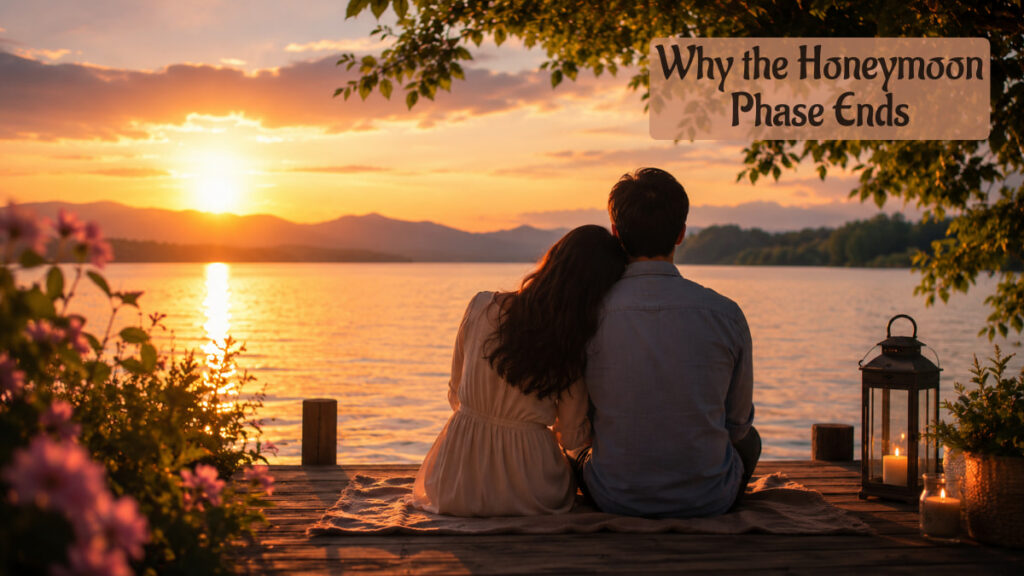
Almost every romantic relationship begins with a magical period often called the honeymoon phase. During this time, everything feels effortless. Conversations last for hours, flaws seem insignificant, physical attraction is intense, and simply being together creates happiness. Couples often wonder why life suddenly feels brighter, why problems seem easier to handle, and why they cannot stop thinking about each other.
Yet, for many relationships, this extraordinary feeling gradually fades. The butterflies disappear, small disagreements become frequent, daily responsibilities replace spontaneous adventures, and partners begin asking an unsettling question: “What happened to us?”
Many people mistakenly believe that the end of the honeymoon phase is proof that love itself has faded. In reality, research suggests something very different. The transition is not necessarily the end of love—it is the end of novelty. Whether a relationship becomes stronger or weaker after this stage depends largely on how both partners respond to the changes.
Cell biologist Bruce H. Lipton, in his book The Honeymoon Effect, argues that the bliss experienced in the early days of love is not merely luck or chemistry. Instead, it is a biological state influenced by perception, emotions, beliefs, and the subconscious mind. According to Lipton, couples can consciously recreate many aspects of this state by changing how they think, communicate, and interact.
Modern psychology supports parts of this perspective. Studies have shown that couples who continue practicing appreciation, emotional responsiveness, and shared experiences report significantly higher relationship satisfaction even after decades together. The honeymoon phase may naturally evolve, but happiness in a relationship does not have to disappear with it.
“What we call falling out of love is often just falling out of attention, appreciation, and presence.”
The Science Behind the Honeymoon Phase
When people fall in love, their brains undergo remarkable chemical changes. Scientists have found that romantic love activates the brain’s reward system, releasing large amounts of dopamine, often called the “feel-good” neurotransmitter. Dopamine creates excitement, motivation, and anticipation, making every interaction with a partner feel rewarding.
At the same time, hormones such as oxytocin and vasopressin strengthen emotional bonding and trust. Oxytocin, sometimes referred to as the “love hormone,” increases during physical affection such as hugging, kissing, and holding hands. These biological responses create feelings of closeness and emotional security.
Research using brain imaging at Stanford University and other institutions has shown that the brains of newly in-love couples display heightened activity in regions associated with reward and motivation. Interestingly, these areas resemble those activated by achieving important goals, explaining why romantic love often feels exhilarating.
Psychologists estimate that the honeymoon phase typically lasts between six months and two years, although this varies considerably among couples. During this period, people naturally focus on their partner’s strengths while overlooking many imperfections. This phenomenon is partly explained by positive cognitive bias, where the brain emphasizes rewarding experiences and minimizes negative information.
Relationship researcher Dr. Helen Fisher has described romantic love as one of the most powerful natural motivational systems in the human brain. However, the brain is also designed to adapt. Just as a new car, home, or promotion eventually becomes familiar, relationships gradually lose their novelty. This process, known as hedonic adaptation, affects nearly every aspect of human happiness.
The fading of excitement does not indicate failure. Instead, it reflects the brain’s remarkable ability to conserve energy by treating familiar experiences as normal. The challenge for couples is learning how to replace automatic familiarity with intentional appreciation.
Why the Magic Fades
Although changing brain chemistry plays an important role, biology alone does not explain why some couples grow apart while others become even closer over time.
One of the biggest reasons is routine. As responsibilities increase through careers, finances, children, and household duties, couples naturally spend more time solving problems than creating joyful experiences. Conversations become centered around schedules, bills, and obligations instead of dreams, laughter, and curiosity.
Another major factor is subconscious programming. Bruce Lipton suggests that during the honeymoon phase, people temporarily override many of their unconscious behavioural patterns because powerful positive emotions dominate their perceptions. As those emotions stabilize, deeply ingrained habits learned during childhood begin resurfacing.
These unconscious programs often include communication styles, conflict responses, beliefs about love, and emotional defense mechanisms learned from parents or early life experiences. Without realizing it, individuals may repeat the same relationship patterns they witnessed growing up.
Psychologist Dr. John Gottman’s decades of research further illustrates this point. After studying thousands of couples, his team found that criticism, defensiveness, contempt, and stonewalling are among the strongest predictors of relationship dissatisfaction and divorce. These behaviours often emerge gradually as familiarity replaces intentional kindness.
Stress also plays a significant role. Chronic stress increases cortisol, the body’s primary stress hormone. Elevated cortisol reduces patience, empathy, and emotional availability while making conflict more likely. Partners who once saw each other as sources of comfort may begin associating each other with pressure and frustration.
Technology has introduced another modern challenge. Studies indicate that excessive smartphone use during shared time reduces relationship satisfaction because it interrupts meaningful conversations and emotional connection. Even brief distractions can communicate that a device has become more important than the person sitting nearby.
Perhaps the greatest mistake couples make is assuming that love should continue automatically. In reality, the effortless excitement of early romance eventually gives way to a stage where love becomes a conscious daily practice rather than an automatic emotional response.
Changing the Inner Story
Bruce Lipton emphasizes that perception shapes biology. Whether or not every aspect of this claim is universally accepted, psychology strongly supports the idea that thoughts and expectations significantly influence relationship behaviour.
People rarely respond to reality alone; they respond to the meaning they assign to reality. A forgotten anniversary may be interpreted as proof of being unloved or simply as a busy mistake. The interpretation often determines the emotional reaction more than the event itself.
Research in positive psychology has consistently shown that gratitude changes how people perceive their relationships. Couples who regularly express appreciation report higher levels of trust, intimacy, and long-term satisfaction than those who focus primarily on problems.
Changing subconscious beliefs requires awareness. Many individuals carry hidden assumptions such as “relationships always become boring,” “people eventually leave,” or “I am not lovable enough.” These beliefs quietly influence daily behaviour and often become self-fulfilling prophecies.
Replacing these narratives begins with recognizing them. Instead of assuming negative intentions, emotionally healthy couples develop the habit of giving each other the benefit of the doubt. They ask questions before making conclusions and seek understanding instead of immediate judgment.
Communication also transforms when partners become emotionally responsive rather than emotionally reactive. Listening without interrupting, validating feelings without immediately offering solutions, and expressing needs without blame create an atmosphere where emotional safety can flourish.
Dr. Gottman’s research found that stable marriages maintain approximately five positive interactions for every negative one during conflict. These positive moments include smiling, affection, humour, appreciation, gentle touch, and words of encouragement. This ratio highlights an important truth: lasting relationships are built less on avoiding disagreements and more on consistently increasing positive emotional experiences.
Changing the inner story also means recognizing that no partner can permanently provide happiness if individuals neglect their own emotional well-being. Self-care, personal growth, meaningful friendships, and pursuing purpose outside the relationship actually strengthen romantic connections by reducing unhealthy dependence.
Bringing the Spark Back
The encouraging news is that the honeymoon feeling can be recreated—not by pretending life has no challenges, but by intentionally rebuilding the conditions that originally created emotional closeness.
Novelty remains one of the most effective tools. Researchers have found that couples participating in exciting or unfamiliar activities together experience increased relationship satisfaction because new experiences stimulate dopamine production. Traveling to new places, learning a hobby together, taking dance lessons, hiking, or even trying unfamiliar restaurants can revive feelings associated with early romance.
Another powerful habit is expressing appreciation daily. Simple statements such as “Thank you for making dinner,” “I appreciate how hard you work,” or “I love the way you handled that situation” reinforce positive perceptions that often disappear under routine.
Physical affection should not be underestimated. Frequent hugs, kisses, holding hands, and affectionate touch stimulate oxytocin release, strengthening emotional bonds even when life feels stressful. These small gestures often communicate love more effectively than expensive gifts.
Intentional communication is equally important. Setting aside uninterrupted time to talk without phones or television helps couples reconnect emotionally. Instead of discussing only responsibilities, partners benefit from asking questions about dreams, fears, goals, memories, and future aspirations.
Forgiveness also plays a central role in restoring closeness. Every long-term relationship experiences misunderstandings and disappointment. Holding onto resentment slowly erodes emotional intimacy, while genuine forgiveness creates space for renewed trust.
Couples who continue dating each other often maintain stronger relationships than those who stop investing in shared experiences after marriage. Regular date nights, surprise gestures, handwritten notes, or recreating memorable early experiences remind both partners that romance is created through action rather than circumstance.
Finally, maintaining curiosity about each other keeps relationships alive. People continue evolving throughout life. Partners who remain interested in discovering each other’s changing dreams, opinions, and ambitions avoid the trap of believing they already know everything about one another.
Conclusion
The honeymoon phase was never meant to last forever in its original biological form. The brain naturally adapts, excitement becomes familiarity, and daily life introduces responsibilities that early romance rarely faces. However, the end of the honeymoon phase does not have to become the end of passion, friendship, or emotional intimacy.
The strongest relationships are not those that never lose excitement. They are the ones that repeatedly choose to create it again. By understanding the science of love, recognizing subconscious patterns, practicing gratitude, improving communication, embracing novelty, and investing intentionally in each other, couples can replace fading excitement with something even more valuable—deep, resilient, and enduring connection.
Bruce H. Lipton’s central message offers a hopeful perspective: the “honeymoon effect” is not simply a lucky accident reserved for the beginning of a relationship. While the intense chemistry of new love naturally changes, many of the emotions associated with that magical period can be consciously cultivated throughout life. Love is not sustained by chance alone. It grows through awareness, consistent effort, and the daily decision to see one’s partner not as someone familiar to overlook, but as someone extraordinary to appreciate.
In the end, the happiest couples are rarely the luckiest. They are the ones who understand that romance is less about finding the perfect person and more about continually choosing to create the perfect environment for love to thrive.