You wake up to the sound of your smartphone alarm. Before you’ve even brushed your teeth, your brain has been bombarded with breaking news, social media updates, unread emails, and group chat notifications. In the first hour of your day, you’ve consumed more information than a person in the 17th century might have encountered in an entire week.
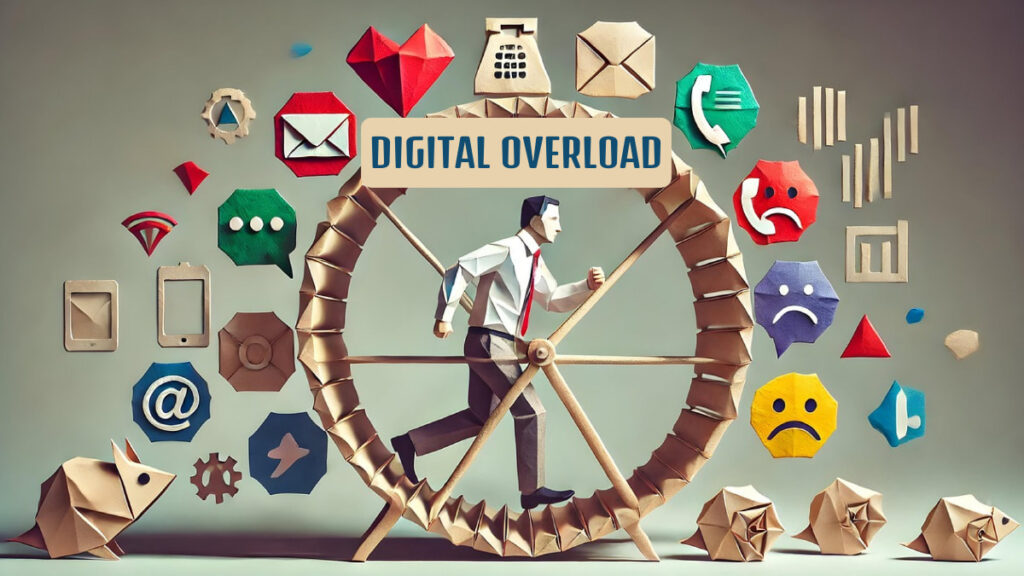
This is the reality of modern life: we are drowning in information but starved of focus. The term “digital overload” describes this overwhelming flood of data and notifications that compete for our attention. While technology has brought convenience, speed, and connection, it has also fractured our ability to concentrate, think deeply, and be present.
Our brains were never designed for this nonstop stream of information. We evolved to focus on one thing at a time. Now, our phones and devices pull us into a state of constant partial attention — never fully engaged in one thing, but also never truly resting. The result? Stress, mental tiredness, poor productivity, and even burnout.
But this isn’t a hopeless scenario. By understanding the mechanics of digital overload and intentionally designing our habits, we can reclaim our ability to focus.
“Almost everything will work again if you unplug it for a few minutes, including you.” – Anne Lamott
Digital Overload and Its Impact on Your Brain
Digital overload isn’t just about “being online too much”—it’s about how the sheer quantity of digital stimuli affects the way your brain processes information. Every ping, ding, or flashing notification triggers a microburst of dopamine, the brain’s reward chemical. This feels good in the moment, which is why we keep checking our devices, but over time it rewires our neural pathways.
Neurologically, we’re becoming addicted to novelty. Every swipe or refresh offers the possibility of something new—an email, a comment, a breaking headline—which keeps us in a cycle of seeking rather than doing. This constant stimulation prevents the brain from entering deep focus, also known as “flow state,” which is essential for meaningful work and learning.
The costs are significant. Researchers have found that multitasking—often encouraged by the digital environment—reduces efficiency, increases mistakes, and even lowers IQ temporarily. Furthermore, chronic exposure to fragmented information has been linked to increased anxiety, reduced memory retention, and decreased creative thinking.
When your attention is split across multiple tabs, apps, and alerts, your cognitive resources drain faster. It’s like trying to run a marathon while constantly being stopped to answer random questions—you never get into a rhythm. Over time, this mental exhaustion feels like an invisible weight, making even simple tasks seem overwhelming.
The Myth of Multitasking
Many people wear multitasking like a badge of honor, believing it demonstrates efficiency. In reality, what most of us call multitasking is “task-switching”—rapidly shifting from one task to another. Each switch comes with a “cognitive cost” because the brain has to reorient itself to the new task’s demands.
Research from Stanford University has shown that heavy multitaskers are actually worse at filtering out irrelevant information, have poorer working memory, and struggle more to switch between tasks compared to those who focus on one thing at a time.
The irony is that technology gives us the illusion of productivity—ticking off small, easy tasks quickly feels good—but it robs us of the ability to work on projects that require sustained effort. We end up prioritizing the urgent over the important.
For example, answering emails while writing a report may feel like you’re “getting things done,” but the interruptions break your concentration, meaning the report takes far longer and is likely lower in quality. This fractured attention also leaves you feeling mentally scattered, even after the workday ends.
The Emotional Toll
Digital overload isn’t just a productivity issue—it’s also an emotional one. Constant connectivity blurs the boundaries between work and personal life, creating a low-grade but persistent sense of urgency. We feel compelled to respond instantly, afraid of missing out or falling behind.
This pressure activates the body’s stress response. Cortisol levels rise, heart rate increases, and over time, this chronic stress can contribute to anxiety disorders, insomnia, and burnout. The worst part is that many people don’t realize their mental exhaustion is tied to their digital habits—they simply assume they’re “tired” or “bad at concentrating.”
The loss of mental stillness is one of the most overlooked consequences of digital overload. In quieter times, our brains naturally wander, connect ideas, and recharge. But with constant input, we rarely give ourselves the gift of boredom or reflection. Even short moments—waiting in line, commuting, or eating alone—are now filled with scrolling.
This matters because the brain’s “default mode network,” which activates during rest, plays a vital role in creativity, problem-solving, and emotional regulation. Without it, we may feel perpetually restless, disconnected from ourselves, and creatively blocked.
Reclaiming Focus
The good news is that the same technology that distracts us can be managed in ways that protect our focus. The first step is to establish digital boundaries—clear limits on when, where, and how you use your devices.
Start with notification management. Disable non-essential alerts and group necessary ones into scheduled summaries. This prevents your brain from being hijacked by constant interruptions. Consider creating “focus zones” during the day—time blocks where you silence your phone, close email tabs, and dedicate yourself to deep work.
Physical separation also helps. Keep your phone out of arm’s reach while working, or better yet, in another room. When possible, use different devices for different purposes (e.g., a laptop for work, a tablet for reading) to create a mental distinction between modes.
Equally important is setting end-of-day digital cutoffs. Choose a time in the evening when you disconnect from work email and social media to give your brain space to wind down. Many people find that reading a physical book, journaling, or engaging in a hobby before bed drastically improves sleep quality and next-day focus.
Boundaries aren’t about rejecting technology—they’re about using it intentionally, on your terms, rather than letting it dictate your mental state.
Mindful Consumption
Just as a healthy diet depends on what you eat, your mental clarity depends on what information you consume. In a world of infinite content, the ability to curate your digital intake is a critical skill.
Start by auditing your digital “inputs.” Which apps, websites, or accounts genuinely add value to your life, and which simply fill time? Unfollow, unsubscribe, or mute sources that provoke unnecessary stress or contribute to information clutter.
Practice single-channel focus when consuming information. For example, if you’re reading an article, resist the urge to open multiple tabs “just in case.” Let your brain fully process one thing before moving to the next.
Another strategy is the “information fast.” Set aside a day or weekend where you consume only essential content—no news, no social media, no YouTube rabbit holes. This temporary reset can help you notice just how much noise you’ve been tolerating and give you space to reconnect with your own thoughts.
Mindful consumption also means being aware of your emotional state while online. If certain platforms consistently leave you feeling anxious, angry, or inadequate, consider taking an extended break. Protecting your focus also means protecting your emotional energy.
Train Your Brain
Focus is like a muscle—the more you train it, the stronger it gets. Unfortunately, digital overload has left many of us with weak attention spans, accustomed to constant switching. Rebuilding deep focus requires deliberate practice.
Begin with short intervals of deep work—uninterrupted periods where you work on a cognitively demanding task with full attention. Start with 25–30 minutes and gradually increase as your stamina improves. The key is to eliminate all possible distractions during this time.
Meditation and mindfulness practices are powerful tools for strengthening attention. By training yourself to notice when your mind has wandered and gently bringing it back, you develop the mental discipline needed for sustained focus in daily life. Even five minutes of daily mindfulness can make a noticeable difference over time.
Physical health also plays a role. Regular exercise, quality sleep, and balanced nutrition improve brain function and resilience to stress. When your body is well cared for, your mind can sustain attention for longer periods without fatigue.
Lastly, build “focus rituals.” Whether it’s making tea before starting work, playing a specific playlist, or arranging your workspace in a certain way, rituals signal to your brain that it’s time to enter a concentrated state. Over time, this conditioning can help you slip into focus more easily.
Redefining Productivity in the Digital Era
One of the reasons digital overload thrives is because we’ve equated productivity with constant activity. The busier we look, the more valuable we believe we are. But in reality, the most impactful work often comes from doing less, more deeply.
Redefining productivity means shifting from a quantity mindset (how much we do) to a quality mindset (how well we do it). It’s about asking: Am I working on what truly matters? rather than Am I busy enough?
This shift also requires acknowledging the value of rest and reflection. In the digital era, stepping away from devices isn’t laziness—it’s a strategic choice to protect your cognitive resources. Great ideas rarely emerge from an inbox; they emerge when the mind has space to connect dots in new ways.
Organizations, too, have a role to play. Encouraging “always-on” culture may deliver short-term responsiveness but leads to long-term burnout and reduced innovation. Forward-thinking companies are experimenting with no-meeting days, email-free hours, and results-focused metrics rather than time-based ones.
When we measure productivity by outcomes instead of hours, we naturally resist the lure of digital busyness and focus on what truly drives progress.
Creating a Life Outside the Screen
One of the most overlooked ways to fight digital overload is to build more offline moments into your life. If all your free time is spent on a screen — even for fun — your brain never fully rests from the constant stimulation.
Make time for activities that don’t involve technology. It could be cooking, gardening, playing a sport, going for a walk, or spending time with friends face-to-face. These offline activities help your brain reset, improve your mood, and make it easier to focus when you do go back to work.
Physical hobbies, in particular, are powerful because they engage your body and mind together. Whether it’s painting, playing music, or fixing something with your hands, these activities give your brain a break from the rapid-fire pace of the digital world.
It’s also important to be fully present in these moments. That means not checking your phone while doing them. At first, this might feel strange or even boring, but over time, you’ll start to enjoy the calm and mental clarity that comes from truly switching off.
A healthy balance between screen time and real-world activities is one of the most effective ways to protect your focus long-term.
Conclusion
Digital overload is not going away. If anything, the pace and volume of information will only increase as new technologies emerge. Waiting for the world to slow down is not an option—the solution lies in taking control of our own habits, attention, and mental environment.
By understanding the neurological effects of constant stimulation, setting firm digital boundaries, curating our information intake, and training our focus muscles, we can navigate the digital age without losing ourselves to it.
Reclaiming focus isn’t about rejecting technology—it’s about ensuring that technology serves our goals, rather than hijacking them. In a culture where distraction is the default, choosing to be fully present is a radical act. And in that choice lies the possibility of deeper work, richer relationships, and a calmer, more intentional life.
The challenge is real, but so is the reward: the ability to direct your mind where you want it to go, for as long as you need it to be there. That is true power in the 21st century.