
• Author
  • Copyright Report
  • Privacy Policy
  • Terms & Condition
  • Contact
  • About
Wednesday, June 24, 2026
Fastlane Freedom
No Result
View All Result
  • Mindfulness
  • Money
  • Grow Business
  • Essential Reading
  • Popular Quotes
  • Student
  • Parenting
  • Videos
  • About
  • Contact
  • Mindfulness
  • Money
  • Grow Business
  • Essential Reading
  • Popular Quotes
  • Student
  • Parenting
  • Videos
  • About
  • Contact
No Result
View All Result
Fastlane Freedom
No Result
View All Result
  • Author
  • Copyright Report
  • Privacy Policy
  • Terms & Condition
  • Contact
  • About

Home » Important ‘Interviewing’ Tips for Manager

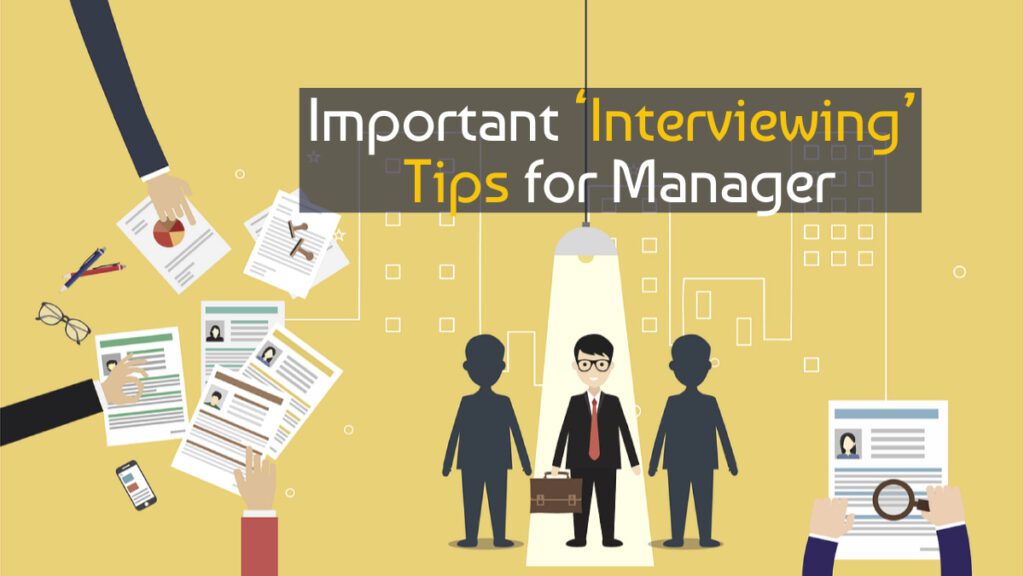
Important ‘Interviewing’ Tips for Manager

Vinod Singh by Vinod Singh
April 30, 2022
Reading Time: 7 mins read
A A
0
Important ‘Interviewing’ Tips for Manager

Table of Contents

  • Available Means for Interview
  • #1 Key Point (Be an Active Listener)
  • #2 Key Point (Questions to Ask)
  • #3 Key Point (Four Categories)
  • #4 Key Point (Hypothetical Situation)
  • #5 Key Point (References)

Interviewing! this is one of the emotionally charged tasks a manager performs. The main purpose of the interview is to:

•  select a good performer

•  educate him as to who you and the company are

•  determine if a mutual match exists

•  sell him on the job

For the manager, interviewing is about making a judgment on how the candidate would perform in your company’s environment. When you’re hiring, you must judge potential contributions. Within the hour or so at your disposal, you must move between the world of the past employer and your own, and project the candidate’s future performance in a new environment based on his own description of past performance. This managerial task is clearly tricky and high-risk, but unfortunately unavoidable.

“Only those who dare to fail greatly can ever achieve greatly.” – Robert F. Kennedy

Available Means for Interview

The means at your disposal typically consist of an hour or two of interview time and a check of the candidate’s references. We know how hard it is to assess the actual past performance of our own subordinates even though we spent much time working closely with them. Here we sit somebody down and try to find out in an hour how well he is likely to perform in an entirely new environment. If performance appraisal is difficult, interviewing is just about impossible. The fact is, we managers have no choice but to perform the interview, no matter how hard it is. But we must realize that the risks of failure are high.

The other tool we have for assessing potential performance is to research past performance by checking references. But you’ll often be talking to a total stranger, so even if he comments freely about the candidate, what he says won’t have much meaning to you without some knowledge of how his company does business and what values it works by. Moreover, while few references will out-and-out lie, they tend not to volunteer specific critical remarks. So reference-checking hardly exempts you from getting as much as you can out of the interview.

#1 Key Point (Be an Active Listener)

The applicant should do 80 percent of the talking during the interview, and what he talks about should be your main concern. But you have a great deal of control here by being an active listener. Keep in mind you only have an hour or so to listen. When you ask a question, a talkative or nervous person might go on and on with his answer long after you’ve lost interest. Most of us will sit and listen until the end out of courtesy. Instead, you should interrupt and stop him, because if you don’t, you are wasting your only asset—the interview time, in which you have to get as much information and insight as possible. So when things go off the track, get them back on quickly. Apologize if you like, and say, “I would like to change the subject to X, Y, or Z.” The interview is yours to control, and if you don’t, you have only yourself to blame.

#2 Key Point (Questions to Ask)

An interview produces the most insight if you steer the discussion toward subjects familiar to both you and the candidate. The person should talk about himself, his experience, what he has done and why, what he would have done differently if he had it to do over, and so forth. But remember, this should be done in terms familiar to you, so that you can evaluate its significance. In short, make sure the words used mean the same thing to both of you.

What are the subjects that you should bring up during the interviewing process? Here is the list of some of the best questions suggested by a group of managers :

–Describe some projects that were highly regarded by your management, especially by the levels above your immediate supervisor.

–What are your weaknesses? How are you working to eliminate them?

–Convince me why my company should hire you.

–What are some of the problems you are encountering in your current position? How are you going about solving them?

–Why do you think you’re ready for this new job?

RELATED POSTS

Stop Over-Conscious Parenting: Raising Confident Kids

Great Entrepreneurs Aren’t Perfect—But They Build the Future

Why the World Needs More Risk-Takers, Not More Critics

Escaping the Traffic Jam of Stress, Salary & Spreadsheets

Why Saving Money Is Like Dieting—Easier Said Than Done

Meetings: Where Minutes Are Taken and Hours Are Lost

–What do you consider your most significant achievements? Why were they important to you?

–What do you consider your most significant failures? What did you learn from them?

–What was the most important course or project you completed in your college career? Why was it so important?”

With these questions, we get the desired information about the candidate. Information collected falls into four categories as explained in #3 key point.

#3 Key Point (Four Categories)

The information to be gained here tends to fall into four distinct categories. First, you’re after an understanding of the candidate’s technical knowledge: not engineering or scientific knowledge, but what he knows about performing the job he wants—his skill level. For an accountant, technical skill means an understanding of accounting; for a tax lawyer, tax laws; and so on. Second, you’re trying to assess how this person performed in an earlier job using his skills and technical knowledge; in short, not just what the candidate knows, but also what he did with what he knows. Third, you are after the reasons why there may be any discrepancy between what he knew and what he did, between his capabilities and his performance. And finally Forth, you are trying to get a feel for his set of operational values, those that would guide him on the job.

Let’s look at how the questions above fit into the four categories.

Technical/Skills: describe some projects, what are your weaknesses

What He Did With Knowledge: past achievements, past failures

Discrepancies: what did you learn from failures, problems in current position

Operational Values: why are you ready for new job, why should my company hire you, most important college course/project

#4 Key Point (Hypothetical Situation)

In the interviewing process, asking a candidate to handle a hypothetical situation can also enlighten you. Andrew S. Grove (former CEO of Intel) shared his experience on this “I once interviewed someone for the position of cost accountant at Intel. He had a Harvard MBA and came from the foodservice industry. He knew nothing about the semiconductor business and I knew nothing about finance, so we really couldn’t talk in much detail about his technical ability to do the job. I decided to take him through the semiconductor manufacturing process step by step. After saying I would answer any specific questions he had, I asked him what the finished cost of a wafer would be. He asked some questions and pondered matters for a while. He then started to think his way through the basic semiconductor cost accounting principles, discovering some of them as he went along, and ultimately came up with the correct answer. He was hired because this exercise demonstrated (as it turns out, correctly) that his problem-solving capacity was first-rate.”

Another approach follows that you may want to use while interviewing. The candidate can tell you a great deal about his capabilities, skills, and values by asking you questions. Ask the candidate what he would like to know about you, the company, or the job. The questions he asks will tell you what he already knows about the company, what he would like to know more about, and how well prepared he is for the interview.

#5 Key Point (References)

References! this is one of the very important aspects of interviewing. When you are talking to these references, you’re really after the same information that you tried to get directly from the candidate. If you know the reference personally, you have a much better chance of getting “real” information. If you don’t, try to keep him on the phone long enough to let some sort of personal bond develop. If you can uncover some common experience or association, the reference will probably become more open with you.

In general, the last ten minutes of a half-hour conversation are much more valuable than the first ten minutes, thanks to that bond. If possible, you should talk with the applicant again after you have checked his references, because you may have gotten some new perspectives. Such a follow-up interview can be quite a focused affair. (Article is inspired from ‘High Output Management’ by Andrew S. Grove)


Featured reads

Mindful Shots, Volume-1 cover
Mindful Shots, Volume-1
Vinod Singh
Self-Help, Mindfulness

Mindful Shots, Volume-1

Vinod Singh

4.5 · reviews

Most people live their entire lives without truly understanding how their minds work or the immense power they hold within. Fewer than two percent of people can confidently answer questions like: What drives my thoughts? Why do I feel resistance to my own goals? You’ve likely experienced moments when you wanted to take a bold step—perhaps starting a new business or making a life-changing decision—only to hear an inner voice warning you of failure. That voice often justifies its fears by recalling countless stories of others’ setbacks—family members, friends, society, even distant headlines. It’s as if your mind maintains a detailed archive of every failure around you, replaying them to keep you from moving forward. But what if this inner voice could be understood, reprogrammed, and even turned into your greatest ally? Imagine what would be possible if both your conscious intentions and subconscious patterns worked together instead of pulling in opposite directions. This collection, Mindful Shots, brings together some of the most insightful writings on mindfulness from Fastlane Freedom. Each piece explores practical and scientific perspectives on how the mind shapes our choices, influences our health, and even participates in physical healing. Through research-backed insights and timeless wisdom, this book will help you see that the mind isn’t just a passive observer—it’s an active force capable of changing your reality. By learning how to quiet the noise, shift your mental inputs, and harness your inner voice, you’ll gain a clearer path to personal growth, emotional balance, and a deeper understanding of what mindful living truly means.

Amazon Flipkart
Parenting Essentials cover
Parenting Essentials
Vinod Singh
Self-Help, Parenting

Parenting Essentials

Vinod Singh

4.5 · reviews

Parenting is a journey—one of the most rewarding, challenging, and transformative experiences life has to offer. But it’s not a path we are meant to walk alone. Essential Parenting was born out of a deep desire to support and empower parents at every stage of their journey, from the early days of pregnancy to the complex teenage years. Drawing insights from the Fastlane Freedom platform, this book brings together wisdom, mindfulness, and practical strategies to help you raise confident, emotionally strong, and value-driven children. At Fastlane Freedom, we believe that conscious parenting begins with self-awareness. Children absorb more from our behaviour than our words. It’s in our everyday actions—our calm during chaos, our patience in moments of frustration, our consistency in values—that they find their foundation. Parenting is not about being perfect; it’s about being present, intentional, and compassionate.

Amazon Flipkart
The Wealth Code, Volume-1 cover
The Wealth Code, Volume-1
Vinod Singh
Self-Help, Finance

The Wealth Code, Volume-1

Vinod Singh

4.5 · reviews

The Wealth Code: Volume-1 is a personal development and financial education book written by Vinod Singh. It is designed to empower readers by teaching them principles of wealth creation, financial freedom, and personal growth. The book offers practical strategies to achieve financial success, with a vision to uplift and transform the lives of millions by promoting financial literacy and entrepreneurial thinking. Mr. Singh's approach is rooted in inspiring individuals to take control of their financial destinies while cultivating a mindset focused on long-term success and abundance.

Amazon Flipkart
ShareSendTweetPinShareShareShareShareShareShareBookmarkShare
Vinod Singh

Vinod Singh

In 2019, Vinod Singh, a Belief Changer, founded Fastlane Freedom after 3.5 years of research on Mindfulness and its connection to money. Fastlane Freedom is driven by a vision: ‘Enhancing Lives of Millions’ by reshaping people’s beliefs to transform their financial situations. With 16 years of professional experience, Vinod dedicates himself to providing top-notch, practical content on Mindfulness, Money, Business, Parenting, Popular Quotes and Student Life.

Related Posts

Stop Over-Conscious Parenting

Stop Over-Conscious Parenting: Raising Confident Kids

June 21, 2026
Great Entrepreneurs Aren't Perfect

Great Entrepreneurs Aren’t Perfect—But They Build the Future

June 17, 2026
The World Needs More Risk-Takers

Why the World Needs More Risk-Takers, Not More Critics

June 15, 2026
Escaping the Traffic Jam of Stress, Salary & Spreadsheets

Escaping the Traffic Jam of Stress, Salary & Spreadsheets

June 7, 2026
Saving Money Is Like Dieting

Why Saving Money Is Like Dieting—Easier Said Than Done

June 6, 2026
meetings

Meetings: Where Minutes Are Taken and Hours Are Lost

June 2, 2026
Analysis paralysis

Analysis Paralysis: The Silent Success Killer Nobody Talks About

May 31, 2026
The Power of Selective Blindness

The Power of Selective Blindness: Why Success Often Requires Ignoring the Noise

May 29, 2026
The Market Rewards Patience, Not Panic

The Market Rewards Patience, Not Panic – Fastlane Freedom

May 28, 2026
Load More

Support Ad-Free Content

Dear Valued Reader,

At Fastlane Freedom, we believe in delivering the highest quality content without the distraction of ads. Our platform is dedicated to enriching your life with insightful blogs on Mindfulness, Financial Wisdom, Business Strategies, Student Success, and Effective Parenting.

To keep our content free from ads and accessible to all, we need your support. Your donation helps us maintain our commitment to providing valuable, ad-free resources that empower you to thrive in every aspect of life.

Join us in our mission to “Enhancing Lives of Millions” by fostering knowledge and growth. Every contribution is invaluable and directly enhances the quality and accessibility of our content. Donate now and help us continue to make a difference!

Support Now

Main Category

  • Mindfulness
  • Money
  • Grow Business
  • Essential Reading
  • Popular Quotes
  • Student
  • Parenting
  • Videos
  • About
  • Contact

Money

  • Power of Compounding
  • Learn from Rich People
  • Power of Saving
  • Money Tips
  • Financial Freedom
  • Debt Management

Grow Business

  • Business Tips
  • Workplace Practices
  • Marketing Tips
  • Entrepreneurship
  • Success Rules
  • Leadership
  • Productivity Improvement

Mindfulness

  • Subconscious Mind
  • Growth Mindset
  • Overcome Fear
  • Success Habits
  • Achieve Goals
  • Happiness Secrets

Parenting

  • Before Birth Facts
  • Health and Wellness
  • Parenting Tips and Strategies

Student

  • Early Success Secrets
  • Study Tips
  • Career Goals

© 2026 fastlanefreedom.com - Design and Manage by Binary Techne.

No Result
View All Result
  • Money Blogs
  • Essential Reading
  • Mindfulness
  • Grow Business
  • Parenting
  • Student
  • Popular Quotes
  • About
  • Contact

© 2026 fastlanefreedom.com - Design and Manage by Binary Techne.