
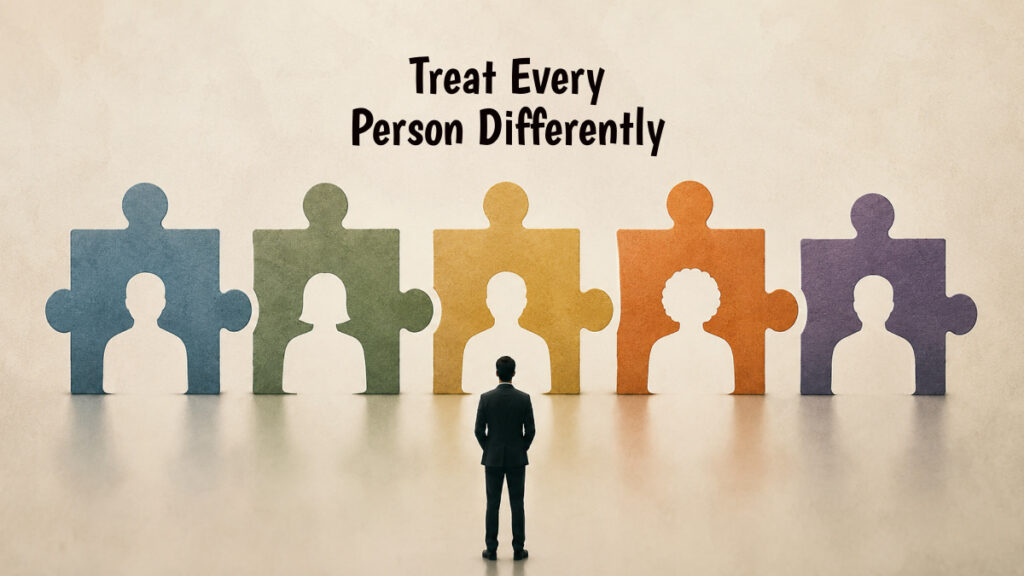
Modern management has long been obsessed with fairness, consistency, and standardization. Leaders are trained to apply the same rules, expectations, and rewards to everyone in the name of equality. While this approach appears ethical on the surface, it quietly ignores a fundamental truth about human beings: no two people are the same. They differ in temperament, motivation, life stage, learning speed, emotional needs, and natural strengths. Treating everyone identically assumes a uniform workforce that simply does not exist.
True fairness is not sameness; it is equity. Treating people differently — thoughtfully, intentionally, and transparently — means aligning work with individual strengths, coaching people in ways they can best receive, and creating conditions where each person has a genuine chance to succeed. This idea, powerfully articulated in First, Break All the Rules, challenges one of management’s deepest assumptions: that consistency automatically produces performance. In reality, performance thrives when managers learn to see people as individuals rather than interchangeable resources.
“Great managers discover what is unique about each person and then capitalize on it.”- Marcus Buckingham
This blog explores why individualized management matters, what research and real-world case studies reveal, how managers can practice it effectively, the systems that make it scalable, the risks involved, and the measurable payoffs for organizations willing to move beyond one-size-fits-all leadership.
Why Individuality at Work Matters
Decades of organizational research have consistently shown that people perform better when there is a strong fit between who they are and what they are asked to do. Studies on person–job fit and person–organization fit demonstrate meaningful links between alignment and outcomes such as job satisfaction, commitment, engagement, and reduced turnover intention. When people feel that their work reflects their abilities and values, they are more likely to invest effort and remain loyal to the organization.
Engagement research reinforces this conclusion. Gallup’s extensive studies, involving millions of employees worldwide, reveal that one of the strongest predictors of engagement is whether employees have the opportunity to do what they do best every day. This single idea has profound implications. It means that engagement is not primarily about perks or motivational speeches, but about how well managers tailor roles, feedback, and expectations to individual strengths.
Team-level research supports the same principle. Google’s well-known Project Aristotle examined why some teams consistently outperform others. The conclusion was not superior intelligence or experience, but conditions such as psychological safety, clarity, dependability, and respect for individual contribution styles. Teams thrive when differences are acknowledged and leveraged, not erased. These findings collectively make a compelling case: performance is not created by forcing uniform behaviour, but by designing work around human variation.
What Treating People Differently Looks Like
Individualized management is often misunderstood as favouritism or leniency. In reality, it is disciplined, intentional, and deeply practical. It shows up in how work is assigned, how feedback is delivered, how schedules are structured, and how careers are developed.
In practice, this may mean reshaping responsibilities so one employee spends more time on analytical tasks while another focuses on relationship-building. It may involve recognizing that one person thrives on public recognition while another prefers private acknowledgment. It may mean offering flexibility to someone balancing caregiving responsibilities while providing structure to someone who performs best with routine.
A powerful example comes from Ritz-Carlton, where employees are trained and trusted to make individualized decisions in service of guest needs. This philosophy extends inward as well. Employees are not treated as identical service units but as professionals capable of judgment. The organization’s success lies not in rigid scripts but in deeply ingrained values and training that allow people to personalize their actions responsibly.
Similarly, many organizations highlighted in management literature encourage employees to shape portions of their roles to better match their interests and strengths. When people have a voice in how their job is done, engagement increases because work begins to feel like an extension of who they are, not an imposition they must endure.
How Managers Actually Do It
Treating people differently is not instinctive for most managers; it must be learned and practiced. The first essential skill is accurate observation. Great managers pay attention to what energizes their team members, where they struggle, and how they respond under pressure. They ask questions, listen carefully, and test small adjustments rather than making sweeping assumptions.
Communication is another critical skill. The same message delivered in the same way does not land equally with everyone. Some employees value direct, unfiltered feedback, while others need context and reassurance to absorb the same information. Adaptive communication is not inconsistency; it is effectiveness.
Individualized managers also think differently about development. They reject the assumption that success equals promotion into management. Instead, they create multiple growth paths, recognizing that some people want depth, mastery, and influence without people management. By honouring diverse ambitions, they prevent talent loss and frustration.
Above all, strong managers make individualization predictable rather than random. Team members understand that adjustments are based on performance, strengths, and role requirements, not personal favouritism. This consistency of principle — not uniformity of treatment — is what builds trust.
Systems That Make Individualization Scalable
Individualized management cannot survive on managerial goodwill alone. For it to endure, organizations must embed it into systems that make personalization scalable, ethical, and aligned with business goals.
One of the most important system shifts is moving from process obsession to outcome clarity. When success is defined by results rather than rigid methods, managers gain the freedom to let people work in ways that suit them best. Accountability remains strong, but autonomy increases.
Structured one-on-one conversations play a crucial role. These conversations allow managers to diagnose engagement, identify friction points, and make ongoing adjustments. When they are part of the organizational rhythm, individualized treatment becomes expected rather than exceptional.
Training systems must also evolve. Managers cannot personalize effectively without learning how to coach strengths, manage bias, and adapt communication. Ritz-Carlton’s empowerment model works precisely because it is supported by rigorous training and cultural clarity. Freedom operates within boundaries.
Finally, HR policies must support flexibility without creating fear. When policies define guiding principles rather than rigid rules, managers are empowered to tailor work responsibly. Individualization becomes a capability, not a liability.
Risks, Pushback, and How to Avoid Unfairness
The most common objection to individualized management is the fear of favouritism. This concern is valid — and manageable. Problems arise not from difference itself, but from unexplained difference. When employees understand why decisions are made, perceptions of unfairness diminish dramatically.
Transparency is essential. Managers must be able to explain the rationale behind flexibility, assignments, and opportunities. When criteria are clear and applied consistently, people accept that different circumstances require different responses.
Bias presents a more subtle risk. Without structure, managers may unconsciously favour people who resemble them. To counter this, strong organizations rely on documented performance data, structured feedback, and clear development criteria. These tools anchor personalization in evidence rather than preference.
Legal and ethical boundaries also matter. Certain accommodations require formal processes and HR oversight. Individualization should work alongside policy, not around it. Leaders who model ethical, transparent personalization set a tone that cascades through the organization.
Real-World Payoff
When people feel seen as individuals, engagement deepens naturally. They bring more energy, creativity, and commitment because they are no longer fighting the system to be themselves. Gallup’s research consistently links individualized attention from managers to higher productivity, better customer outcomes, and stronger profitability.
Retention improves because people rarely leave environments where they are understood and developed. Many resignations attributed to pay or workload are, at their core, reactions to environments that demand constant conformity. Individualized management addresses this root cause.
Innovation flourishes as well. Teams that respect different thinking styles and working preferences generate better ideas and adapt faster. Google’s research confirms that psychological safety and respect for individual contributions enable experimentation and learning.
Perhaps the greatest payoff is cultural. Organizations that treat people as individuals communicate a powerful message: you are valued for who you are, not how closely you conform. This culture attracts talent, builds resilience, and prepares organizations for a future where adaptability is the ultimate competitive advantage.
Conclusion
Treating every person differently is not a rejection of fairness — it is its highest expression. It requires managers who can observe, adapt, and explain their decisions; systems that reward outcomes rather than sameness; and cultures that value equity over uniformity. Research, case studies, and lived organizational experience all point to the same conclusion: people perform best when work fits them, not when they are forced to fit work.
In an era where personalization defines everything from technology to education, leadership cannot remain standardized. Organizations that embrace individualized management do more than improve performance — they create workplaces where people are allowed to be fully human. And that, ultimately, is where sustainable excellence begins.