
Imagine two situations.
In the first, you are walking down the street and someone gives you ₹1,000 as a gift. You feel happy. Perhaps you smile, call someone, or decide to treat yourself to a nice meal. The unexpected money makes your day a little better.
In the second situation, you reach into your wallet and discover that ₹1,000 is missing. Maybe you lost it while travelling, or you accidentally transferred it to the wrong account. Suddenly, your mood changes. You feel irritated, disappointed, and perhaps even angry with yourself. You keep thinking about where the money went.
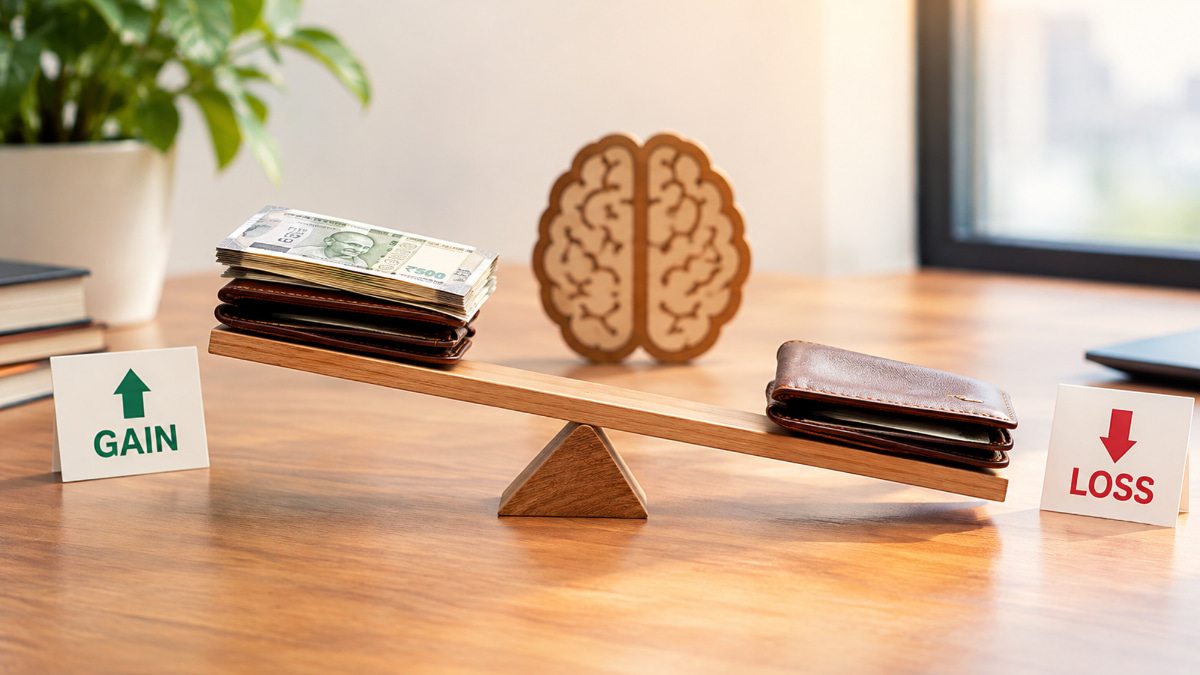
Here is the interesting part: The emotional pain of losing ₹1,000 can be greater than the happiness of gaining ₹1,000. The amount of money is exactly the same, but your mind does not treat the two experiences equally.
This tendency is known as loss aversion, one of the most important ideas in behavioural economics. It explains why people often make poor financial decisions, hesitate to invest, sell investments too early, or hold on to losing stocks for years.
The concept became widely known through the work of psychologists Daniel Kahneman and Amos Tversky. Kahneman explored this and many other features of human thinking in his influential book Thinking, Fast and Slow.
Understanding loss aversion is not just an interesting psychological exercise. It can change how you save money, invest, spend, borrow, and make important decisions about your future.
“A loss is not always the end of your wealth; sometimes, refusing to accept it is what makes the loss bigger.”
Why Loss Feels So Painful
For a long time, economists often assumed that people make decisions by logically calculating the possible benefits and costs. If gaining ₹1,000 makes you happier by a certain amount, losing ₹1,000 should create an equal amount of unhappiness.
But real human behaviour does not always work that way.
Kahneman and Tversky’s research on prospect theory showed that people evaluate financial outcomes relative to a reference point. That reference point might be the money they currently have, the price they paid for an investment, or what they expected to receive.
Suppose you have ₹10,000 in your bank account. If someone gives you another ₹1,000, your balance becomes ₹11,000. You are likely to feel pleased, but your entire life may not change.
Now imagine that your balance falls from ₹10,000 to ₹9,000 because of an unexpected expense. You may immediately feel that something has gone wrong. You might start worrying about your budget, upcoming bills, or whether you will have enough money for the month.
The financial difference is the same: ₹1,000. The emotional response is not.
Loss aversion means that losses tend to have a stronger psychological impact than equivalent gains. The mind pays special attention to what has been taken away, what has gone wrong, and what might become worse.
Think about a child who receives ten chocolates. If you give the child two more, the child is happy. But if you take two chocolates away, the child may protest strongly. The child is not necessarily being unreasonable. The brain is reacting differently to gaining something and losing something already possessed.
This tendency may have developed partly because avoiding danger and protecting existing resources were important for survival. Losing food, shelter, money, or social support could have serious consequences. However, the same mental tendency that helped our ancestors remain cautious can sometimes create problems in modern financial life.
The important lesson is that your emotional reaction is not always an accurate measurement of the financial importance of an event. A small loss may feel enormous, while a valuable long-term gain may feel less exciting.
The ₹1,000 Experiment
Let us consider a simple example.
Imagine that you are offered a choice between two options.
Option A guarantees that you will receive ₹1,000.
Option B gives you a 50% chance of receiving ₹2,000 and a 50% chance of receiving nothing.
Both options have the same expected monetary value of ₹1,000. If you were making the decision only by calculating the average outcome, you might consider them equally attractive.
However, many people prefer the guaranteed ₹1,000 because they dislike uncertainty. They do not want to risk receiving nothing.
Now change the situation.
Imagine you have already received ₹2,000, but someone tells you that you must choose between two options:
Option A guarantees that you will lose ₹1,000.
Option B gives you a 50% chance of losing ₹2,000 and a 50% chance of losing nothing.
Again, both options have an expected loss of ₹1,000.
Yet many people become more willing to gamble when facing a loss. They may choose Option B because the possibility of avoiding the loss feels attractive, even though there is also a chance of losing more.
This is one of the patterns described by prospect theory. People do not always evaluate gains and losses in the same way. Their decisions depend on whether they feel they are moving into a gain or trying to escape a loss.
The original research by Kahneman and Tversky used carefully designed experiments involving hypothetical and real choices. It showed that people often behave inconsistently with traditional models of perfectly rational decision-making.
The lesson is not that people are incapable of logic. It is that emotions, reference points, and the way a decision is presented can influence financial choices.
This becomes especially important when money is involved in investments, where outcomes are uncertain and prices change constantly.
Consider two investors.
Investor A buys a stock for ₹10,000. After a few months, its value rises to ₹11,000. The investor feels satisfied and sells it to secure the ₹1,000 gain.
Investor B buys another stock for ₹10,000. Its value falls to ₹9,000. The investor refuses to sell because doing so would mean accepting a ₹1,000 loss. Instead, the investor keeps waiting, hoping that the price will return to the original purchase price.
Both investors are reacting to a change of ₹1,000. But their behaviour is very different.
Investor A may be taking profits too quickly. Investor B may be holding on to a poor investment for too long. Neither decision is automatically correct simply because it feels emotionally comfortable.
How Loss Aversion Damages Investing
Investing is one of the areas where loss aversion can have the greatest impact.
The value of stocks, mutual funds, bonds, and other investments can rise and fall. Even a well-planned portfolio may experience temporary declines. If you cannot tolerate seeing the value of your investments fall, you may make decisions based on fear rather than on your long-term financial goals.
Imagine that you invest ₹1,00,000 in a diversified equity mutual fund. After several months, the market declines, and your investment is now worth ₹85,000. You see a loss of ₹15,000 on your investment statement.
Your first reaction might be, “I have lost ₹15,000. I must get out before things become worse.”
This reaction is understandable. Seeing your hard-earned money decline can be painful. But the decision to sell should not be based only on the emotional discomfort of the loss.
You need to ask more useful questions. Has your investment goal changed? Has the underlying portfolio become unsuitable for your risk tolerance? Has the fund’s strategy or quality changed? Or is the decline part of a normal period of market volatility?
If the investment remains appropriate for your goals, selling purely because of fear may turn a temporary decline into a permanent loss. On the other hand, holding an unsuitable investment merely because you cannot bear to accept a loss can also be harmful.
Loss aversion can create two opposite problems.
The first is panic selling. When markets fall, investors become frightened and sell their investments to escape further losses. If markets later recover, these investors may miss part of the recovery. They might then hesitate to invest again because they fear another decline.
The second is holding on to losing investments for emotional reasons. An investor buys a stock at ₹500. Its price falls to ₹300 because the company’s business is deteriorating. Instead of reassessing the investment, the investor says, “I will sell only when it comes back to ₹500.”
But the original purchase price is not a guarantee of future value. The market does not know or care what price you paid.
A stock does not become a good investment simply because you want to recover your money. Sometimes, accepting a loss and moving the remaining money into a better opportunity is the more sensible decision.
This behaviour is related to another psychological tendency called the disposition effect—the tendency of investors to sell winning investments relatively quickly while holding losing investments for too long. Research in behavioural finance has documented this pattern in many investment settings.
Loss aversion can also make investors prefer investments that appear safe but may not keep pace with inflation. Someone may avoid a diversified equity investment entirely because they fear short-term losses, even when their financial goals require long-term growth.
The solution is not to ignore risk. The solution is to distinguish between temporary price movements, permanent financial damage, and investments that no longer fit your plan.
The Cost of Emotional Decisions
Loss aversion does not affect only stock markets. It influences everyday financial decisions in ways that may be difficult to notice.
Imagine that you buy a gym membership for ₹12,000 for an entire year. After two months, you realise that the gym is too far from your home, the timings do not suit you, and you rarely go.
You continue paying attention to the membership because you do not want to feel that your ₹12,000 has been wasted. You tell yourself, “I have already paid, so I must keep going.”
But the money has already been spent. Whether you attend the gym tomorrow should depend on whether it benefits you now, not on how much you paid in the past.
This is closely related to the sunk cost fallacy. Loss aversion can make people uncomfortable with accepting that a previous decision did not work. As a result, they may continue spending time, energy, or money simply to avoid admitting a loss.
The same thing happens in business.
A business owner invests ₹5 lakh in a project. After a year, the project is clearly losing money and has little potential. Instead of examining the facts, the owner keeps investing more because abandoning the project would mean accepting that the original ₹5 lakh did not produce the expected result.
This can turn a manageable loss into a much larger one.
Loss aversion also influences shopping. A person may buy something expensive because it is advertised as being “50% off.” Later, the person may refuse to return it, even when the product is unnecessary, because returning it feels like giving up a special opportunity.
In another situation, someone might refuse to negotiate a salary or business contract because they fear losing an existing benefit. They may accept an unfair arrangement simply because the possibility of losing what they already have feels more painful than the possibility of gaining something better.
Even saving money can be affected. Some people avoid reviewing their financial statements because they are afraid of discovering losses or mistakes. But avoiding information does not protect wealth. It only delays the opportunity to make improvements.
The common thread is simple: When avoiding emotional pain becomes more important than evaluating reality, financial decisions can become expensive.
How to Make Better Decisions
Loss aversion is a natural part of human psychology. You cannot simply command yourself never to feel bad about losing money. But you can create systems that prevent temporary emotions from controlling important financial decisions.
The first step is to understand your reference point. Ask yourself, “Why does this loss feel so painful?” Is it because you genuinely need the money? Is it because you expected a different result? Or is it because you are comparing your current position with an earlier, more comfortable one?
For example, if your investment falls from ₹1,00,000 to ₹90,000, the loss may feel overwhelming. But if your original plan was to invest for fifteen years, a short-term decline should be evaluated in the context of that time horizon. This does not mean the loss is unimportant. It means the decision needs a broader perspective.
The second step is to create a financial plan before emotions become intense. Decide how much money you need for emergencies, how much you can invest for the long term, and how much risk you can realistically tolerate. An emergency fund can reduce the pressure to sell long-term investments during a difficult period.
A suitable asset allocation can also help. If you invest more money in volatile assets than you can emotionally or financially handle, market declines may push you into panic selling. A balanced plan should consider your goals, time horizon, financial situation, and risk tolerance.
The third step is to separate the decision from the result. A good decision can sometimes produce a bad outcome, and a poor decision can occasionally produce a good outcome.
Suppose you research an investment carefully, understand its risks, and invest an amount suitable for your goals. If the market falls unexpectedly, that does not automatically mean your decision was foolish.
Similarly, if you invest in a risky stock without research and happen to make a large profit, the result does not prove that the decision was wise.
Evaluating the quality of your process helps you avoid being controlled by short-term outcomes.
The fourth step is to use rules instead of relying entirely on feelings. You might decide to review your investments at fixed intervals rather than checking prices every few minutes. You might establish clear criteria for buying, selling, or rebalancing. You might also use automatic monthly investments if they suit your circumstances and goals.
These approaches do not eliminate risk. They reduce the chance that fear or excitement will dominate every decision.
Finally, learn to accept small, manageable losses as a normal part of financial life. Not every investment will succeed. Not every business idea will work. Not every purchase will be useful. The goal is not to avoid every possible loss. That is impossible.
The goal is to prevent one uncomfortable loss from causing a much bigger financial mistake.
Protect Your Future, Not Your Ego
There is a deeper lesson behind loss aversion: People often try harder to avoid feeling like they have lost than to improve their actual financial position.
An investor may hold a declining stock because selling would feel like admitting a mistake. A business owner may continue funding a failing project because abandoning it feels humiliating. A person may keep an expensive subscription because cancelling it makes the original payment feel wasted.
In each case, the mind is trying to protect something. Sometimes it is protecting money. But sometimes it is protecting pride, identity, or the belief that a previous decision was correct.
This is where financial maturity begins. You learn to ask, “What decision will serve me best from this point forward?” rather than, “How can I avoid admitting that I lost?”
Imagine that you have ₹50,000 left after an investment falls sharply. You can spend the next year hoping that the investment returns to its original value, or you can objectively evaluate whether the remaining ₹50,000 is in the right place.
The past loss matters. It may affect your goals and your financial situation. But it should not automatically control every future decision.
A useful question to ask is: “If I did not already own this investment, would I buy it today at its current price?” This question helps you examine the present opportunity instead of becoming trapped by the original purchase price.
You can also imagine advising a friend. If your friend were holding an investment that no longer made sense, would you tell them to keep it merely because they disliked accepting a loss? Or would you encourage them to look at the facts?
Sometimes, we give better advice to others because we are not carrying the same emotional burden.
The most successful financial decisions are not always the ones that feel best in the moment. Sometimes, the right decision feels uncomfortable because it requires accepting reality, changing direction, or admitting that a previous plan did not work.
That discomfort is not necessarily a sign of failure. It may be the price of learning.
Conclusion: The Loss You Must Not Ignore
Losing ₹1,000 may hurt more than winning ₹1,000 feels good because the human mind does not treat gains and losses equally. Loss aversion makes financial setbacks feel heavier, risks appear more threatening, and previous decisions harder to abandon.
This tendency can protect us from careless behaviour, but it can also lead to panic selling, poor investments, unnecessary spending, and decisions driven by pride rather than facts.
You do not need to become emotionless to become financially wiser. You need to recognise when your emotions are trying to protect you from the discomfort of a loss.
The next time an investment falls, a business plan fails, or you realise that you have spent money on something unnecessary, pause before reacting. Ask yourself whether you are protecting your future—or simply trying to avoid the feeling of losing.
Because the biggest financial loss is not always the ₹1,000 that disappears from your wallet.
Sometimes, it is the opportunity you sacrifice because you were too afraid to accept a small loss.