
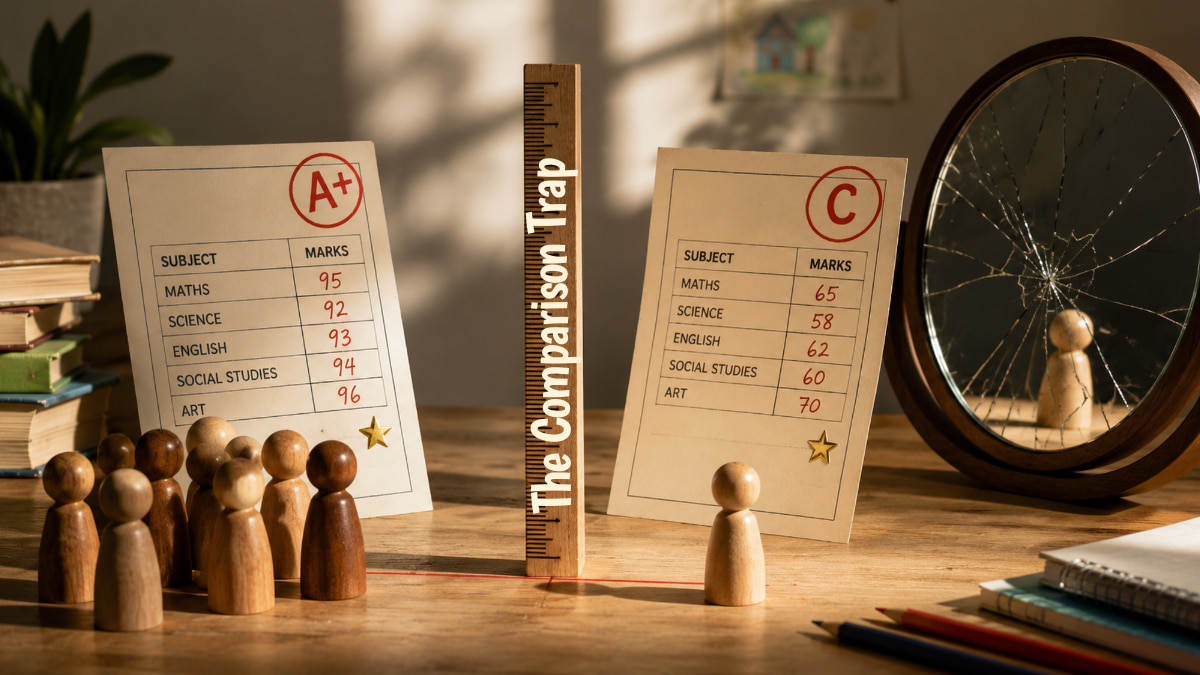
Every parent wants their child to succeed. They want good grades, good habits, discipline, confidence and a secure future. But in trying to push their children toward success, many parents unknowingly use one of the most damaging tools in parenting: comparison. “Look at your cousin. He studies so much.” “Your friend scored 95. Why can’t you?” “Your sister is so responsible. Learn something from her.” These statements may sound harmless to an adult, but to a child, they can carry a very different message: “Someone else is better than me.”
The intention behind comparison is usually good. Parents are rarely trying to make their children feel inferior. They are trying to motivate them, correct them or show them what is possible. But children do not always hear the intention behind the words. They hear the judgment. And when comparison becomes a regular part of parenting, it can slowly change the way a child sees themselves.
A 2024 study published in the Journal of Experimental Child Psychology examined parental social comparison and children’s self-concept and mastery motivation. The research included 194 parents and 102 preschool children. Interestingly, parents sometimes viewed comparison as motivating, while children’s own reports showed that parental comparison could be negatively associated with mastery motivation through a weaker self-concept.
This reveals an important parenting lesson: what parents believe they are communicating and what children actually experience can be two very different things.
“Don’t measure your child against someone else’s journey; help them discover the strength in their own.”
When Comparison Becomes a Habit
Comparison often starts with something small. A parent notices that another child wakes up early, reads more books, gets better grades or behaves more responsibly. The parent looks at their own child and thinks, “Why can’t my child do the same?” Then comes the familiar sentence: “You should learn from him.”
The parent sees this as advice. The child may hear it as rejection.
The problem becomes bigger when the comparison is repeated. One conversation may not have a lasting effect, but years of hearing that another child is smarter, more disciplined, more talented or more successful can gradually become part of a child’s identity. Instead of thinking, “I need to improve my mathematics,” the child may begin thinking, “I am bad at mathematics.” Instead of saying, “I need to work harder,” they may conclude, “I am not as capable as other children.”
This distinction is extremely important. A child should be able to separate performance from identity. Getting a low mark does not mean the child is unintelligent. Losing a competition does not mean they are a loser. Making a mistake does not mean they are careless. But frequent comparison can blur these boundaries.
Children are also still developing their understanding of themselves. During early childhood, parents play an important role in shaping how children understand their own abilities and worth. The 2024 research on parental comparison found that children’s self-concept may be an important pathway connecting comparison with their motivation to master challenging tasks.
That means a sentence intended to produce improvement can sometimes produce the opposite result. Instead of thinking, “I can become better,” the child starts thinking, “I am simply not good enough.”
Why Comparison Kills Confidence
Confidence does not come from constantly being told that you are better than others. Real confidence comes from experiencing progress. A child attempts something difficult, struggles, practices, makes mistakes, learns something new and eventually improves. Each small experience teaches the brain, “I can handle difficult things.”
Comparison can interfere with this process because it changes the focus from growth to ranking.
Imagine a child scores 80 marks. The parent says, “Your friend scored 92. Why are you behind?” The child may have improved significantly from the previous examination, but that achievement becomes invisible. The only thing that matters now is the gap between the child and someone else.
The child therefore learns an unhealthy lesson: improvement is not enough. Someone else must be defeated.
This can create anxiety around performance. If another child is always the standard, there will almost always be a reason to feel inadequate. There will always be someone who scores higher, runs faster, speaks better, earns more, looks different or achieves something earlier.
Eventually, the child may stop enjoying learning because every activity becomes a competition.
This is particularly dangerous when children begin avoiding challenges. If a child already believes that others are more capable, difficult tasks can feel threatening. Why attempt something where failure might confirm what they already believe about themselves?
The research on parental social comparison supports this concern. In the 2024 study, children who perceived more parental comparison showed a negative relationship between comparison and mastery motivation through their self-concept. In simple terms, when children felt that their parents were constantly comparing them with others, the way they viewed themselves could affect their willingness to take on challenges.
A parent may think comparison creates pressure to perform. But too much pressure can create fear of failure instead.
The Damage You Cannot See
The most worrying part of comparison is that its damage is often invisible. A child may continue attending school, completing homework and participating in activities. From the outside, everything may look perfectly normal. But inside, the child may be developing a harsh internal voice.
They may begin comparing themselves automatically. A friend gets higher marks, and they feel inferior. Another child wins a competition, and they feel jealous. Someone receives praise from a teacher, and they wonder why they are never good enough. Eventually, the parent may not even need to make the comparison because the child has learned to do it themselves.
This can create perfectionism, fear of failure and reluctance to try new things. Some children respond by working excessively hard because they feel they must constantly prove themselves. Others respond in the opposite way and stop trying because they believe the result has already been decided.
The second response is often misunderstood as laziness. But sometimes what looks like laziness is actually discouragement. If a child repeatedly experiences the message that someone else is always better, giving up can become emotionally safer than trying and failing again.
Sibling comparison can be particularly damaging. Telling one child, “Why can’t you be responsible like your brother?” may create temporary obedience, but it can also turn siblings into competitors. Instead of celebrating each other’s success, children may begin seeing one another as threats to parental approval.
That is not the kind of competition children need.
Life will provide enough competition later. School, careers, sports, social media and society will constantly show children people who appear more successful. Home should not become another scoreboard.
Home should be the place where children can fail without losing their sense of belonging.
Compare Progress, Not People
The solution is not to stop expecting anything from children. Children need standards, discipline, boundaries and honest feedback. Parents should absolutely tell children when they are avoiding responsibility or not putting in enough effort. The key is to correct behaviour without attacking identity.
Instead of saying, “Why can’t you study like your friend?” a parent can ask, “What is making studying difficult for you?” Instead of saying, “Your sister is much more organized,” they can say, “Let’s find a routine that helps you manage your time better.”
The difference may look small, but the message is completely different.
One message says, “You are inferior to someone else.”
The other says, “You have a problem we can solve.”
Parents can also shift the comparison from other people to the child’s own progress. Instead of asking whether the child scored higher than a classmate, ask whether they understood something that they struggled with previously. Instead of asking whether they won, ask what they learned. Instead of focusing only on the final result, notice the process that produced it.
This teaches children that improvement is within their control.
Specific feedback is particularly useful. Rather than saying, “You are brilliant,” parents can say, “You kept working even when that problem was difficult.” Rather than saying, “You are the best,” they can say, “Your preparation improved this time, and it showed in your result.”
This kind of feedback connects achievement with behaviour and effort rather than creating a fixed identity.
The goal is not to make children believe they are better than everyone else. The goal is to help them believe they can learn, improve and handle challenges.
Give Them a Stronger Voice
Parents have enormous influence over the voice that eventually develops inside a child’s head. If children repeatedly hear, “Why aren’t you like him?” they may eventually say the same thing to themselves.
But if they repeatedly hear, “You can learn this,” “Mistakes are part of learning,” “Let’s figure this out,” and “You don’t have to be like someone else,” they may develop a very different inner voice.
That voice can stay with them long after childhood.
Imagine a teenager facing an examination, a job interview or a difficult decision. The world will already be asking, “Are you good enough?” They do not need their parents’ voice adding to that pressure. They need an inner voice saying, “I may not know everything yet, but I can learn.”
That is real confidence.
And perhaps this is the most important shift parents can make: stop asking, “How does my child compare with other children?” and start asking, “Is my child becoming a stronger version of themselves?”
Every child develops at a different pace. One may excel academically while another excels socially. One may discover a talent at ten while another discovers it at twenty. One may be confident early while another needs more time. Childhood is not a race with one finish line.
The child who scores the highest today is not guaranteed to have the best life tomorrow. The child who struggles today is not destined to remain behind forever.
What matters is whether the child develops the confidence to keep learning.
Don’t Make Comparison Their Inner Voice
Think about the last time you compared your child with someone else. Maybe you said it casually. Maybe you were frustrated. Maybe you genuinely believed the comparison would motivate them. You may have forgotten the sentence minutes later.
Your child may remember it for years.
This is why parenting is so powerful. We often measure our influence by the big things we do for our children, but sometimes it is the repeated small sentences that shape them the most.
Your child does not need to be better than their cousin. They do not need to beat their sibling. They do not need to become the smartest person in the classroom.
They need to know that they are capable of growth.
So the next time you are tempted to say, “Look at that child,” pause for a moment.
Look at your own child instead.
Ask what they are struggling with. Ask what they are learning. Ask what support they need. Ask what progress they have made.
Because the ultimate goal of parenting is not to raise a child who constantly looks around to see who is ahead.
It is to raise a child who can look in the mirror and confidently say:
“I don’t have to be better than everyone else. I just have to keep becoming better than I was yesterday.”