
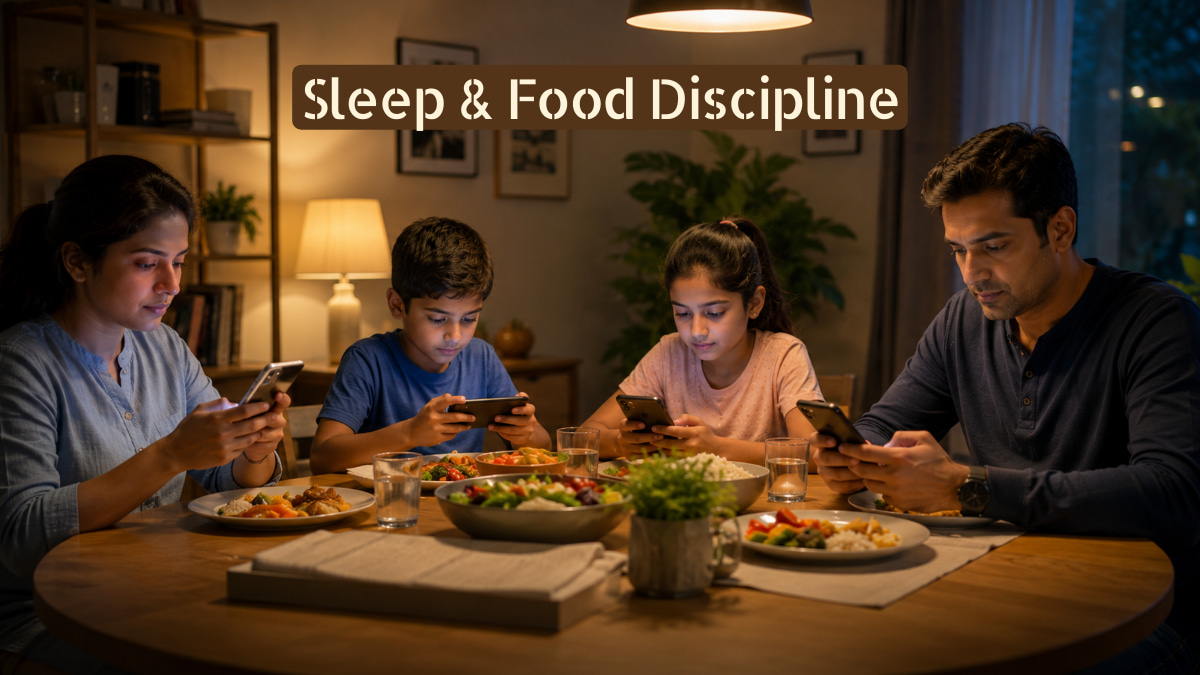
A generation ago, people rarely needed reminders about sleep and food discipline. Life naturally followed a rhythm. People worked during the day, rested at night, and ate meals at relatively fixed times. Today, however, modern life has changed the environment around us. Work continues beyond office hours, entertainment never ends, smartphones stay active 24 hours a day, and food is available with just a few clicks.
This convenience has improved many aspects of life, but it has also created new challenges. Many people are sleeping later, eating without awareness, skipping proper meals, and spending more time looking at screens than listening to their body’s signals. Children are growing up in an environment where mobile phones are present during study, play, entertainment, and even family meals.
The result is visible everywhere. People are increasingly struggling with tiredness, poor concentration, weight gain, stress, lifestyle diseases, and reduced emotional balance. The problem is not a lack of knowledge. Most people already understand that sleep and healthy food are important. The real challenge is maintaining discipline in a world designed to constantly distract us.
Sleep and food are not ordinary habits. They are the foundation of physical health, mental performance, emotional stability, and long-term success. In today’s culture, where convenience often defeats consistency, discipline around sleep and eating has become non-negotiable.
“Take care of your body today, because it is the only place you have to live tomorrow.” – Jim Rohn
The Modern World Is Fighting Our Natural Rhythm
Human beings evolved with a natural biological clock. For thousands of years, sunlight guided our waking hours, darkness signalled rest, and food availability followed natural patterns. Our bodies developed systems that depend on regularity.
However, modern lifestyles have changed faster than human biology can adapt. Artificial lights allow us to stay awake late into the night. Smartphones, social media, online videos, and streaming platforms constantly stimulate the brain when it should be preparing for rest. Many people sleep with their phones beside them and check notifications even before getting out of bed.
This disruption affects the body’s circadian rhythm, the internal clock that controls sleep, hormones, metabolism, and many other functions. When this rhythm is disturbed regularly, the body experiences stress.
Food habits have also changed dramatically. Earlier generations mostly consumed fresh, home-prepared meals. Today, ultra-processed foods, sugary drinks, fast food, and packaged snacks have become common parts of daily life. These foods are designed for convenience and taste, but frequent consumption can negatively affect health.
According to the World Health Organization, obesity worldwide has nearly tripled since 1975. The rise of obesity, diabetes, heart disease, and other lifestyle-related conditions is closely connected with changes in diet, physical activity, and daily routines.
The modern world gives us more choices than ever before, but without discipline, those choices can easily work against our health.
Sleep Is Not Wasted Time, It Is Recovery Time
One of the biggest mistakes of modern culture is treating sleep as something that can be sacrificed. Many people proudly say they sleep only four or five hours because they are busy working, building a career, or managing responsibilities. However, science shows that chronic sleep deprivation reduces performance rather than increasing it.
Sleep is not a passive activity. It is a powerful biological process where the body repairs itself and the brain performs essential maintenance. During quality sleep, memories are strengthened, damaged cells are repaired, hormones are balanced, immune function improves, and the brain clears metabolic waste.
Research by sleep scientist Matthew Walker and other researchers has shown that insufficient sleep affects almost every major system of the body. Adults generally need around seven to nine hours of sleep for optimal health, although individual needs may vary.
Poor sleep affects daily life in many ways. A tired brain struggles with concentration, creativity, patience, and decision-making. Sleep deprivation weakens the part of the brain responsible for self-control, making people more likely to make unhealthy choices.
This is why people often crave sugary foods after a poor night’s sleep. Lack of sleep increases hunger-related hormones and reduces signals that tell us we are full. As a result, tired people often consume more calories without realizing it.
Long-term sleep problems have been associated with higher risks of obesity, type 2 diabetes, heart disease, weakened immunity, anxiety, and depression.
Sleep should not be viewed as a luxury reserved for people who have finished all their work. It should be viewed as the foundation that allows us to perform better in every area of life.
Food Discipline in the Age of Distraction
Food is not just something that fills our stomach. It directly influences our energy, hormones, brain function, immunity, and overall health. Every meal sends signals to our body about how to function.
Unfortunately, today’s food environment encourages impulsive eating. Many foods are created to provide immediate pleasure rather than long-term nourishment. High amounts of sugar, refined carbohydrates, unhealthy fats, and artificial ingredients can make people crave more even when the body has received enough energy.
Research published in medical journals has linked higher consumption of ultra-processed foods with increased risks of obesity, cardiovascular problems, diabetes, and other chronic diseases.
However, food discipline does not mean following extreme diets or avoiding every enjoyable food. It means developing awareness. It means understanding what the body needs and creating balance.
One of the biggest challenges today is distracted eating. A common scene in many homes is children eating while watching videos on mobile phones, and adults scrolling through social media while having meals. The dining table, which was once a place for family connection, is increasingly becoming another screen time zone.
When people eat while distracted, they pay less attention to their food. The brain does not properly register taste, quantity, or fullness signals. This can lead to overeating and unhealthy food choices. Research on mindful eating suggests that paying attention during meals helps improve eating behaviour and satisfaction.
For children, mobile use during meals can have deeper consequences. Family meals provide an important opportunity for conversation, emotional connection, and learning healthy habits. When screens replace interaction, children lose valuable moments of communication and relationship building.
Parents often worry about what children eat, but they should also consider how children eat. A child who learns to eat slowly, enjoy food, and participate in family conversations develops healthier habits for life.
Simple rules like keeping phones away from the dining table, eating meals together whenever possible, and creating fixed meal timings can make a significant difference.
Sleep and Food Create a Powerful Health Cycle
Sleep and food are deeply connected. Improving one area often improves the other, while ignoring one can damage the other.
A person who sleeps poorly often feels tired throughout the day. To compensate, they may depend on caffeine, sugary snacks, or processed foods for quick energy. These choices can disturb blood sugar levels and affect sleep quality later.
Similarly, eating heavy meals late at night, consuming excessive sugar, or maintaining irregular meal timings can interfere with the body’s natural sleep cycle.
On the other hand, good sleep improves self-control and decision-making. When people are well-rested, they are more likely to choose nutritious foods, exercise regularly, and maintain healthier routines.
This relationship is especially important for children and teenagers. Their bodies and brains are still developing, making quality sleep and nutrition essential. Studies have shown that children with better sleep routines often perform better academically, have improved attention, and display better emotional regulation.
Parents play the most important role because children copy what they observe. If adults constantly use phones during meals, sleep late, or choose unhealthy habits, children naturally learn the same behaviour.
Healthy habits are not only taught through advice. They are transferred through daily examples.
Discipline Creates Long-Term Freedom
Many people see discipline as a restriction, but true discipline creates freedom. A person who protects their sleep has more energy. A person who eats mindfully has better health. A person with better health has more opportunities to enjoy life and pursue meaningful goals.
The biggest mistake in today’s culture is focusing only on short-term comfort while ignoring long-term consequences. Staying awake late feels enjoyable in the moment. Scrolling endlessly feels relaxing. Eating unhealthy food feels satisfying temporarily. But repeated choices shape our future health.
Success is not built only through ambition, intelligence, or hard work. It is built on the foundation of daily habits. A tired brain cannot perform at its best. A neglected body cannot support great dreams for long.
The future quality of our life is being created by ordinary decisions made every day. The choice to sleep on time. The choice to eat without a screen. The choice to give our body real nourishment instead of constant convenience.
In a world where everything demands our attention, protecting our basic biological needs has become an act of self-respect.
Years from now, people will not regret the extra hour they spent sleeping or the healthier meal they chose. They will appreciate the energy, health, and mental clarity those small decisions created. Sleep and food discipline may look simple, but they quietly decide how long, how healthy, and how meaningful our journey through life becomes.