Have you ever started something with great enthusiasm, only to find that your motivation gradually fades? Perhaps you set an ambitious goal, made a firm decision to change, or promised yourself that this time you would stay consistent. In the beginning, the goal felt important, the benefits seemed clear, and you genuinely believed you could follow through.
But as time passed, other priorities took over. The goal that once occupied your mind began to feel less urgent. You did not necessarily abandon it or change your mind. You simply found yourself thinking about it less and acting on it less often.
Why does this happen? Does our willpower become weaker, or is something else happening inside our brains?
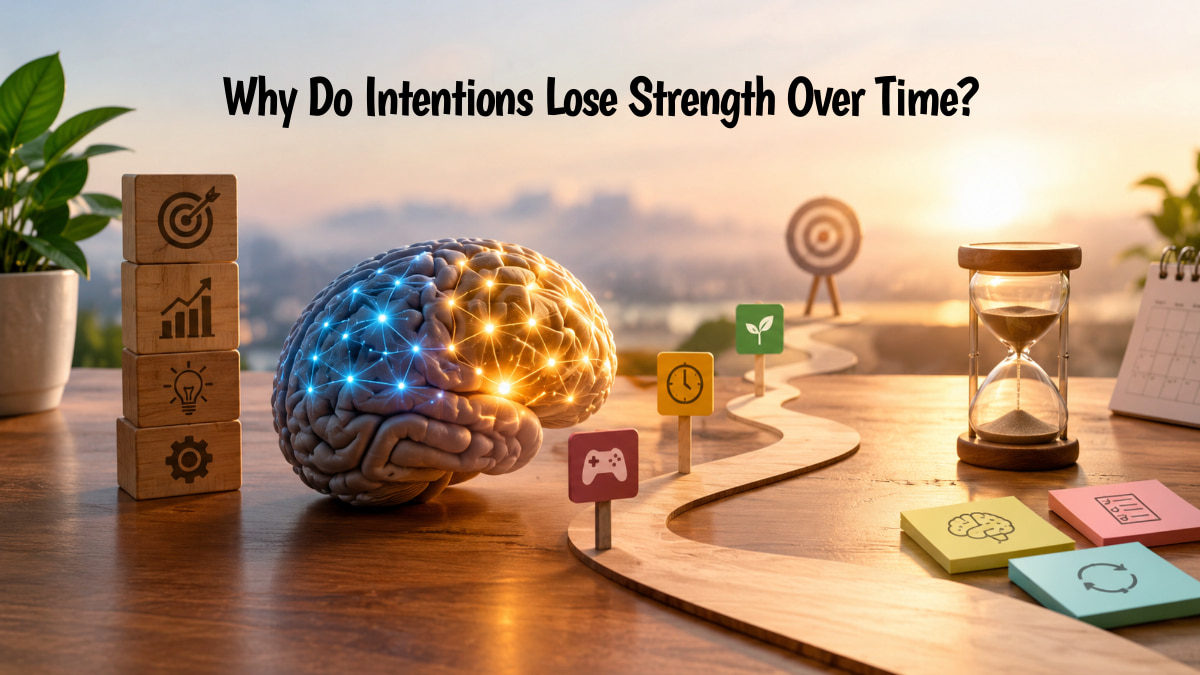
The answer is more interesting than we might expect. Our intentions do not always translate into consistent action because our attention shifts, immediate rewards compete with future benefits, and established habits can influence our behaviour more strongly than we realise.
Understanding these processes can help us stop relying entirely on motivation and build better ways to follow through on what matters.
“A strong intention sets the direction, but consistent action determines how far you go.”
Why Intentions Fade
One important distinction can help us understand this problem: knowing that a goal matters to us is not the same as keeping it important in our everyday decisions.
When we set a new goal, our attention is usually focused on it. We think about the outcome, imagine the benefits, and consider how achieving it might improve our lives. At that moment, the goal is mentally accessible, meaning it comes to mind easily and can influence our decisions.
However, our attention does not remain fixed on one thing. New information, competing responsibilities, changing circumstances, and immediate demands constantly influence what we think about. As our attention shifts, the goal may become less prominent in our minds.
This does not mean that we have forgotten the goal completely or that it has stopped mattering to us. Instead, it may no longer come to mind at the moments when it needs to influence our behaviour.
Psychology studies related processes through concepts such as goal accessibility and attention. In simple terms, information that is readily available in our minds is often better positioned to influence our thinking and decisions. However, this influence depends on the situation and is not automatic in every case.
Consider the difference between having a long-term goal and actively using that goal to guide your choices. You may genuinely want to become financially secure, develop a valuable skill, or build a successful business. Yet, when you make individual decisions, that larger goal may not always be at the front of your mind.
The problem is not necessarily that the goal has become less important. The problem may be that its importance is not consistently reflected in your daily decisions.
This is why setting a goal once and then assuming it will guide your behaviour indefinitely is often insufficient. We need ways to bring our priorities back into focus.
One practical approach is to revisit the reason behind a goal periodically. Ask yourself why it matters, what achieving it would change, and what might happen if you continue postponing the necessary actions. This is not about thinking constantly about your ambitions. It is about ensuring that important goals remain relevant when decisions need to be made.
A goal becomes more useful when it does not merely exist in your mind but also influences the choices you make along the way.
Why We Choose Now Over Later
Imagine two options. You can enjoy something rewarding today, or you can put in some effort now to receive a potentially greater benefit several months from now. You understand that the second option may be better for your future, yet the first feels more attractive in the moment.
Why does this happen?
One explanation comes from a psychological phenomenon known as temporal discounting. It describes the tendency for people to value rewards less when those rewards are delayed, compared with rewards they can receive sooner. The strength of this tendency varies between people and situations, but it can have a significant influence on decisions.
For example, saving money can support long-term financial security, while spending it may provide immediate satisfaction. Learning a valuable skill may improve future opportunities, while avoiding the effort feels easier today. Building a business may require months or years of consistent work, even though the rewards remain uncertain at the beginning.
In each case, the future benefit may be substantial, but it is distant. The immediate reward, by contrast, is available right now.
This creates a conflict between what we know is beneficial over the long term and what feels attractive in the present. We can understand the value of a future outcome intellectually without feeling its importance as strongly when faced with an immediate choice.
Importantly, this does not mean that people always choose immediate pleasure. We save for retirement, pursue difficult qualifications, build companies, and make sacrifices for our families. Human beings can plan for the future. However, immediate rewards can compete with long-term intentions, especially when the future benefit feels uncertain or distant.
How can we use this knowledge to our advantage?
First, recognise the moment when a short-term desire begins competing with a long-term priority. Instead of immediately blaming yourself for lacking discipline, identify the actual choice in front of you.
Second, translate the distant goal into a clear action you can take now. Financial independence, for example, is a long-term outcome. Reviewing your spending, following a sensible savings plan, or making a considered investment decision are actions that can support it today.
Third, avoid leaving important decisions entirely to how you feel in the moment. You can establish rules in advance, simplify good choices, and create boundaries around decisions that repeatedly pull you away from your priorities.
The aim is not to eliminate every immediate pleasure or make life unnecessarily difficult. It is to prevent short-term attractions from repeatedly undermining outcomes that matter more to you in the long run.
Making better long-term decisions requires more than knowing what is good for you. It requires a way to protect that knowledge when an immediate reward becomes tempting.
How Habits Override Intentions
Many people assume that once they have made a clear decision, their behaviour should naturally follow. Unfortunately, deciding to change and consistently acting differently are two separate challenges.
Psychologists often describe this as the intention–behaviour gap: the difference between what people intend to do and what they actually do.
A person may sincerely intend to make more thoughtful decisions, improve their professional skills, manage money more carefully, or become more consistent in their work. Yet, the intention alone does not guarantee that the desired behaviour will follow.
One reason is that much of our behaviour is influenced by habits and familiar responses. When a behaviour has been repeated in similar circumstances, it can become increasingly automatic. We do not need to reconsider every detail each time; familiar situations can begin to trigger familiar actions.
This automaticity is useful. It reduces the mental effort required for many activities. However, it can also create difficulties when an old pattern conflicts with a new goal.
Imagine someone who has spent years making decisions quickly under pressure. They now decide to become more analytical and careful. The intention is genuine, but when a difficult situation arises, the familiar response may still be to act immediately rather than pause and evaluate the available information.
Simply remembering the new intention may not be enough. The person also needs to practise a different response and create a process that supports it.
This leads to an important distinction: an intention describes what we want to do, while our habits and behaviour patterns influence what we actually do.
The solution is not to treat habits as permanent or to assume that change is impossible. Rather, we need to understand the conditions that maintain existing behaviour and deliberately practise alternatives.
Ask yourself a few questions. In which situations do you repeatedly make decisions that conflict with your goals? What usually happens just before you abandon your plan? Is the old behaviour triggered by pressure, uncertainty, discomfort, or the attraction of an easier option?
These questions can reveal patterns that general promises to improve often fail to address.
Once you identify the pattern, you can work on changing your response to it. Instead of repeatedly telling yourself to be more disciplined, decide what discipline should look like in the specific situation where you tend to struggle.
For instance, if uncertainty causes you to delay important decisions, you might establish a clear process for gathering information, setting a decision deadline, and evaluating your options. If pressure leads you to act impulsively, you might make pausing and reviewing the facts part of your decision-making process.
The exact solution will depend on the behaviour, but the principle remains the same: meaningful change often requires more than a stronger intention. It requires a different response that can be practised consistently.
Turning Intentions into Action
Psychological research offers several ways to improve the chances that intentions will lead to action. Two particularly useful approaches are implementation intentions and mental contrasting.
Implementation Intentions: Plan Your Response
Psychologist Peter Gollwitzer conducted influential research on implementation intentions. The central idea is simple: do not merely decide what you want to achieve. Decide what you will do when a specific situation arises.
Compare these two statements:
“I will make better decisions.”
“When I feel pressured to make an important decision immediately, I will pause, review the available information, and then decide.”
The first statement expresses a general intention. The second connects a particular situation with a planned response.
This is often described as an if–then plan: if a particular situation occurs, then I will take a specific action.
Why can this help?
When a situation arises, we may have limited attention, feel emotional pressure, or be tempted by an immediate reward. If we have already decided how to respond, we may not need to develop an entirely new plan in that moment.
A clear plan can help direct our attention towards the intended behaviour and reduce the uncertainty surrounding what to do next.
This approach can be applied to many goals. Someone who wants to manage their finances more carefully might decide in advance to review the costs and alternatives before making a significant purchase. A professional who wants to improve the quality of their decisions might establish a checklist to use before committing to a major choice.
The important point is that the plan should be specific, realistic, and connected to a situation that genuinely occurs. A vague plan such as “I will work harder” offers little guidance when a real obstacle appears.
Implementation intentions do not guarantee success, and their effectiveness depends on factors such as the person, the goal, and the situation. Nevertheless, they provide a practical way to connect intentions with concrete actions.
Mental Contrasting: Prepare for Obstacles
Another useful approach is mental contrasting, developed by psychologist Gabriele Oettingen.
It involves thinking about a desired outcome while also identifying the present obstacles that could prevent you from achieving it.
This matters because imagining a positive future and preparing to create that future are not the same thing.
When we focus only on how good success would feel, we may overlook the difficulties involved. We might imagine the rewards without considering the behaviours, skills, or changes needed to obtain them.
Mental contrasting encourages a more balanced approach. First, clarify what you want to achieve and why it matters. Then identify the most important obstacle standing between you and that outcome.
For example, a business owner who wants to grow their company might recognise that uncertainty about making mistakes repeatedly delays important decisions. Identifying that obstacle creates an opportunity to address it directly, perhaps by improving the decision-making process, defining acceptable risks, or setting clear criteria for taking action.
The obstacle should be realistic and relevant. The purpose is not to imagine every possible problem or become pessimistic. It is to recognise what could genuinely interfere with progress.
Research by Oettingen and colleagues has examined mental contrasting, including its combination with implementation intentions. This combined approach is often called MCII—mental contrasting with implementation intentions. In practical terms, it links a desired outcome to an obstacle and then to a planned response.
You can use the approach in four steps:
- Define the outcome. Be clear about what you want to achieve and why it matters.
- Identify the benefit. Consider what meaningful improvement the outcome would bring.
- Recognise the obstacle. Identify a realistic behaviour, belief, or circumstance that could hold you back.
- Create an if–then plan. Decide what you will do when that obstacle appears.
Together, these steps help turn a broad aspiration into a more actionable strategy. Instead of relying only on enthusiasm, you prepare for the moment when your enthusiasm may not be enough.
How Repetition Builds Habits
When we begin a new behaviour, it often requires conscious effort. We have to remember what we decided to do, resist familiar responses, and deliberately choose a different action.
Over time, repeating a behaviour in a consistent context can make it easier and more automatic. In some circumstances, the behaviour gradually requires less conscious attention because the connection between the situation and the response becomes stronger.
This is one reason habits matter so much when pursuing long-term goals. If every useful action requires a fresh burst of motivation, maintaining consistency can be difficult. When a behaviour becomes more automatic, it may require less effort to initiate and sustain.
Research by Phillippa Lally and her colleagues, published in 2009, examined how everyday behaviours developed into habits. The study followed 96 participants over 12 weeks as they practised a chosen behaviour in a consistent context.
The researchers found considerable variation in how quickly behaviours became automatic. The results are often associated with the figure of approximately 66 days, which was the estimated median time in the study for the behaviour to approach its modelled asymptote of automaticity. This is not a universal deadline for habit formation, nor does it mean that every habit takes exactly 66 days.
The time required can vary depending on the behaviour, the individual, the circumstances, and how consistently the behaviour is repeated.
The most useful lesson is not to count a fixed number of days. It is to understand that repetition and context can help make behaviour more automatic.
If a new behaviour still requires reminders and conscious effort, that does not automatically mean you are failing. At the beginning, paying attention to the behaviour is part of the process. Repeated practice may gradually reduce the effort required.
However, repetition alone is not enough. The behaviour must also be useful for the goal you want to achieve. If your approach is ineffective, repeating it indefinitely will not necessarily produce the desired result. You need to observe the outcome, learn from experience, and adjust your approach when necessary.
Consistency should therefore not be confused with blindly following the same method. It means repeatedly taking appropriate action while remaining willing to improve the process.
A practical way to apply this principle is to identify the specific behaviour that contributes to your goal. Then make it easier to repeat under reasonably consistent conditions. Review your progress and refine the method as you learn what works.
As the behaviour becomes more familiar, you may find that you no longer need to rely on the same level of conscious effort to initiate it.
When a useful behaviour becomes easier through repetition, progress depends less on finding motivation every day and more on maintaining a process that supports the behaviour.
Conclusion: Build a System That Lasts
Our intentions can lose their influence over time for several reasons. Our attention shifts, immediate rewards compete with future benefits, and established habits can pull us towards familiar behaviour even when we genuinely want to change.
Understanding these processes does not mean that we should stop setting ambitious goals or blame our brains whenever we struggle. It means we can approach personal change more intelligently.
Instead of assuming that a strong intention will automatically produce consistent action, we can build practical ways to support it. We can revisit our priorities, recognise the attraction of immediate rewards, identify the habits that conflict with our goals, plan our responses to obstacles, and repeat useful behaviours until they become easier to perform.
We also need to accept that motivation will not remain constant. Some days we will feel focused and enthusiastic. On other days, the same goal may feel distant or difficult. A realistic plan helps us continue making progress even when our emotions are less supportive.
The aim is not to control every thought or eliminate every distraction. It is to create conditions in which our important intentions have a better chance of influencing our decisions.
Ultimately, success is not determined only by how strongly we want something at the beginning. It also depends on how effectively we translate that desire into actions we can sustain, evaluate, and improve over time.
You do not need to feel equally motivated every day. You need a clear goal, a practical plan, and a way to keep moving towards it even when your initial enthusiasm fades.