Have you ever bought something expensive, only to realize later that you did not really need it? Perhaps you purchased a costly course but stopped watching after a few lessons. Maybe you invested in a stock that kept falling, yet you continued holding it because you believed it would eventually recover. Or you kept paying for a gym membership you rarely used because you had already spent so much money on it.
In each situation, you knew that continuing might not be the best choice. Still, letting go felt difficult.
Why?
Because the human mind does not like accepting losses. When we invest money, time, effort, or emotions into something, we develop an attachment to it. Even when the decision turns out to be wrong, we often keep going—not because the future looks promising, but because we cannot bear to accept that the past investment may be wasted.
This tendency is closely connected to loss aversion and the sunk-cost fallacy. Psychologists Daniel Kahneman and Amos Tversky explored how people make decisions under uncertainty, while researchers such as Hal Arkes and Catherine Blumer studied why people continue with failing choices.
Understanding these psychological patterns can help ordinary people make better financial decisions. Because sometimes, the money we lose is not caused by one bad decision. It is caused by our refusal to stop making it.
“The money you have already lost should not decide how much more you are willing to lose.”
The Money Already Spent
Imagine that you purchase a ₹20,000 online course. You are excited in the beginning, but after two weeks, you realize that the course is poorly designed and does not offer what you expected. And you have also discovered a better, more affordable way to learn the same skill.
You now have two choices. You can stop the course and use your remaining time and money more wisely, or you can continue watching it simply because you have already paid ₹20,000.
Many people choose the second option.
They tell themselves, “I cannot waste the money I have already spent.”
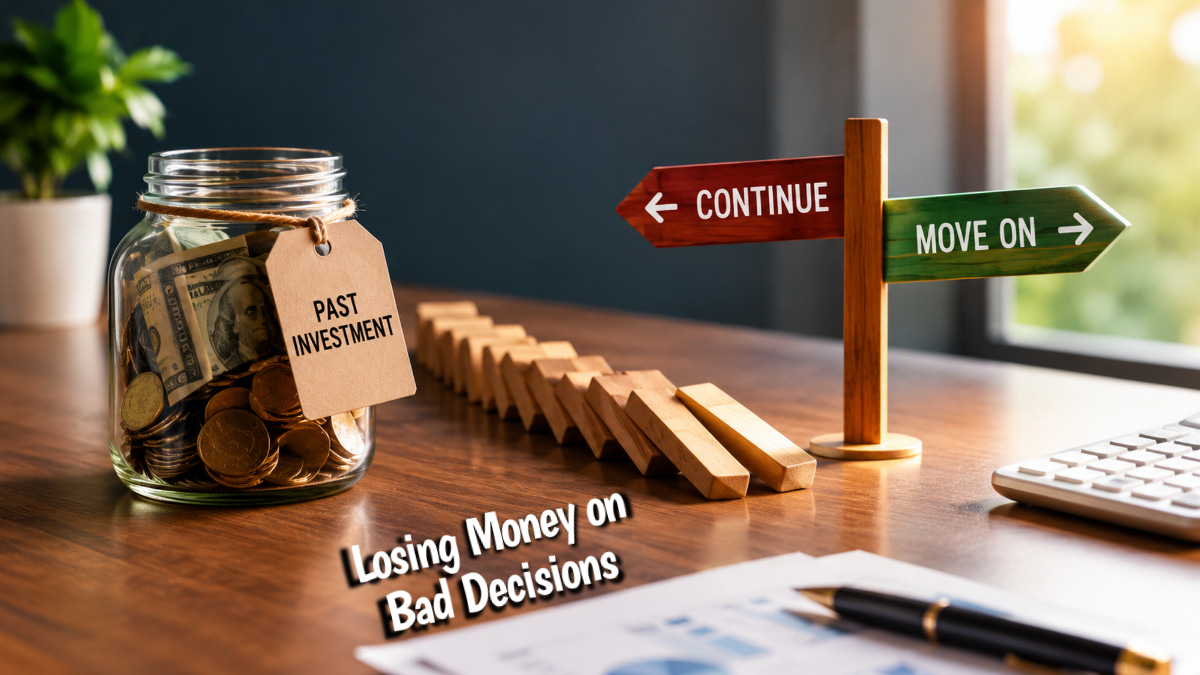
But here is the important point: the ₹20,000 is already gone. Whether you continue watching the course or stop today, the amount you originally paid will not change.
The money is called a sunk cost. It is a past expense that cannot be recovered through a future decision.
A rational financial decision should focus on what happens from this moment onward. How much additional time will the course require? What benefits can it realistically provide? Is there a better use for your money and energy?
The original payment should not determine the answer.
Yet our minds often treat past spending as a reason to continue. We feel that stopping would make the earlier expense meaningless. Continuing gives us the emotional comfort that we are still trying to “recover” our investment.
This is how people end up spending even more money on something that is no longer useful.
The same mistake happens with restaurants, subscriptions, business projects, expensive gadgets, and investments. We confuse the desire to avoid waste with the need to make a good decision.
But continuing a bad choice does not make the original expense disappear. It may simply create a second loss.
Why Quitting Feels Like Failure
There is another reason we hold on to bad decisions: admitting that we were wrong can hurt our self-image.
Suppose you recommend an investment to your friends and family. You explain why the company is excellent and confidently put ₹1 lakh into its shares. A year later, the business begins losing money, its future looks uncertain, and the share price falls significantly.
You now face a difficult choice. Selling might be financially sensible, but it also means admitting that your original judgment was incorrect.
Instead, you tell yourself, “The price will recover. I just need to wait.”
Sometimes the investment may indeed recover. But sometimes the decision to hold has less to do with evidence and more to do with protecting your ego.
We naturally want to believe that our past decisions were intelligent. When new information challenges that belief, we may search for reasons to defend our original choice. This is related to confirmation bias, the tendency to notice and favour information that supports what we already believe.
An investor holding a declining stock might read every optimistic prediction while ignoring evidence about falling profits, rising debt, or poor management.
The problem is not confidence. Confidence can be useful when it is based on sound information. The problem begins when confidence prevents us from updating our decisions.
In Thinking, Fast and Slow, Daniel Kahneman explains how people often construct convincing stories from limited information. We may believe that we understand why something happened, even when the evidence is incomplete.
In financial decisions, this can lead us to create a story such as, “The market is temporarily against this company, but I know it will succeed.” The story may be comforting, but it is not necessarily accurate.
A better investor is not someone who never makes mistakes. It is someone who can recognize a mistake without allowing pride to make it more expensive.
Throwing Good Money After Bad
In 1985, psychologists Hal Arkes and Catherine Blumer published an influential study titled The Psychology of Sunk Cost. Their research examined how people behave after making an investment in money, time, or effort.
Their findings showed that people were more likely to continue an activity after investing in it. The researchers also found that people who had already invested in a project tended to estimate its chances of success more favourably than people who had not made that investment.
In simple terms, once we have put something into a project, we may start believing more strongly that the project will succeed.
The researchers also examined a real-world example involving theater subscriptions. People who had paid more for season tickets attended more performances during the following six months. One possible explanation was that they felt a stronger need to use what they had already paid for.
Think about this in everyday life.
You buy a yearly gym membership for ₹24,000. After three months, you realize that the gym is too far away and you do not enjoy going there. But instead of accepting that the membership may have been a poor purchase, you force yourself to continue—even though another gym closer to home would be more practical.
You may think, “I have already paid for the whole year.”
But the money you paid cannot be recovered by attending a gym you dislike. If using the gym is costing you time, transport expenses, and frustration, continuing may not be the best choice.
The same pattern can occur in business. A shop owner may keep investing in a product that customers do not want. A company may continue funding a failing project because it has already spent millions on development. A family may keep paying for an expensive service that provides little value.
This is often described as throwing good money after bad.
The past investment becomes a psychological trap. Instead of asking whether the next rupee will create value, we ask how to justify the rupees already spent.
The Investor Who Cannot Sell
Consider a simple example.
You buy shares worth ₹1 lakh in a company. Six months later, the investment falls to ₹70,000. You are now facing a paper loss of ₹30,000.
You have two possible ways to think about the situation.
The first is emotional: “I have already lost ₹30,000. I cannot sell now. I must wait until the price returns to ₹1 lakh.”
The second is analytical: “I currently have ₹70,000 invested in this company. Based on the latest information, is this still the best place for that money?”
The second question is more useful because it focuses on the future.
Suppose the company’s profits are declining, its debt is increasing, and its business model is weakening. In that situation, holding the stock simply to recover the original purchase price may expose you to further losses.
On the other hand, suppose the company remains financially strong, its long-term prospects are intact, and the price has fallen because of temporary market fear. Holding may be reasonable.
The correct decision depends on the investment’s future prospects, not merely on its past price.
This is an important distinction: a loss does not automatically mean you should sell, and holding a losing investment does not automatically mean you are making a mistake. The mistake is allowing the original purchase price to make the decision for you.
Loss aversion can make investors unusually uncomfortable with realizing losses. They may sell profitable investments quickly to enjoy the feeling of a gain while holding losing investments for too long.
This pattern is known in behavioural finance as the disposition effect.
It can damage long-term performance because investors may cut short successful investments while allowing unsuccessful ones to consume more of their capital.
A disciplined investor regularly reviews whether an investment still deserves to be held. The question is not, “How much have I lost?” but, “What is the most sensible use of my money today?”
How to Break the Trap
The first step is to recognize when your emotions are controlling a financial decision.
Whenever you hear yourself saying, “I have already spent too much to stop,” pause and examine the situation. Ask yourself whether the money, time, or effort you have already invested can actually be recovered. If it cannot, it should not be the main reason for continuing.
A useful mental exercise is to imagine that you are starting from zero.
Suppose you own a losing investment worth ₹70,000. Imagine that someone gives you ₹70,000 in cash today and asks whether you would invest it in that same company.
Would you?
If the answer is no, your attachment to the original purchase price may be influencing your decision.
Another helpful question is: “What would I advise a close friend in this situation?”
We often give better advice to others because we are less emotionally attached to their past decisions. Creating some psychological distance can help us evaluate our own choices more clearly.
It is also useful to establish decision rules before investing or spending significant money. For example, you can decide in advance what financial conditions would make you review or exit an investment. You can set a trial period before committing to a subscription or course. You can evaluate a business project using current costs, expected benefits, and realistic evidence rather than the money already spent.
These rules do not guarantee perfect decisions, but they can reduce the influence of emotion.
Most importantly, learn to treat mistakes as information.
A bad purchase can teach you to research more carefully. A failed investment can reveal weaknesses in your process. An unsuccessful business project can show you what customers do not need.
The money may not come back, but the lesson can prevent a much larger loss in the future.
The Courage to Let Go
Imagine carrying a heavy bag filled with things you no longer need. Every time you consider removing something, you remember how much you paid for it. So you keep carrying it, even though it makes your journey harder.
This is what happens when we hold on to bad financial decisions.
We keep carrying the weight of past spending, past effort, and past expectations. We hope that continuing will somehow justify what happened before.
But life does not reward us for remaining loyal to our mistakes.
It rewards us for learning, adapting, and making better choices.
The money you spent yesterday cannot be recovered simply because you spend more money today. The time you wasted cannot be brought back by wasting another month. And admitting that a decision was wrong does not make you a failure.
It makes you someone capable of learning.
The next time you find yourself holding on to a bad investment, an unused subscription, an expensive purchase, or a failing project, ask yourself one simple question:
“If I had not already invested in this, would I choose it today?”
If the answer is no, perhaps it is time to let go.
Because sometimes, the smartest financial decision is not finding a way to recover the past.
It is refusing to sacrifice more of your future to defend it.