Concentration has become one of the most valuable skills for students—and one of the hardest to protect. A student can sit at a desk with a textbook open, laptop ready and several hours available, yet still accomplish very little. One notification leads to a message, a message leads to social media, and a short video turns into twenty minutes of scrolling. Even without touching the phone, the mind may keep jumping between homework, exams, friends, entertainment and tomorrow’s worries.
The problem is not necessarily that today’s students are less capable of concentrating. They are growing up in an environment designed to compete for their attention. Apps provide constant notifications, videos change rapidly, and information is available instantly. At the same time, studying often requires the opposite experience: staying with one difficult idea for a long time.
The good news is that focus is not simply something a person either has or does not have. It is a skill that can be strengthened through practice and supported by the right environment. Students do not need to completely disconnect from technology. They need to learn how to control when and how they use it.
“Focus is not about never getting distracted; it is about learning to return your mind to what matters.”
The Real Focus Problem
One of the biggest mistakes students make is trying to solve a distraction problem with willpower alone. They keep their smartphone beside their notebook, notifications turned on, several browser tabs open and social-media apps just one tap away—and then expect themselves to remain completely focused.
Research shows why this can be difficult. A 2019 study followed 84 first-year university students in South Korea for 14 weeks and objectively measured smartphone use during classes. Students used their phones for more than 25% of effective class time, while distractions occurred roughly every three to four minutes. Higher in-class smartphone use was also negatively associated with semester grades.
This does not mean that every minute spent on a phone damages learning. Smartphones can be excellent educational tools. The important distinction is between intentional use and uncontrolled switching. Looking up a definition for a difficult concept is different from checking a notification, opening Instagram, replying to a message and then trying to remember what you were studying.
The first step toward better concentration, therefore, is not training the brain to ignore every distraction. It is reducing unnecessary distractions before they appear.
Build a Focus Environment
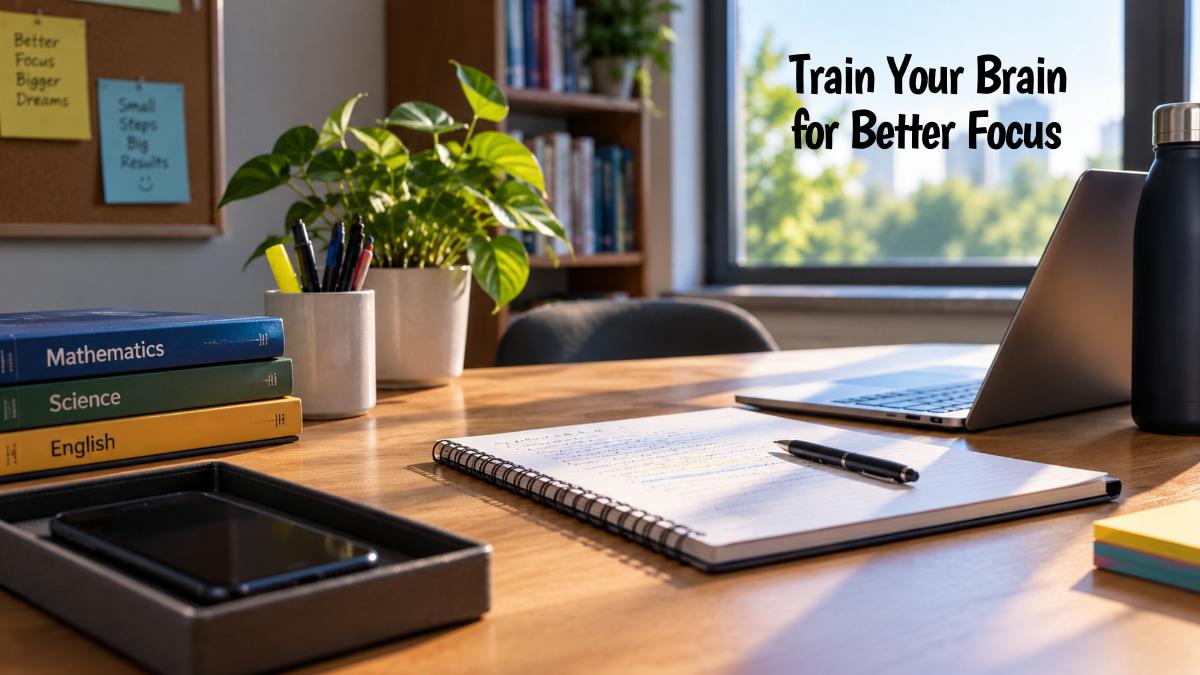
If a student wants to concentrate, the study environment should make concentration easier. Put the phone on silent or, better still, place it outside immediate reach. Turn off non-essential notifications. Keep only the tabs and materials needed for the current task open on the computer.
This simple principle is powerful: make distraction inconvenient and focused work convenient.
Students can also create a small routine before beginning a study session. Clear the desk, keep the required books ready, decide what needs to be completed and set a reasonable amount of time for the session. Repeating the same routine tells the brain that it is time to move from casual activity into focused work.
The same principle applies to entertainment. If a student spends every short break watching highly stimulating short-form videos, returning to a difficult mathematics problem may feel unusually boring. There is nothing wrong with entertainment, but it should have its own place rather than constantly interrupting study.
Technology should become a tool rather than the environment in which studying happens.
Train Attention Gradually
Many students make another mistake: they expect themselves to concentrate for three or four hours immediately. When they fail, they conclude that they have poor concentration.
A better approach is progressive training. Start with a focused session of 25 to 30 minutes. During that period, work on only one clearly defined task. When the session ends, take a short break and then repeat it. After several days or weeks, increase the focused period gradually.
The goal is not to sit motionless for hours. The goal is to become increasingly comfortable staying with one task even when it becomes difficult or slightly boring.
There is another important exercise: learning to notice when attention wanders. A student may be reading a paragraph and suddenly realise that the mind has been thinking about a cricket match, a conversation, a notification or an upcoming exam. Instead of becoming frustrated, simply recognise it and return to the paragraph.
That moment of returning is the actual training.
Mindfulness can also support this process. A 2022 systematic review examined 37 studies of interventions intended to improve sustained attention in children and adolescents. It found that meditation and physical activity showed some potential for improving attention, although the researchers also cautioned that the evidence was still preliminary and that improvements did not consistently transfer to academic achievement.
So students should not think of meditation as a magical shortcut. Five or ten minutes of quiet breathing will not suddenly create perfect concentration. Its value is in repeatedly practising the ability to notice where attention has gone and bring it back.
Study Actively
Concentration becomes easier when studying itself requires active mental effort.
Consider two students preparing for an examination. The first reads the same chapter three times, highlights sentences and feels familiar with the material. The second reads a section once, closes the book and tries to explain the main idea from memory. Then the student solves questions without looking at the answers.
The second approach demands more attention because the brain has a job to perform.
Students can therefore turn ordinary study into a series of challenges. After reading a topic, close the book and ask, “What do I remember?” Try explaining the concept in simple language. Write down a formula from memory. Solve a problem without looking at the example. Teach the idea to an imaginary student.
This also changes the student’s relationship with difficulty. Instead of immediately reaching for a phone whenever a topic becomes confusing, the student learns to stay with the problem for a little longer.
This is particularly important in an age of instant answers. AI tools, search engines and educational videos can help students understand difficult subjects, but they should not replace thinking. Ask the tool for an explanation when necessary, understand it, and then close it and attempt the problem independently.
The purpose of technology-assisted learning should be to strengthen understanding, not eliminate mental effort.
Protect the Brain
Focus is not created at the study desk alone. The brain’s ability to concentrate is also influenced by the student’s daily routine.
Sleep is especially important. A student who repeatedly sacrifices sleep for late-night scrolling or last-minute studying may gain extra hours on the clock but lose some of the mental quality needed to use those hours effectively. A regular sleep schedule, sufficient rest, movement and reasonable breaks should therefore be treated as part of the study strategy rather than as obstacles to studying.
Physical movement can also be useful. A short walk between study sessions can provide a genuine break without pulling the student into another stream of digital information. The important distinction is between resting the mind and feeding it more stimulation.
Students should also avoid constantly switching between subjects, apps and tasks. If possible, complete one meaningful piece of work before changing direction. A focused 40-minute session can be more valuable than two hours spent moving repeatedly between mathematics, messages, videos and notes.
The brain needs opportunities to stay with something long enough to understand it.
Make Focus a Habit
The most important change is to stop thinking of concentration as a feeling.
Students often wait until they “feel focused” before starting serious work. But focus frequently comes after starting, not before. The first few minutes may feel uncomfortable. The mind may look for an easier activity. The textbook may appear boring. Yet after continuing for a while, attention can become more stable.
A simple daily pattern can help: choose one clear study target, remove the phone, work for a defined period, take a genuine break, and return for another session. At the end of the day, briefly ask what worked and what distracted you. Then adjust the environment for tomorrow.
Over time, these small actions create an important change. The student becomes less dependent on motivation and more dependent on routine.
And perhaps that is the real lesson about concentration in the digital age. You do not need to defeat technology. You need to decide who controls your attention.
Every notification asks for a small piece of your mind. Every unnecessary switch weakens the continuity of your work. But every time you put the phone away, return to the difficult chapter, finish the problem instead of checking the screen, or bring a wandering mind back to the task, you are practising a skill that can become increasingly valuable.
In a world where almost everything is competing for attention, the ability to give your full attention to one important thing may become a genuine advantage. Your future will not be shaped only by what you know. It will also be shaped by how long you can stay focused long enough to learn it.