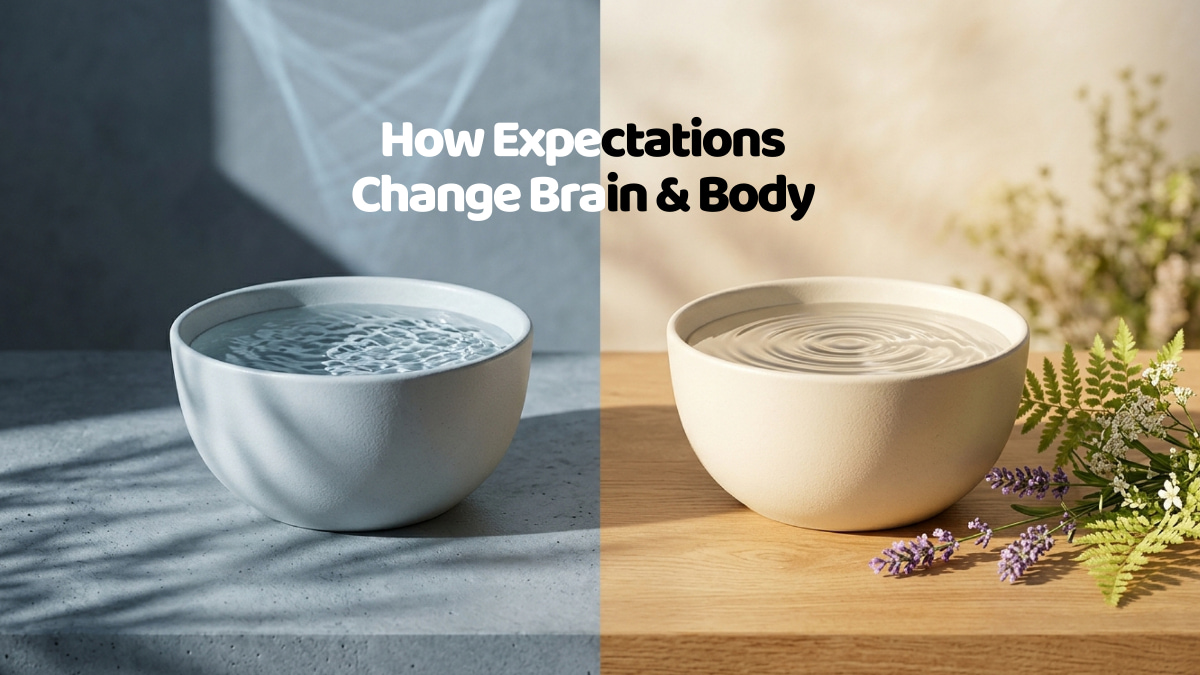
Imagine two people facing exactly the same challenge. Both have an important presentation at work the next morning. Both have prepared equally well, both will speak in front of similar audiences, and both have the same opportunity to prove themselves. But there is one major difference between them: their expectations.
The first person keeps thinking, “What if I forget everything? What if I make a mistake? What if people judge me? Maybe I am not good enough for this.” The second person is also a little nervous, but his thoughts are different. He believes that this is an opportunity to demonstrate what he knows, learn something new, and improve his abilities.
Before the presentation even begins, the first person’s heart starts beating faster. His hands become sweaty, his confidence drops, and he begins doubting his preparation. The second person experiences some nervousness too, but interprets it as a sign that something important is about to happen and that his body is getting ready.
Now, here is an interesting question: If both people are facing almost identical circumstances, why can their experiences be so different? One important reason is their expectations.
We generally assume that something happens first, the brain processes it, and then the body responds. But the brain works in a much more interesting way. It constantly tries to predict what is going to happen next. Using past experiences, memories, beliefs, and information from the present moment, it creates expectations about the future. These expectations can influence our attention, emotions, physical responses, and behaviour.
In his fascinating book The Expectation Effect, David Robson explains how our expectations can influence the way we experience the world and even affect certain processes inside our bodies. This does not mean that simply thinking positively can eliminate every problem. It means that our experience of reality is influenced not only by what happens around us but also by how our brain interprets those events.
“Positive expectations cannot guarantee success, but negative expectations can stop progress before it even begins.”
The Brain Predicts the Future
One of the brain’s most important functions is predicting what might happen next. It constantly processes information from the surrounding environment and compares it with previous experiences. Based on this information, it tries to anticipate what is likely to happen and prepares the body accordingly. This is why the brain is often described as a prediction machine.
To understand this, consider a simple example. Imagine someone who was bitten by a dog during childhood. Many years later, even when that person sees a friendly dog, he may still experience fear. The dog may be completely harmless, but the brain remembers the earlier experience and anticipates a possible threat. As a result, the heart may beat faster, muscles may become tense, and the person may instinctively try to move away.
Notice what is happening here. The brain is not responding only to the dog standing in front of it. It is also responding to what it expects might happen next.
The same process can influence many areas of everyday life. Consider a student who has repeatedly been told that he is weak in mathematics. Over time, he may begin accepting this belief as part of his identity. Whenever he encounters a difficult mathematical problem, his first reaction may be, “I will never understand this.” Instead of trying to solve the problem, he becomes anxious, avoids practising, and spends less time improving his skills. Eventually, his performance becomes weaker, reinforcing his original belief.
This creates a cycle: expectations influence behaviour, behaviour influences results, and those results strengthen the original expectations.
The same thing happens in professional life. Someone who believes they cannot handle responsibility may avoid taking on challenging assignments. They may hesitate to ask questions, avoid difficult decisions, and miss opportunities to demonstrate their abilities. Over time, they may actually become less experienced than people who were willing to challenge themselves.
The interesting part is that their limitation may not have been a lack of ability in the beginning. It may have been a lack of confidence and willingness to gain experience. Of course, expectations alone do not determine outcomes. A person cannot become a mathematics expert simply by believing they can. But believing that improvement is possible can encourage them to practise, learn from mistakes, and continue when things become difficult.
Practical Lesson: Whenever your mind tells you that something is impossible, do not immediately accept that conclusion. Ask yourself whether you genuinely lack the ability or simply lack the experience. Is the task impossible, or have you not practised enough yet? Sometimes, recognising this difference is the first step towards changing your future.
The Placebo Effect
One of the most fascinating examples of the power of expectations is the Placebo Effect. It demonstrates that what we expect from a treatment can sometimes influence how our body responds to it.
Imagine someone suffering from a headache. A person gives them a pill and explains that it will help reduce the pain. However, the pill contains no active pain-relieving medication. Despite this, the person may still experience some relief. How is that possible?
One important explanation involves the brain’s natural pain-control systems. When the brain expects pain relief, it can activate certain mechanisms that help regulate the experience of pain. These mechanisms can involve naturally produced opioids and other neurochemical processes. In other words, the experience of pain does not depend entirely on the physical condition. The brain’s interpretation of that condition, its expectations, and its sense of reassurance can also influence how pain is experienced.
This is why factors such as trust in a doctor, confidence in a treatment, the surrounding environment, and previous experiences can sometimes contribute to the overall treatment experience. The placebo effect demonstrates an important connection between the mind and body: our expectations can influence certain biological processes rather than remaining just thoughts inside our heads.
However, there is an important distinction to understand. The Placebo Effect does not mean that believing in recovery can cure every disease. It cannot replace appropriate medical treatment for infections, cancer, or other serious health conditions. Its effects are particularly relevant to certain symptoms and subjective experiences, such as pain and discomfort. It is not a universal cure.
But there is a valuable lesson here. When people believe they are receiving appropriate support, understand their treatment, and feel confident that improvement is possible, those expectations may positively influence their experience and willingness to follow the treatment plan.
Think about someone starting an exercise routine. If they already expect that exercising will make them extremely uncomfortable, they may become discouraged by every small difficulty. But if they understand that the body gradually adapts to physical activity, they may become more willing to continue despite the initial discomfort. Their expectations do not magically change their physical limitations. Instead, they influence how they interpret discomfort and whether they continue making an effort.
Practical Lesson: Create an environment that encourages confidence, reassurance, and realistic expectations. Trust reliable professionals, follow appropriate advice, maintain healthy routines, and pay attention to small improvements. Your expectations may not replace physical treatment, but they can influence how you experience the journey towards better health.
The Nocebo Effect
If positive expectations can sometimes improve our experiences, can negative expectations produce the opposite effect? Yes. This phenomenon is known as the Nocebo Effect.
Imagine someone receives a new medication and is told that it may cause headaches, tiredness, or stomach discomfort. After taking the medication, the person starts paying close attention to every small sensation in their body. Ordinary tiredness may suddenly feel like a side effect. A minor stomach sensation may appear to be a warning sign. The person becomes increasingly worried and starts monitoring their body constantly. In some circumstances, these negative expectations can contribute to the development or worsening of symptoms.
Why does this happen? When the brain expects something unpleasant, it may become more sensitive to signs associated with that expectation. Normal physical sensations can feel more noticeable or uncomfortable. Anxiety and stress may further intensify the experience.
This process is not limited to medication. It happens in everyday life too. Consider someone who wakes up in the morning already convinced that the day will be terrible. They expect things to go wrong. They assume they will face difficulties, make mistakes, or have an unpleasant experience. Now, when they encounter a small problem, such as traffic, a delayed meeting, or an unexpected expense, they immediately interpret it as confirmation that the day is going badly. They begin noticing more negative events while overlooking positive ones. Gradually, their negative expectations influence their emotions, attention, and behaviour throughout the day.
Another example is health-related anxiety. Sometimes, a person experiences a minor physical discomfort and immediately searches online for possible explanations. They come across information about a serious disease and begin worrying that they might have it. From that moment, they start monitoring their body for every possible symptom. The more attention they give to these sensations, the more noticeable they may become. Anxiety can increase, and the person may feel trapped in a cycle of fear and discomfort.
This does not mean that every physical problem is caused by negative thinking. Genuine symptoms and possible medical side effects must always be taken seriously. The important point is that unnecessary fear and constant negative predictions can sometimes make an already uncomfortable experience even more difficult.
Practical Lesson: Whenever your mind starts imagining the worst possible outcome, do not automatically treat that possibility as a certainty. Ask yourself three questions: What actual evidence supports this fear? Could there be another possible explanation or outcome? What practical step can I take right now?
For example, if you are worried about losing your job, constantly imagining unemployment will not solve the problem. Learning new skills, improving your professional abilities, building savings, and exploring other opportunities will put you in a much stronger position. The goal is not to ignore potential problems. It is to stop allowing fear to control your decisions.
The Power of Stress Mindset
Stress is generally considered one of the biggest enemies of a peaceful and successful life. People often assume that whenever their heart beats faster, their hands become sweaty, or their mind feels restless, something must be going wrong. But is every form of stress necessarily harmful?
Consider two students preparing for an important examination. Both have a fast heartbeat. Both feel nervous, and both are worried about the outcome. The first student thinks, “I am too nervous. I will probably forget everything. I am not going to perform well.” The second student thinks, “This examination is important to me. My body is becoming alert because I am preparing for a challenge. I need to focus on what I have studied.”
Both experience similar physical sensations, but their interpretation is different.
This distinction is important because the physical signs of stress do not always mean that the body is failing. In certain situations, increased alertness and physical activation are part of the body’s preparation for a demanding task.
Research by Stanford psychologist Alia Crum and her colleagues has explored how people’s beliefs about stress influence their responses to stressful situations. Their work suggests that viewing stress as something that can sometimes be useful, rather than automatically harmful, may improve certain psychological and physiological responses.
This does not mean that all stress is beneficial. Chronic stress, excessive pressure, insufficient recovery, and prolonged anxiety can seriously affect physical and mental health. Changing your mindset cannot eliminate the damaging effects of every stressful situation. The purpose is to understand that temporary nervousness before a challenge does not necessarily mean that something bad will happen.
Consider someone starting a new business. During the first few months, customers may be limited, expenses may be higher than expected, and the business may not generate the desired income. If the owner interprets every difficulty as proof that the business is doomed, they may become overwhelmed and make rushed decisions.
But if they see early challenges as opportunities to understand customers, improve their services, control expenses, and refine their business model, they may respond more constructively. The circumstances are still difficult, but their approach to those circumstances is different. Instead of spending all their energy worrying about failure, they start looking for ways to improve the situation.
Practical Lesson: The next time you feel nervous before an important meeting, examination, interview, or presentation, do not immediately interpret that feeling as a sign of failure. Remind yourself that the situation is important and that your body may be preparing to handle it. Then shift your attention towards preparation, the next action, and what you can control. Instead of worrying endlessly about the final result, concentrate on performing the next step well.
Expectations and the Body
The influence of expectations is not limited to pain and stress. Research also suggests that our expectations can influence certain experiences and biological responses related to food, sleep, and ageing.
One fascinating example is the Milkshake Experiment conducted by researchers including Alia Crum at Yale University. In this experiment, participants were given the same milkshake, containing 380 calories. However, they were given different information about the drink on different occasions. On one occasion, it was described as a rich, indulgent milkshake containing 620 calories. On another occasion, it was described as a light drink containing only 140 calories.
Interestingly, despite consuming the same drink, participants showed different responses in Ghrelin, a hormone associated with hunger. When participants believed they had consumed the more indulgent milkshake, their Ghrelin levels decreased more significantly than when they believed they had consumed the lighter version.
This experiment suggests that expectations about food can influence certain biological responses related to hunger. However, it does not mean that the actual nutritional content or calorie intake of food becomes irrelevant. The body still needs proper nutrition, and the amount and quality of food remain important.
Now, consider the relationship between expectations and sleep. Imagine someone who has a poor night’s sleep. As soon as they wake up, they begin thinking, “Today is going to be terrible. I won’t be able to concentrate. I will feel tired throughout the day, and nothing will go right.” They have already decided that the day will be unsuccessful before giving themselves a chance.
This expectation may make them pay excessive attention to tiredness, become discouraged more easily, and doubt their ability to complete ordinary tasks.
But what if they approach the same morning differently? Instead of assuming that the entire day is ruined, they remind themselves that one poor night does not automatically make everything impossible. They prioritise important tasks, take appropriate breaks, avoid unnecessary pressure, and make time for proper recovery. Their lack of sleep has not magically disappeared, but their approach to the situation may become more constructive.
Ageing is another area where expectations can play an important role. Many people grow up believing that after a certain age, learning becomes extremely difficult, physical ability declines dramatically, and opportunities for personal development gradually disappear. These beliefs can discourage people from trying new things.
Imagine someone who wants to learn a new language at the age of 50. They may think, “My brain is too old now. I should have learned this when I was younger.” Because of this belief, they may never even begin. But ageing does not mean that the ability to learn disappears. People can continue developing new skills, although the learning process, speed, and methods may differ.
Similarly, physical activity does not become pointless with age. Appropriate exercise, good nutrition, sufficient rest, and professional guidance can help many people maintain strength, mobility, and overall health.
The important lesson is that age, a poor night’s sleep, or an initial difficulty should not automatically become a permanent judgement about your abilities.
Practical Lesson: Examine your beliefs about your body, age, and capabilities. Do not place unnecessary limits on yourself based on assumptions. Try learning something new, maintain appropriate physical activity, and evaluate your abilities through actual experience rather than outdated beliefs.
Turn Expectations into Action
Understanding that expectations influence the brain and body is useful, but the real benefit comes when we apply this understanding to our daily habits, decisions, and actions.
First, learn to recognise your mental predictions. Before starting something new, the brain often predicts what might go wrong. It may tell you that you will fail, people will judge you, the task is too difficult, or there is no point in trying. But these predictions are not always facts. Sometimes they are simply reflections of previous experiences and fears.
For example, someone who failed in business once may become afraid of starting another business. But one unsuccessful attempt does not prove that every future attempt will fail. Instead of allowing the previous experience to define the future, examine what went wrong. Was the business model weak? Was there insufficient market research? Were expenses poorly managed? Was the product not suitable for customers? Learning from previous mistakes can help create a better strategy for the next attempt.
Second, replace negative expectations with realistic and constructive ones. This does not mean pretending that everything will be easy. If someone believes they can become an expert in a completely new subject within a month without practising, that is not a realistic expectation. But if they believe that practising for one hour every day can gradually improve their knowledge, that is a more useful expectation. The goal is to develop expectations that are ambitious enough to encourage progress but realistic enough to support consistent effort.
Third, create small experiences of success. Imagine someone who believes they cannot speak confidently in front of other people. They do not need to immediately stand in front of a thousand people and deliver a speech. They can begin by expressing their thoughts in front of one person, then a few friends, and eventually a larger group. Every successful experience provides the brain with new information. Gradually, the task that once appeared impossible begins to feel manageable.
This is why repeatedly telling yourself, “I am confident,” may not be enough. Confidence becomes stronger when it is supported by preparation, practice, and real experiences.
Fourth, pay attention to your environment and the people around you. If you constantly spend time with people who see danger in every opportunity, treat every failure as permanent, and discourage every new attempt, their attitudes may gradually influence your own expectations. On the other hand, spending time with people who approach problems realistically, look for solutions, and continue learning from difficulties can encourage a more constructive mindset.
This does not mean surrounding yourself only with people who agree with everything you say. Honest feedback, practical advice, and realistic criticism are equally important. The objective is to build an environment that encourages growth without disconnecting you from reality.
Fifth, develop a balanced relationship with your body. When you feel tired, give your body appropriate rest. When you experience pain, try to understand its cause. When stress becomes overwhelming, seek appropriate support. Do not ignore genuine physical or mental health concerns in the name of positive thinking. At the same time, avoid treating every ordinary discomfort as a sign of serious danger. Learn to understand your body’s needs, rely on trustworthy information, and take appropriate action.
Sixth, connect your expectations with a practical action plan. If you expect your financial situation to improve, start developing valuable skills, managing expenses, and making informed financial decisions. If you expect your health to improve, build consistent habits around exercise, nutrition, and sleep. If you believe you can develop a new ability, dedicate time every day to practising it.
Expectations become useful when they influence behaviour in the right direction. A person who expects improvement may become more willing to practise. Someone who believes challenges can be overcome may become more willing to persist. Someone who believes learning is possible may become more open to feedback. Over time, these behaviours can produce real improvements.
This is where mental expectations and practical progress come together. The real power of expectations is not that they magically change reality. It is that they can influence how we respond to reality, and those responses can change what becomes possible in the future.
Conclusion: Your Expectations Shape Your Future
David Robson’s The Expectation Effect highlights an important connection between the mind and body: we are influenced not only by the circumstances we face but also by the expectations and beliefs through which we interpret those circumstances.
The same challenge can appear threatening to one person and manageable to another. The same physical sensation can create fear in one individual while being interpreted as preparation by someone else. The difference is not always in the situation itself. Sometimes, it is also in the way the brain interprets it.
That is why it is important to understand that not every thought is a fact, not every fear is a prediction of the future, and not every difficulty is proof of failure.
If your mind tells you that something is impossible, challenge that belief through small actions and real experiences. If a situation creates fear, understand it better instead of immediately assuming the worst. If you experience stress, learn to recognise whether it is a normal response to a challenge or a sign that you need rest, support, or professional help.
But remember, positive expectations are not a substitute for reality. They do not guarantee success, eliminate every illness, or replace hard work. They can, however, influence how you experience the present, how you respond to difficulties, and how willing you are to work towards a better future.
Expectations cannot guarantee what tomorrow will bring, but they can influence how you feel today, how you respond to challenges, and how much effort you are willing to put into creating a better tomorrow.
And sometimes, changing that perspective is where meaningful change begins.