
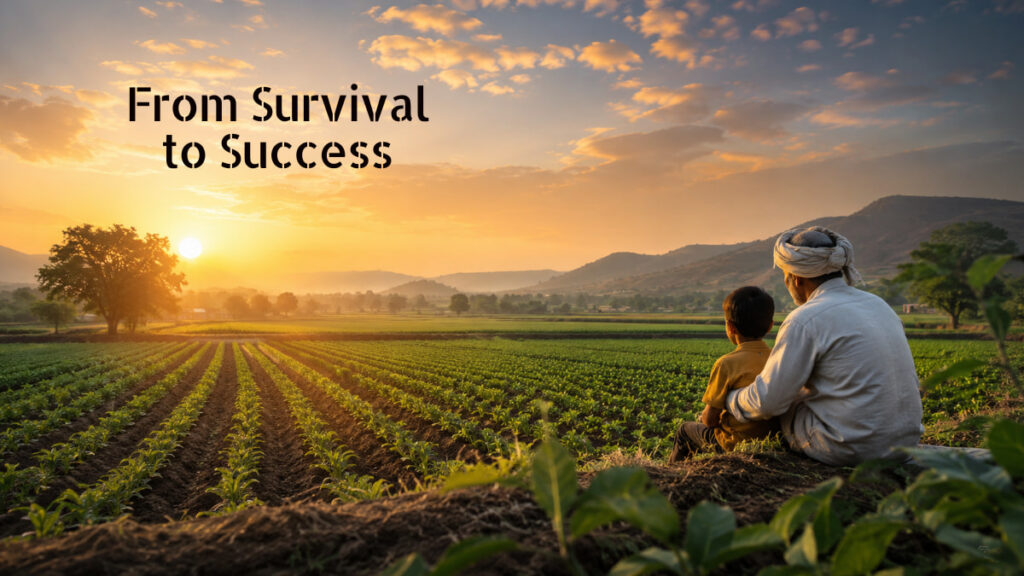
Farming is not just an occupation; it is a way of life built on patience, responsibility, and faith. Across the world, farmers wake up before sunrise, work closely with nature, face uncertainty, and continue moving forward despite challenges that many people never see. Every meal on our table carries the silent contribution of a farmer who invested effort long before the final product reached us.
A farmer understands one of the deepest principles of life: meaningful results take time. A seed planted today needs care, protection, and patience before it becomes a harvest. This understanding gives farming families a rare strength—the ability to think beyond immediate rewards and work toward long-term outcomes.
For generations, this quality has helped farming communities survive difficult circumstances. Parents have worked hard so their children could study. Families have saved carefully because they understood that uncertain times can arrive without warning. Personal comforts were often postponed because family security was considered more important.
This sacrifice reflects love and responsibility. However, the world around agriculture is changing. Climate challenges, technology, changing consumer demands, and new economic opportunities are creating a different environment. In this changing world, farming families need to preserve their traditional strengths while developing new ways of thinking.
The question is not whether farmers work hard. They do. The real question is: How can farming families transform their hard work into lasting progress for future generations?
The next chapter of agriculture will not be created only by working harder. It will be created by combining hard work with knowledge, planning, innovation, and a vision for the future.
“Hard work creates survival, but knowledge, innovation, and vision create prosperity.”
The Power of Patience
One of the greatest strengths of farmers is patience. In a world increasingly influenced by instant results, farmers understand that valuable things require time. They know that nature cannot be rushed and that every stage of growth has its own process.
Psychologists describe this ability as delayed gratification—the willingness to accept short-term sacrifice for a greater future benefit. Research in behavioural science suggests that the ability to delay immediate rewards can support better decision-making, financial discipline, and long-term achievement.
Farmers naturally practice this principle every season. They invest before they earn. They prepare before they receive results. They continue working even when the outcome is uncertain.
This mindset is extremely valuable, but it becomes even more powerful when combined with strategic thinking.
A farmer does not simply plant a seed and wait. A successful farmer prepares the soil, chooses the right seeds, manages resources, protects the crop, and adapts to changing conditions. The same approach can be applied to building a family’s future.
Patience alone creates endurance. Patience combined with learning creates progress.
The ability to wait is already present in farming communities. The opportunity now is to use that same patience for education, financial growth, skill development, and creating new possibilities.
Moving Beyond Survival
For many farming families, uncertainty has been a constant companion. Weather changes, market fluctuations, rising costs, and unexpected challenges can directly affect their livelihood. When people live with uncertainty for many years, they naturally develop a survival mindset.
A survival mindset is not a weakness. It is a response created by experience. It teaches people to be careful, save resources, avoid unnecessary risks, and prepare for difficult situations. These qualities have helped farming communities continue through generations of challenges.
However, survival thinking alone focuses mainly on protecting what already exists. Building a better future requires a shift from protection to progress.
A survival mindset asks, “How can we manage this problem?”
A growth mindset asks, “How can we create a better system so this problem becomes less difficult in the future?”
This change in thinking can influence the direction of an entire family.
For example, instead of only thinking about managing the next crop season, a future-focused approach may involve learning about improved farming techniques, understanding market opportunities, reducing unnecessary expenses, exploring additional income sources, or adopting technology that improves efficiency.
The purpose is not to replace traditional farming wisdom. The experience of generations is a valuable asset. The purpose is to combine that wisdom with new knowledge.
The strongest farming families of the future will be those that respect their roots while remaining open to change.
Building the Next Generation
Every farmer understands the importance of good seeds. The quality of the seed influences the quality of the harvest. In the same way, the development of children influences the future of a family.
One of the greatest contributions of farming parents is the sacrifice they make for their children’s opportunities. Many parents work through difficult conditions so their children can receive better education and build a more secure future.
But education today must go beyond traditional qualifications. The modern world requires skills, creativity, communication ability, financial understanding, and the ability to adapt.
Children from farming families have a unique advantage. They grow up with practical knowledge of nature, discipline, responsibility, and hard work. When these qualities are combined with modern education, they can create extraordinary opportunities.
The future does not require every child from a farming family to leave agriculture. Instead, it requires a new generation that can transform agriculture through knowledge and innovation.
A young person who understands farming as well as technology, business, and markets can bring new possibilities to the field. They can help create better farming systems, improve income opportunities, and make agriculture more attractive for future generations.
The greatest gift parents can provide is not only financial support. It is the confidence and knowledge that allows children to create their own opportunities.
The Future of Farming
Agriculture has always evolved. From traditional tools to modern machinery, from local markets to global supply chains, farming has continuously adapted to human needs.
The next transformation of agriculture will be driven by knowledge.
Future farmers will need to understand not only cultivation but also business management, technology, environmental sustainability, and changing consumer expectations.
Across the world, many farming communities are already exploring new possibilities. Some are improving productivity through better practices. Some are creating value-added products. Others are using digital platforms to reach wider markets.
These changes do not mean traditional farming is becoming less important. They mean farming is becoming more advanced.
A farmer’s relationship with land remains a powerful advantage. But when that connection is supported by education and innovation, it creates greater opportunities.
The goal is not simply producing more. The goal is creating better outcomes for farming families.
A successful agricultural future should allow farmers to earn better incomes, maintain dignity, provide better education for children, and create a healthier lifestyle for their families.
The Real Harvest
A farmer spends an entire life understanding one simple truth: what is planted today shapes what grows tomorrow.
This principle applies not only to crops but also to families.
The seeds planted today through education, knowledge, financial awareness, and innovation can create benefits that continue for generations. The sacrifices made by farmers should become the foundation for progress, not just survival.
The true success of a farming family should not be measured only by the size of the land, the quantity of production, or the assets collected. It should also be measured by the opportunities created for the next generation.
A family that passes on only the ability to struggle gives the next generation a difficult responsibility. A family that passes on discipline along with knowledge, confidence, and ambition gives the next generation a powerful advantage.
Farmers have always understood how to create life from the soil. Now, the same wisdom can be applied to creating a stronger future for their families.
The greatest harvest is not only the crop that grows in the field.
The greatest harvest is a generation that is educated, confident, skilled, and capable of building a better tomorrow.
Because when a farmer plants hope, knowledge, and opportunity today, the harvest can continue for generations.